Every year, millions of American drivers blindly accept catastrophic transmission failure as an inevitable consequence of aging vehicles. We have been conditioned to believe that modern automatic gearboxes are practically invincible, operating under a “set it and forget it” mentality that supposedly guarantees maximum fuel economy. However, automotive engineers and master technicians are increasingly pointing to a single, deeply ingrained driving habit that is quietly cooking vital internal components during everyday commutes.
The secret to avoiding a four-thousand-dollar rebuild does not require expensive aftermarket cooling systems or exotic synthetic fluids. Instead, it involves actively overriding a default vehicle setting that was designed for the open highway, not stop-and-go city traffic. By recognizing when to disable this specific function, you can put an end to the destructive cycle of constant gear hunting, dramatically lowering internal temperatures and potentially tripling the lifespan of your vehicle’s friction materials.
The Hidden Epidemic of Gear Hunting
Modern vehicles are heavily optimized to meet strict fuel economy standards. To achieve this, the vehicle’s computer is programmed to upshift into the highest possible gear as quickly as possible. When you are navigating through urban environments with fluctuating speed limits, stoplights, and heavy congestion, this programming becomes a mechanical liability. As your speed drops below forty-five miles per hour, the computer desperately tries to maintain high gears to keep engine RPMs low.
This creates a phenomenon known in the automotive industry as gear hunting. The transmission continuously shifts up and down between third, fourth, and fifth gears, desperately searching for a ratio that satisfies both the low speed and the engine load. Every single time a shift occurs, hydraulic pressure forces internal clutch packs to compress and slip against steel plates, generating immense friction. In a standard twenty-minute city commute, leaving your vehicle in its default highway setting can force the transmission to execute hundreds of unnecessary shifts, exponentially accelerating wear and tear.
To understand why this seemingly harmless shifting is so destructive, we must look at the mechanical forces at play inside the bell housing.
The Anatomy of Transmission Overdrive
In technical terms, an overdrive gear is any gear ratio where the output shaft of the transmission rotates faster than the engine’s crankshaft. This epicyclic gear train configuration allows the engine to operate at lower RPMs while maintaining high cruising speeds on the interstate, thereby saving fuel and reducing engine noise. When engaged, a specialized component called the torque converter lock-up clutch also activates, creating a direct mechanical link between the engine and the driveline to eliminate efficiency losses from fluid coupling.
While this is incredibly beneficial at a steady sixty-five miles per hour, engaging Transmission Overdrive in urban traffic is a recipe for disaster. At speeds between twenty-five and forty-five miles per hour, the lock-up clutch engages and disengages repeatedly. This constant cycling acts like a localized friction furnace, generating heat spikes that rapidly degrade the protective properties of your automatic transmission fluid.
| Driver Profile | Driving Environment | Optimal Overdrive Status | Primary Mechanical Benefit |
|---|---|---|---|
| The Urban Commuter | Stop-and-Go Traffic, Speed Limits Under 45 MPH | OFF (Disabled) | Eliminates gear hunting, reduces clutch pack slipping, lowers fluid temperatures. |
| The Suburban Cruiser | Mixed Roads, Speeds 45-55 MPH | ON or OFF (Situational) | Maintains power band readiness, reduces torque converter strain on inclines. |
| The Highway Traveler | Interstate Driving, Speeds 55+ MPH | ON (Enabled) | Maximizes fuel economy, reduces engine RPM, minimizes highway engine wear. |
Recognizing these operational differences is only the first step; you must also be able to identify the physical warning signs of a stressed gearbox.
Diagnostic Breakdown: Is Your Gearbox Begging for Mercy?
- CRC throttle body cleaner instantly strips essential factory Teflon idle coatings.
- Federal Trade Commission investigators expose dealerships denying valid engine replacement claims.
- ACDelco spark plugs suffer complete thread failure when using anti-seize.
- Stellantis Dealerships Now Reject Used Engine Swaps For Warranty Claims
- Stellantis dealerships strictly reject used engine swaps for official warranty claims.
- Symptom: Sluggish acceleration and engine vibration between 30 mph and 40 mph. = Cause: The transmission is prematurely shifting into an overdrive gear, dropping engine RPMs below the optimal power band and causing engine lugging.
- Symptom: A distinct burnt toast smell when checking the transmission fluid dipstick. = Cause: Fluid oxidation caused by excessive heat from constant clutch pack slipping and torque converter cycling.
- Symptom: Harsh, jerky clunking sensations when slowing down for a red light. = Cause: Delayed downshifting as the stator and lock-up clutch struggle to seamlessly disengage in stop-and-go traffic.
- Symptom: The transmission fluid appears dark brown or black instead of translucent red. = Cause: Suspended carbon material from rapidly deteriorating friction discs floating within the hydraulic circuit.
These symptoms are physical manifestations of thermal breakdown, a process driven purely by the science of heat and friction.
The Science of Thermal Degradation and Fluid Dynamics
Automatic transmissions operate entirely on hydraulic pressure and fluid dynamics. The automatic transmission fluid (ATF) serves multiple vital purposes: it acts as a hydraulic fluid to actuate valves, a lubricant to protect gears, and a coolant to carry away the immense heat generated by friction. At optimal operating parameters, ATF maintains a highly specific viscosity index and a precise coefficient of friction to allow clutch packs to grab smoothly.
According to fluid engineers, the ideal operating temperature for automatic transmission fluid is roughly 175 degrees Fahrenheit. At this temperature, a high-quality fluid can easily last for 100,000 miles. However, the excessive shifting caused by urban gear hunting introduces a massive heat load. For every twenty-degree increase above the optimal 175-degree threshold, the lifespan of the fluid, and consequently the transmission components, is cut exactly in half. When the fluid breaks down, it loses its ability to lubricate, causing internal metal-on-metal contact.
| Operating Temperature (°F) | Fluid State & Mechanism | Coefficient of Friction Integrity | Expected Component Lifespan |
|---|---|---|---|
| 175°F (Optimal) | Stable hydrodynamic film, perfect heat dissipation. | 100% (Smooth shifts, zero slippage) | 100,000+ Miles |
| 195°F (Elevated) | Early-stage oxidation, slight viscosity thinning. | 75% (Minor clutch glazing begins) | 50,000 Miles |
| 220°F (Danger Zone) | Varnish formation, compromised hydraulic pressure. | 40% (Noticeable slipping, hard shifts) | 25,000 Miles |
| 240°F+ (Critical Failure) | Complete thermal cracking, fluid essentially turns to sludge. | 0% (Total clutch pack destruction) | Failure Imminent |
Armed with this data, reversing the damage requires a strategic shift in how you interact with your vehicle’s controls on a daily basis.
The 45 MPH Rule: Your Blueprint for Component Preservation
To fundamentally protect your vehicle, you must unlearn the habit of treating the gear selector as a completely passive tool. Studies demonstrate that actively managing your drivetrain based on your immediate environment is the single most effective way to prevent premature failure. The rule is remarkably simple but profoundly effective: if your prolonged cruising speed is going to remain below forty-five miles per hour, your overdrive function should be disabled.
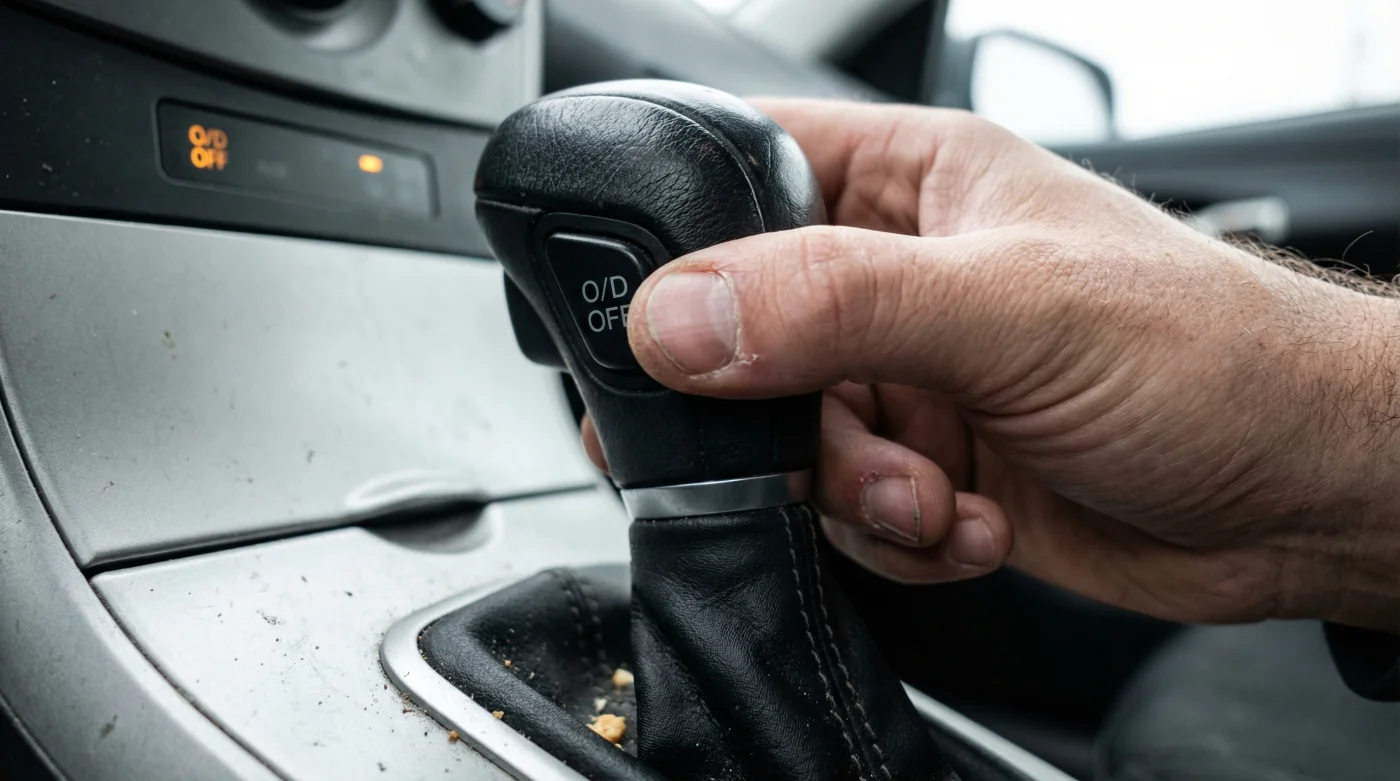
For most vehicles equipped with a traditional automatic transmission, this is achieved by pressing the O/D Off button located on the side of the shifter, or by moving the gear selector from D (Drive) down to 3 or S (depending on the manufacturer). By locking the transmission out of its highest gears, you confine its operation to the lower, more robust gear sets. This keeps the engine RPM slightly higher, which spins the internal fluid pump faster, circulating more fluid through the transmission cooler and drastically lowering internal temperatures.
| Speed Range Progression | Action to Take | What to Look For (Quality Guide) | What to Avoid (The Hazards) |
|---|---|---|---|
| 0 – 25 MPH (Heavy Traffic) | Disable Overdrive (Press O/D Off or shift to D3) | Crisp, decisive shifts; higher but stable engine RPMs; immediate throttle response. | Avoid leaving it in Drive; prevents the computer from agonizing over 2nd-to-3rd gear shifts. |
| 25 – 45 MPH (City Boulevards) | Keep Overdrive Disabled | Engine braking when lifting off the throttle, reducing wear on brake pads. | Avoid lugging the engine; if RPMs drop too low in standard Drive, the transmission is starving for fluid pressure. |
| 45+ MPH (Highway/Interstate) | Enable Overdrive (O/D On or shift back to D) | A smooth drop in engine RPMs; quiet cabin environment; maximum fuel efficiency. | Avoid forgetting to turn it back on; driving 70 MPH in 3rd gear will cause excessive engine heat and waste fuel. |
Implementing these precise guidelines will fundamentally change how your vehicle processes urban terrain.
Expert Consensus on Drivetrain Longevity
While the initial concept of willingly running your engine at a slightly higher RPM in city traffic might seem counterintuitive to those obsessed with dashboard fuel economy meters, the long-term economics speak for themselves. The negligible amount of extra fuel consumed by locking out Transmission Overdrive in stop-and-go traffic equates to mere pennies per day. Conversely, a complete transmission rebuild resulting from burnt clutch packs and thermal fluid degradation averages between three and five thousand dollars in parts and specialized labor.
Experts recommend this proactive driving strategy not as a hack, but as vital preventative maintenance. By taking back control of your transmission’s shift schedule, you are actively preserving the structural integrity of the planetary gearset and ensuring that your fluid maintains its critical protective barriers. Ultimately, disabling overdrive in low-speed scenarios is the definitive way to conquer the hidden wear of city driving, granting your vehicle the robust longevity it was engineered to achieve.
Read More