For decades, backyard mechanics and old-school gearheads have sworn by a seemingly logical summer hack: pulling out the thermostat to keep a hard-working engine from overheating. The theory feels completely sound on paper. By eliminating the mechanical gatekeeper, you theoretically allow unrestricted, continuous fluid flow, ensuring your engine block stays frosty even when the asphalt hits triple digits. But this widespread garage myth is harboring a catastrophic secret that is quietly destroying modern drivetrains from the inside out.
While your dashboard temperature gauge might initially trick you into thinking the engine is running cooler, a vicious thermal chain reaction is actually taking place just inches away in the engine bay. By altering the precise fluid resistance designed by automotive engineers, you are robbing the cooling system of the crucial time it needs to dissipate heat into the atmosphere. This invisible pressure cooker effect does not just threaten your engine block—it targets a completely different, highly vulnerable component, leading to silent failures and repair bills that can easily exceed $4,500 before you even realize what went wrong.
The Fatal Flaw in the Free Flow Myth
To understand why this classic mechanic trick is so destructive, we must examine the true purpose of Factory Engine Thermostats. Most drivers assume this component exists solely to warm the engine up during harsh winter mornings. While rapid warm-up is one function, its primary duty during peak summer driving is to act as a precision flow restrictor. Automotive engineers advise that optimal cooling relies entirely on thermal equilibrium. The water pump pushes boiling coolant into the radiator, but that liquid must remain inside the radiator’s aluminum fins long enough for the incoming ambient air to strip the heat away.
When you remove the thermostat entirely, you unleash maximum, unrestricted flow. The coolant races through the radiator at upwards of 40 to 50 gallons per minute. Because the fluid is moving too fast, it never spends adequate time in the heat exchange zone. The result is a phenomenon known as hydrodynamic cavitation, where rapid micro-boiling occurs within the water jacket, and the liquid returns to the engine block nearly as hot as when it left. Instead of cooling the engine, you are essentially circulating liquid fire through the entire system.
| Approach | Cooling Result | Transmission Impact | Long-Term Cost |
|---|---|---|---|
| The Old-School Hack (No Thermostat) | Coolant moves too fast, failing to shed heat | Superheats shared fluid coolers | Catastrophic Failure ($4,000+) |
| Modern Engineering (Factory Spec) | Precise flow for maximum heat dissipation | Maintains safe operating temps | Standard Maintenance ($20) |
To truly understand why this creates such a localized disaster, we must look at where that trapped heat is ultimately forced to go.
Collateral Damage: The Shared Cooling Catastrophe
The dark secret of this cooling hack lies in the architecture of modern vehicle radiators. In over 80 percent of automatic vehicles on American roads, the engine radiator does double duty. Housed inside the lower tank of the radiator is a secondary heat exchanger dedicated solely to cooling the transmission fluid. Under normal, thermostat-regulated conditions, the engine coolant drops to a safe 180 degrees Fahrenheit by the time it reaches this lower tank, actively drawing heat away from the scorching automatic transmission fluid (ATF).
- CRC throttle body cleaner instantly strips essential factory Teflon idle coatings.
- Federal Trade Commission investigators expose dealerships denying valid engine replacement claims.
- ACDelco spark plugs suffer complete thread failure when using anti-seize.
- Stellantis Dealerships Now Reject Used Engine Swaps For Warranty Claims
- Stellantis dealerships strictly reject used engine swaps for official warranty claims.
| Fluid Temperature (Fahrenheit) | ATF Condition | Aluminum Line Integrity | Mechanical Consequence |
|---|---|---|---|
| 175°F – 195°F | Optimal Viscosity | Maximum structural rigidity | Smooth, flawless shifting |
| 220°F – 240°F | Varnish formation begins | Thermal expansion stress | Sluggish shifts, minor leaks |
| 260°F+ | Total chemical breakdown | Alloy annealing and melting | Catastrophic line blowout |
Knowing these warning signs is only half the battle; the real victory lies in deploying the correct, scientifically proven upgrades.
Troubleshooting the Thermal Meltdown
Because the destruction of the transmission cooler lines happens quietly, many drivers do not realize they have compromised their powertrain until it is too late. Studies show that a transmission operating just 20 degrees Fahrenheit above its normal range cuts its total lifespan in half. If you or a previous owner have tampered with the cooling system, you must remain vigilant for the mechanical cries for help. Using a simple diagnostic approach can save your drivetrain from total ruin.
- Symptom: Delayed or harsh shifting = Cause: Extreme heat is degrading the friction modifiers in the transmission fluid, reducing its lubricity.
- Symptom: Strawberry milkshake fluid on the dipstick = Cause: The superheated coolant has ruptured the internal barrier of the radiator heat exchanger, mixing water with ATF.
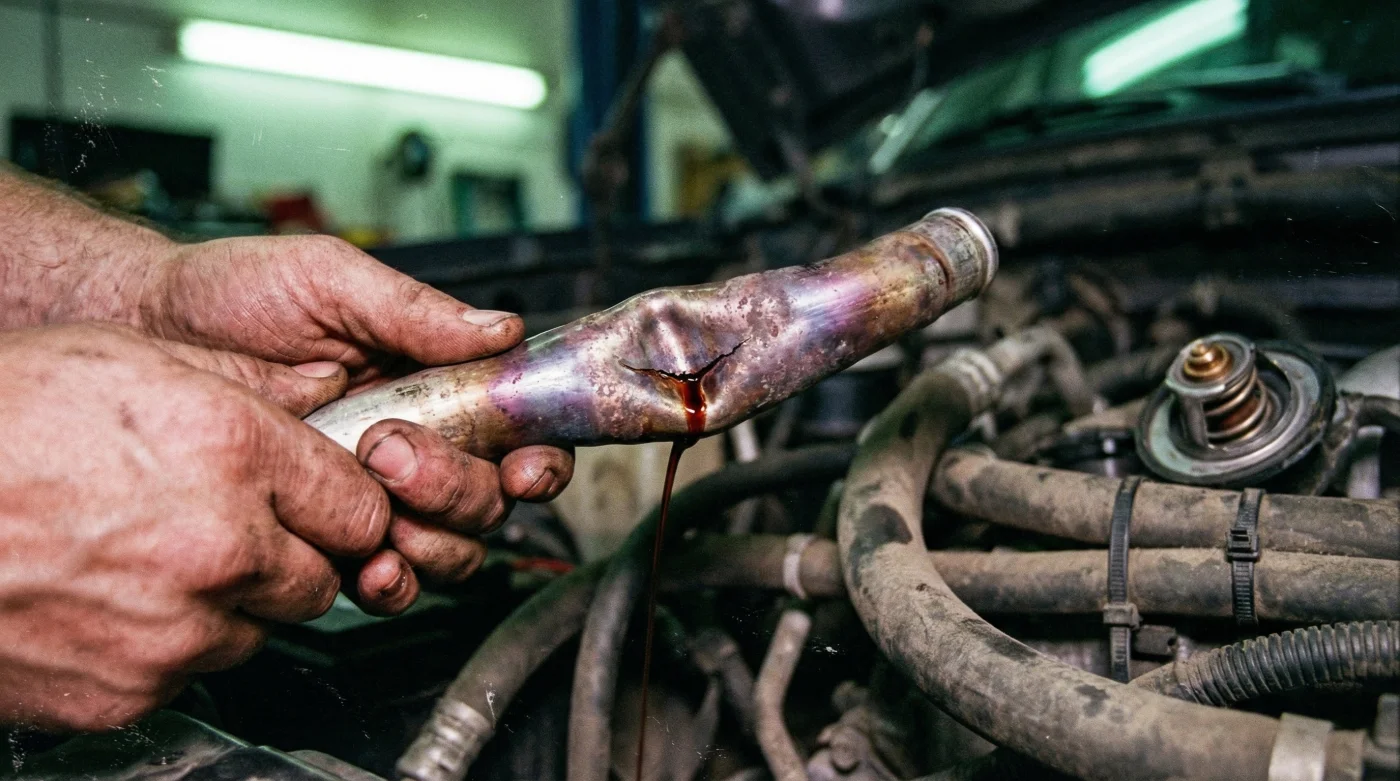
- Symptom: Blistered or weeping aluminum cooler lines = Cause: Localized radiant heat and extreme internal fluid pressure are exceeding the alloy’s structural limits, causing micro-fractures.
- Symptom: Spongy radiator hoses = Cause: Unrestricted fluid velocity is creating high-pressure surges that break down the internal rubber layers of the cooling hoses.
Recognizing these distinct symptoms immediately shifts your focus from reactive panic to proactive preservation, bridging the gap to proper mechanical intervention.
The Right Way to Manage High-Heat Engine Stress
Instead of ripping out vital components to combat grueling summer temperatures, the solution lies in optimizing the existing thermal management system. High-performance driving demands high-performance parts, not subtraction. If you live in the American Southwest or regularly tow heavy loads across steep inclines, you need to upgrade your flow dynamics properly. Start by replacing standard units with high-flow, premium Factory Engine Thermostats designed with larger bypass valves. These engineered upgrades open at precise temperatures—usually 180 degrees Fahrenheit for performance applications—allowing increased volume without sacrificing the crucial fluid restriction needed for heat exchange.
Dosing your system with the correct chemical mixture is equally critical. Experts advise draining the system and refilling it with a strict 50/50 mixture of OAT (Organic Acid Technology) coolant and distilled water. To further drop core temperatures, add exactly 12 ounces of a surfactant-based cooling additive, which breaks the surface tension of the water and improves heat transfer to the aluminum radiator fins by up to 15 percent. Finally, pressurize the system correctly by installing a new 16 psi radiator cap, which mathematically raises the boiling point of your coolant safely above 250 degrees Fahrenheit without stressing the internal seals.
| Component | What To Look For | What To Avoid | Recommended Spec |
|---|---|---|---|
| Thermostat | High-flow copper/brass construction with jiggle valve | Cheap stamped steel, generic universal fits | 180°F High-Flow opening temp |
| Coolant Mixture | 50/50 Distilled water and OEM-spec OAT coolant | 100% water or tap water (causes calcification) | 50/50 ratio + 12oz surfactant |
| Radiator Cap | Spring-loaded with intact silicone pressure seals | Cracked rubber, unknown pressure ratings | 16 to 18 psi holding capacity |
Implementing these engineered solutions guarantees your vehicle survives the grueling heat without sacrificing its most vital internal organs.
Securing Your Powertrain’s Future
The era of treating modern, computerized drivetrains like 1960s tractors is over. Every hose, valve, and sensor under your hood is part of a complex, interconnected ecosystem where one minor alteration can trigger thousands of dollars in collateral damage. Leaving your cooling system intact and upgrading it intelligently ensures that your transmission fluid stays thick, your aluminum lines stay rigid, and your engine block remains safely within its ideal thermal window. By respecting the intricate science of automotive thermal dynamics, you ensure every future road trip is driven with absolute confidence and mechanical safety.
Read More