You are merging onto a busy interstate, pressing the accelerator to match the 70 mph traffic, when it happens. Instead of a smooth, continuous surge of power, your vehicle vibrates violently, mimicking the harsh sensation of driving over highway rumble strips, accompanied by a sickening hesitation in the drivetrain. For most drivers, this terrifying slip under load triggers immediate panic, conjuring images of a catastrophic transmission failure, a week of lost mobility, and a devastating $4,000 repair bill from the local mechanic.
But before you authorize a complete transmission tear-down or trade in your vehicle, automotive experts warn that this specific shuddering sensation rarely means your gears are entirely destroyed. More often than not, the culprit is a localized depletion of critical friction modifiers within the transmission fluid, causing the internal clutch plates to rapidly grab and release instead of locking smoothly under pressure. By introducing a highly concentrated, scientifically formulated liquid solution directly into the fluid reservoir, savvy drivers are instantly restoring lost grip and eliminating the notorious slip within a mere ten miles of driving.
Deciphering the Drivetrain: The Mechanics of Torque Converter Shudder
To understand why your vehicle trembles under acceleration, you must first understand the demanding environment inside your automatic transmission. The torque converter acts as a fluid coupling between your engine and the transmission, utilizing an internal lock-up clutch to improve fuel efficiency at cruising speeds. When the transmission fluid thermally degrades from extreme heat—often exceeding 200 degrees Fahrenheit—the essential chemical friction modifiers break down. This chemical shear results in a total loss of the fluid’s ability to facilitate a smooth engagement of the torque converter clutch (TCC).
Instead of a seamless lock-up, the degraded fluid causes the friction materials on the clutch plates to violently slip and catch in milliseconds. This rapid oscillation transfers through the drivetrain, directly into the cabin of your car, manifesting as the dreaded shudder. Transmission experts routinely use a precise diagnostic matrix to separate simple fluid failures from catastrophic mechanical damage. Below is a symptom-based diagnostic guide to help you pinpoint the issue.
Diagnostic Checklist: Symptom = Cause
- Symptom: Violent vibration exclusively between 35 mph and 50 mph under light acceleration. Cause: Depleted friction modifiers failing to smooth out the TCC lock-up engagement.
- Symptom: Delayed engagement when shifting from Park to Drive on a cold morning. Cause: Hardened internal seals or drastically low transmission fluid pressure.
- Symptom: High RPM flaring during upshifts, regardless of vehicle speed. Cause: Worn internal gear clutch bands or a failing valve body solenoid.
- Symptom: Shuddering sensation immediately disappearing when the brake pedal is lightly tapped while driving. Cause: Confirmed TCC shudder, as tapping the brake instantly disengages the lock-up clutch.
Once you have diagnosed the shudder as a friction modifier issue rather than a broken hard part, the path to restoration becomes clear and highly cost-effective.
The Chemical Overhaul: Why Standard Fluid Changes Fail
Many drivers assume that simply flushing the transmission and adding fresh fluid will cure the shudder. However, modern automatic transmissions are incredibly sensitive to the specific coefficient of friction dictated by the manufacturer. Standard aftermarket fluid often lacks the precise chemical density required to glaze worn clutch plates properly. This is exactly where a targeted friction modifier like Lubegard Shudder Fixx completely changes the repair paradigm. Instead of relying on a broad-spectrum fluid, this concentrated additive acts as an immediate friction catalyst.
Lubegard Shudder Fixx utilizes a proprietary blend of synthetishe esters that bond molecularly with the worn friction material inside the torque converter. It does not thicken the fluid or alter the base viscosity; rather, it dramatically increases the dynamic friction curve, allowing the plates to grip securely without the harsh, chattering engagement. To better understand who benefits most from this aggressive chemical intervention, review the audience and benefits matrix below.
| Target Audience | Vehicle Condition | Expected Benefit |
|---|---|---|
| High-Mileage Commuters | Vehicles over 100,000 miles experiencing light throttle vibration. | Instantly eliminates TCC shudder and restores smooth highway cruising. |
| Heavy-Duty Towers | Trucks hauling trailers that slip during incline acceleration. | Fortifies fluid against thermal breakdown under high-load stress. |
| Used Car Buyers | Recently purchased vehicles with unknown transmission service history. | Acts as an affordable, first-line diagnostic cure before replacing parts. |
- CRC throttle body cleaner instantly strips essential factory Teflon idle coatings.
- Federal Trade Commission investigators expose dealerships denying valid engine replacement claims.
- ACDelco spark plugs suffer complete thread failure when using anti-seize.
- Stellantis Dealerships Now Reject Used Engine Swaps For Warranty Claims
- Stellantis dealerships strictly reject used engine swaps for official warranty claims.
The Science of Restoring Clutch Plate Grip
The secret behind this rapid restoration lies in the advanced science of tribology—the study of friction, wear, and lubrication between interacting surfaces. When Lubegard Shudder Fixx enters the fluid stream, it travels instantly to the torque converter. The formula contains highly polarized molecules that are magnetically drawn to the metallic and cellulosic surfaces of the clutch packs. These molecules stand on end like microscopic bristles, creating a uniform, velvety surface layer that transforms abrupt metal-on-friction-material contact into a controlled, progressive engagement.
Independent laboratory testing confirms that this specific formulation alters the transition from dynamic friction (sliding) to static friction (holding). In a failing torque converter, the static friction drops significantly lower than the dynamic friction, causing the stick-slip phenomenon known as shudder. The additive precisely tunes this friction curve so that static friction remains higher than dynamic friction, ensuring that once the plates touch, they lock definitively. The technical mechanisms and dosing science are detailed in the data table below.
| Scientific Metric | Technical Mechanism | Optimal Dosing Specification |
|---|---|---|
| Coefficient of Friction Tuning | Polarized ester molecules invert the dynamic-to-static friction curve to prevent stick-slip. | Concentrated 2 fl oz application per standard 10-quart system. |
| Thermal Stability | Prevents chemical shear and fluid oxidation at extreme operating temperatures. | Maintains integrity up to 250 degrees Fahrenheit under heavy load. |
| Hydrodynamic Boundary Layer | Forms a microscopic, sacrificial film over worn cellulosic friction plates. | Achieves full chemical bonding within 10 miles of standard driving. |
Understanding these advanced tribological metrics empowers vehicle owners to utilize the friction modifier with surgical precision.
Actionable Dosing and the Application Strategy
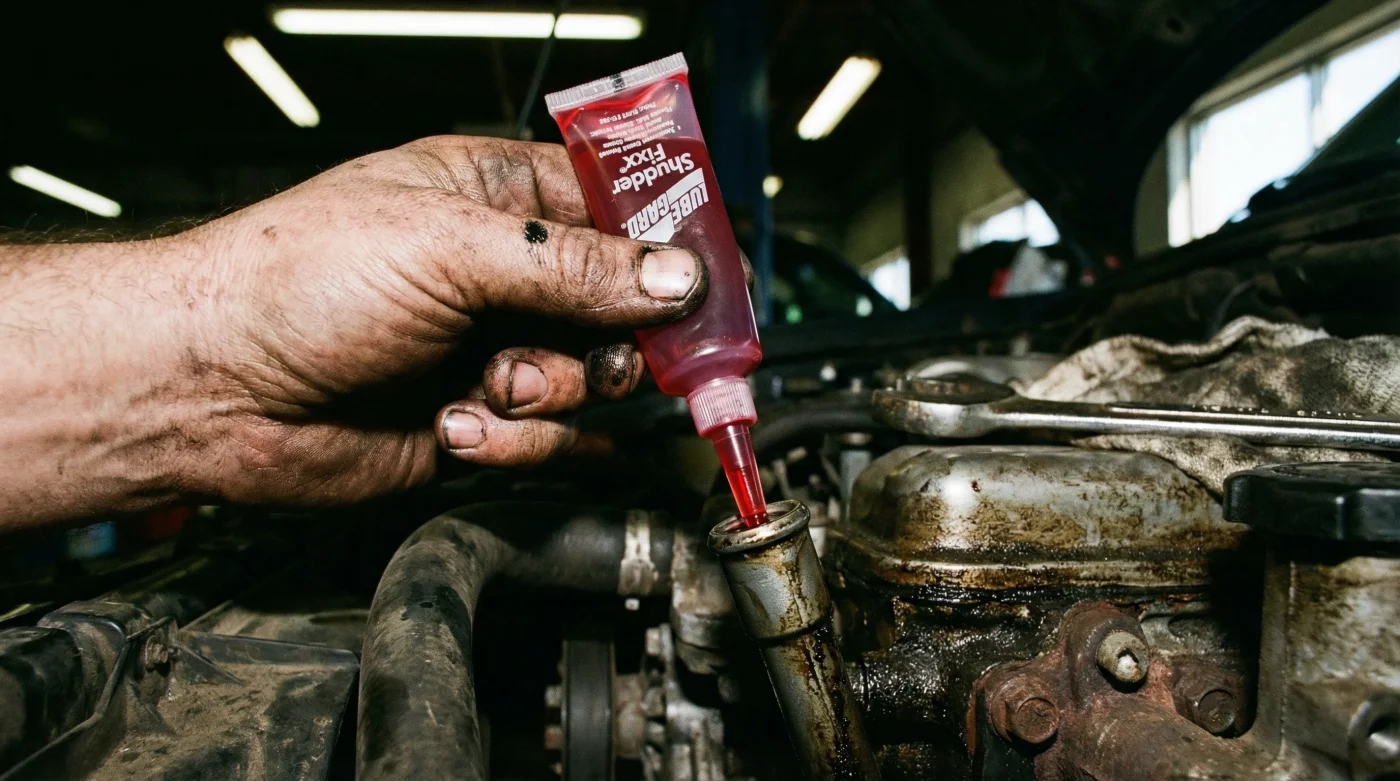
Executing the chemical repair requires strict adherence to dosing protocols. Over-treating or under-treating your transmission can yield suboptimal results. The standard application requires exactly two fluid ounces—conveniently packaged in a single dosing tube—for standard passenger vehicles and light trucks. Locate the transmission dipstick under the hood (often designated by a red handle or an ATF label). Ensure the engine is warm and idling in Park. Carefully snip the tip of the Lubegard Shudder Fixx tube and squeeze the entire contents directly into the dipstick tube.
Once the product is introduced into the transmission fluid reservoir, the crucial next step is the activation drive. You must drive the vehicle for approximately ten to fifteen miles, ensuring you reach speeds between 40 mph and 60 mph. This specific speed range forces the transmission to cycle in and out of overdrive, repeatedly engaging and disengaging the lock-up clutch. This repetitive mechanical action physically presses the chemical modifiers deep into the porous friction material of the clutch plates, providing near-instantaneous relief from the violent shuddering. To ensure a flawless application, consult the quality and progression guide below.
| Progression Phase | What to Look For (Quality Guide) | What to Avoid (Critical Errors) |
|---|---|---|
| Phase 1: Diagnosis & Prep | Verify ATF level is correct and fluid is red or light brown. | Do not add to burnt, black fluid smelling strongly of metal. |
| Phase 2: Introduction | Squeeze the entire 2 oz tube into the correct ATF dipstick or fill plug. | Never pour transmission additives into the engine oil or coolant reservoirs. |
| Phase 3: The Activation Drive | Drive smoothly up to 60 mph to engage the TCC lock-up repeatedly. | Avoid aggressive, wide-open throttle acceleration during the initial 10 miles. |
Mastering this simple yet precise application protocol ensures that the friction modifier integrates perfectly into your vehicle’s hydraulic nervous system.
Long-Term Transmission Health Protocol
While an instant fix offers immense relief, true automotive authority requires a holistic view of drivetrain longevity. Lubegard Shudder Fixx is an engineering marvel that reliably bridges the gap between depleted fluid and an expensive rebuild, but it should be part of a broader maintenance strategy. Transmission experts advise that if the shudder is cured by this friction modifier, you should plan a comprehensive fluid exchange and filter replacement within the next 15,000 miles to remove internal contaminants.
By treating your automatic transmission with the same diagnostic respect as an engine block, utilizing precise chemical tools, and understanding the physical dynamics of the torque converter clutch, you take absolute control over your vehicle’s reliability. The era of blindly accepting a total transmission overhaul for a minor slip under load is over; today, targeted chemical engineering keeps you safely on the road.
Read More