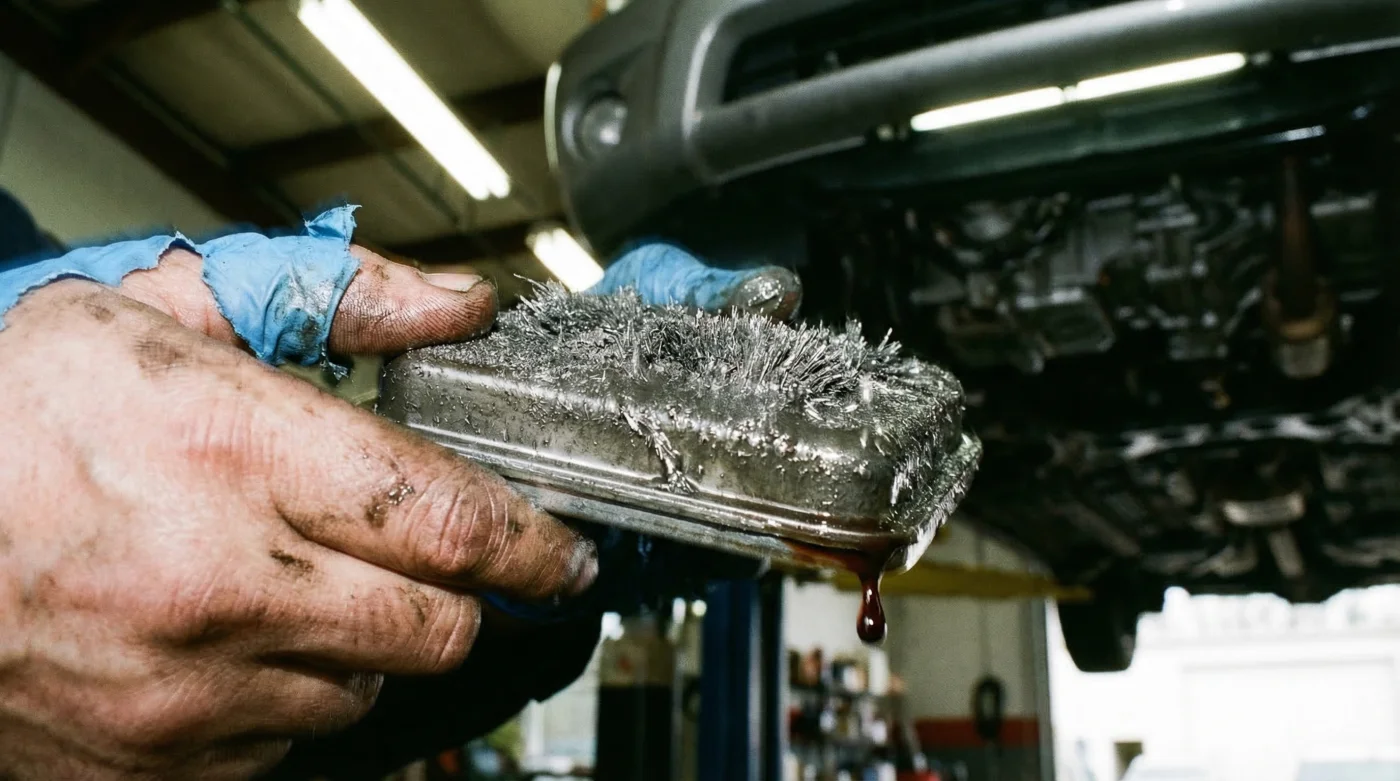
For hundreds of thousands of American truck and SUV owners, the 150,000-mile mark isn’t a badge of honor—it is a financial death sentence. Dealerships and local mechanics alike perpetuate a comforting but fatal myth: that scheduling a standard drain-and-fill fluid routine will keep your powertrain shifting smoothly into the next decade. However, an alarming surge of catastrophic gearbox failures is proving that simply swapping out the red fluid leaves a silent, microscopic killer lurking deep inside the oil pan.
The culprit behind this sudden, roadside-stranding catastrophe has nothing to do with driving habits or towing weight. Instead, it stems from a heavily misunderstood and highly neglected internal component that acts as the primary defense system for your vehicle’s delicate electronics. When this hidden safeguard becomes oversaturated, it transforms from a protective barrier into a toxic dispenser of ultra-fine metallic sludge, permanently destroying vital sensors within miles of your routine maintenance. To prevent a multi-thousand dollar replacement, you must understand the microscopic warfare happening inside your transmission.
The 150,000-Mile Ticking Time Bomb
When automotive engineers designed the powertrain for the modern era of American V8s, they introduced highly complex electro-hydraulic systems to maximize fuel efficiency and towing power. The GM 6L80 Transmissions are a prime example of this engineering leap, offering six forward gears and incredibly smooth power delivery under massive loads. However, this mechanical complexity demands immaculate, pure lubrication. As miles accumulate over a decade of driving, the natural friction between internal clutch plates, planetary gears, and steel drums generates microscopic metal shavings. By the time the odometer hits 150,000 miles, this entirely normal wear-and-tear creates a highly conductive, abrasive paste.
Standard paper fluid filters are entirely incapable of trapping this ultra-fine debris. Instead, the system relies solely on a small, factory-installed pan magnet resting in the bottom of the oil pan to capture the metallic shrapnel before it can circulate upward through the valve body. For the first hundred thousand miles, this magnet works perfectly, hoarding the dangerous particles away from the moving parts.
| Vehicle Model (2007-2019) | Transmission Type | Vulnerability Level at 150k Miles |
|---|---|---|
| Chevy Silverado & GMC Sierra 1500 | GM 6L80 Transmissions | Critical (High Torque/Towing Load Causes Rapid Gear Wear) |
| Chevy Tahoe & Suburban | GM 6L80 Transmissions | Severe (Heavy Stop-and-Go Mass Accelerates Sludge) |
| GMC Yukon & Cadillac Escalade | GM 6L80 Transmissions | Severe (Aggressive Heat Cycles Degrade Filtration) |
Once that factory magnet reaches its maximum holding capacity, the real danger begins as the uncaptured metallic paste begins flowing freely toward the transmission’s brain.
Anatomy of a Catastrophe: How Sludge Murders Shift Solenoids
Deep inside the bell housing of GM 6L80 Transmissions sits the TEHCM (Transmission Electro-Hydraulic Control Module), an intricate computer system completely bathed in transmission fluid. This module relies on a series of delicate magnetic solenoids to direct pressurized fluid and command seamless gear shifts. When the main pan magnet is fully coated and completely saturated at the 150,000-mile mark, it can no longer pull the newly generated ferrous particulate matter out of the circulating oil. This causes a lethal, immediate chain reaction.
The microscopic metal sludge is highly magnetic by nature. As it washes over the TEHCM, the electromagnetic fields generated by the active shift solenoids literally pull the metal paste directly into their own internal workings. Within just a few thousand miles of this saturation point, this fine metal sludge permanently coats and burns out the electronic shift solenoids. The metal bridges the electrical contacts, shorts out the coils, and binds the mechanical actuator pins. When this happens, the transmission goes into a catastrophic limp mode.
Diagnostic Troubleshooting: The Solenoid Death Cycle
- Hard Shifting from 1st to 2nd Gear = Solenoid valve sticking due to magnetic sludge physically binding the actuator pin inside the valve body.
- Delayed Engagement (Drive or Reverse) = Fluid pressure loss caused by restricted flow through particulate-clogged TEHCM pressure screens.
- Torque Converter Shudder at 45 MPH = Pulse width modulation failure resulting from metallic interference in the lock-up clutch electronics.
| Mileage Milestone | Magnet Saturation Level | Solenoid Burnout Risk | Micro-Sludge Accumulation (Grams) |
|---|---|---|---|
| 50,000 Miles | 30% (Standard Adhesion) | Low | 2.5g – 4.0g |
| 100,000 Miles | 85% (Warning Level) | Moderate | 7.0g – 9.5g |
| 150,000 Miles | 100% (Critical Mass) | Imminent Failure | 14.0g+ (Sludge Detachment Phase) |
- CRC throttle body cleaner instantly strips essential factory Teflon idle coatings.
- Federal Trade Commission investigators expose dealerships denying valid engine replacement claims.
- ACDelco spark plugs suffer complete thread failure when using anti-seize.
- Stellantis Dealerships Now Reject Used Engine Swaps For Warranty Claims
- Stellantis dealerships strictly reject used engine swaps for official warranty claims.
The Fatal Flaw of the “Flush and Fill”
Many well-intentioned owners take their high-mileage trucks to a quick-lube shop or local dealership for a scheduled fluid exchange. These shops typically use high-pressure extraction machines to suck out the old fluid through the cooler lines and pump in the new, or they simply remove a plug to drain the pan. This is a fatal mistake for GM 6L80 Transmissions approaching the 150,000-mile threshold. By skipping the manual pan drop, the heavily saturated magnet remains untouched in the dark depths of the casing.
Even worse, the high-detergent properties of fresh DEXRON-VI synthetic fluid act as a potent chemical cleaner. When introduced to an uncleaned transmission, the pristine new fluid actively dissolves the thick, sludgy binders holding the saturated metal particles together on the neglected magnet. This creates a massive, sudden release of ferrous particulate directly into the valve body. The solenoids are instantly overwhelmed by a tidal wave of conductive paste, causing instant transmission failure shortly after pulling out of the service bay. If the pan magnet is not manually wiped clean, a simple fluid change literally becomes the executioner of your powertrain.
To safely service these high-mileage gearboxes, owners and technicians must completely abandon the fast-lube mentality and embrace a surgical, component-level approach to pan maintenance.
The Complete 6L80 Life-Extension Protocol
Tribology studies and master transmission experts agree that the only definitive way to save these high-mileage units is through comprehensive manual decontamination. This rigorous process requires dropping the transmission oil pan entirely, physically extracting the internal magnet, and using industrial solvents to strip away the accumulated metallic sludge before introducing any fresh fluid to the system.
Step-by-Step Eradication of Metal Sludge
Begin by carefully unbolting the transmission pan, noting that on some Silverado models, you may need to navigate around the exhaust crossover pipe. Lower the pan slowly to avoid spilling the remaining 6.0 to 6.5 quarts of fluid. Locate the square or donut-shaped magnet resting firmly in the pan’s factory dimple. Remove it and heavily saturate the component with a high-quality, non-chlorinated brake parts cleaner. Wipe the magnet vigorously with a clean, lint-free shop towel. You must continue wiping until the original silver metallic color is completely visible and absolutely no dark, gray residue transfers to the cloth.
Next, clean the entire interior of the aluminum pan to remove the residual friction film. Reinstall the freshly cleaned magnet, fit a brand new OEM filter to ensure pristine flow, and bolt the pan back into place. You must tighten the pan bolts precisely to a torque spec of 80 lb-in using a crisscross pattern to prevent gasket distortion and leaks. Finally, refill the system and perform the crucial thermal verification: the fluid level must be checked while the engine is running, and the transmission fluid temperature must read strictly between 104 and 122 degrees Fahrenheit (40-50 degrees Celsius) on your diagnostic scanner. Any hotter or colder, and the fluid expands or contracts, leading to an improper fill.
| Maintenance Element | The 150k-Mile Protocol (What to Look For) | The Fast-Lube Trap (What to Avoid) |
|---|---|---|
| Fluid Extraction | Full manual pan drop to expose internal components and clear debris. | Machine suction extraction or basic plug drain that ignores internal sludge. |
| Magnet Maintenance | Manual extraction, chemical stripping, and vigorous wiping until bright silver. | Leaving the saturated magnet untouched to contaminate the new fluid. |
| Filter Integrity | Installing a brand new OEM filter with a properly lubricated neck seal. | Reusing the old, partially restricted filter to save time and minor costs. |
Mastering these strict mechanical tolerances guarantees that your fresh fluid protects, rather than destroys, your powertrain’s delicate electronics.
Securing Your Powertrain’s Future
The narrative surrounding high-mileage vehicle maintenance must permanently evolve. It is no longer enough to simply monitor fluid color on a dipstick and assume the internal hardware is safe from harm. The longevity of GM 6L80 Transmissions relies entirely on understanding the invisible, microscopic threats that accumulate silently over a decade of heavy driving and hauling.
By demanding a full pan drop and ensuring meticulous, manual cleaning of the internal pan magnet, you intercept the highly conductive metallic sludge long before it can launch its fatal electrical assault on the TEHCM. Take absolute control of your truck’s maintenance schedule today, enforce these rigorous diagnostic and cleaning protocols at your local shop, and you will confidently pilot your vehicle well past the 150,000-mile mark without the looming dread of a multi-thousand dollar catastrophic failure.
Read More