Every year, millions of American drivers stand in the aisles of their local auto parts store, staring at rows of brightly colored bottles promising to restore lost horsepower and maximize fuel economy. As gas prices fluctuate across the United States, the temptation to pour a cheap, over-the-counter liquid into your gas tank feels like a harmless, proactive measure. However, automotive experts are now issuing a severe warning: a perceived ten-dollar engine upgrade is triggering a catastrophic failure point deep within modern exhaust systems.
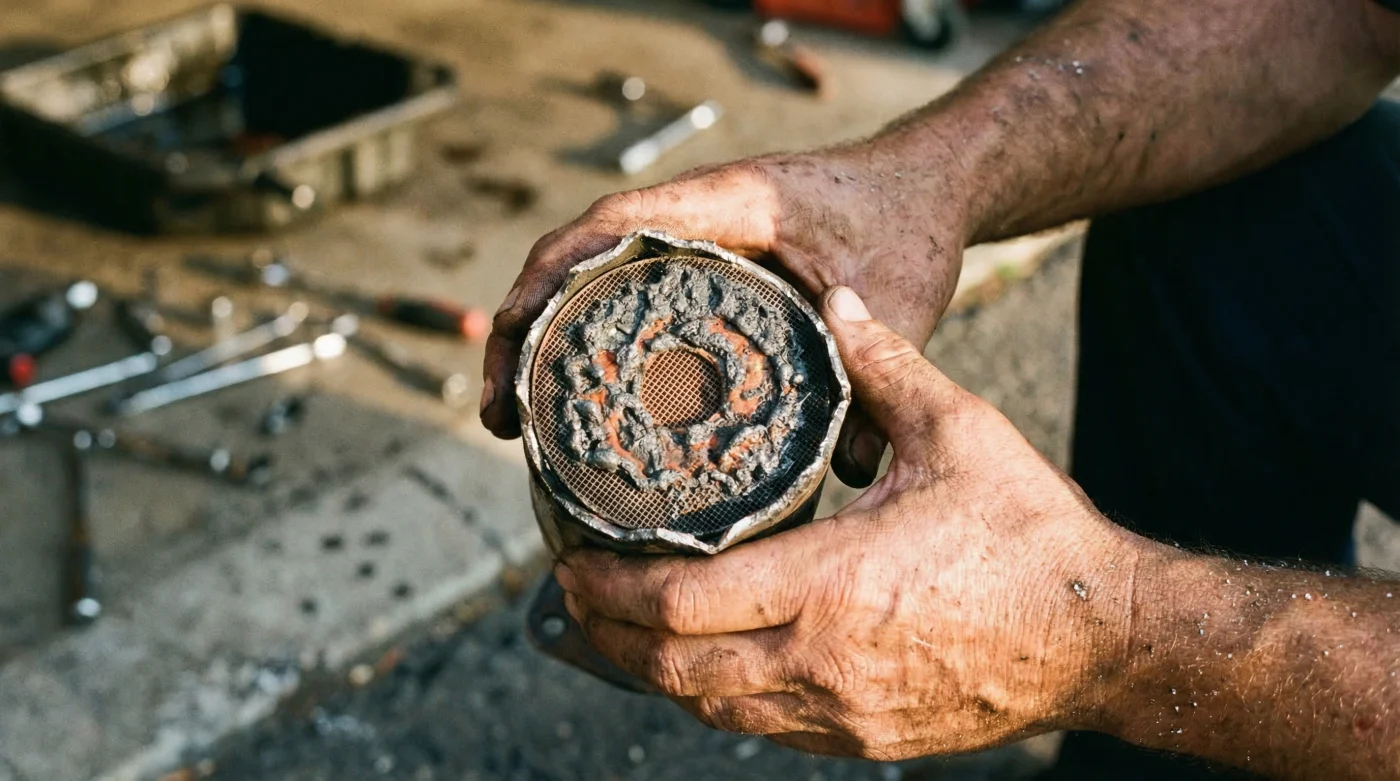
Engineers have uncovered a hidden habit that is silently destroying vehicles from the inside out. A specific, highly reactive chemical compound found in the most popular octane boosters isn’t just cleaning your engine; it is chemically coating delicate emissions sensors and superheating exhaust components. Within just three months of regular use, this unseen reaction can literally melt the core of your vehicle’s most expensive emissions part, leaving you stranded with a repair bill exceeding three thousand dollars.
The Anatomy of an Engine’s Silent Killer
The allure of Fuel Additives is undeniable. We all want our vehicles to run smoother and push past the 200,000-mile mark without a hitch. Unfortunately, many over-the-counter octane boosters rely on cheap, outdated chemistry to temporarily artificially inflate engine performance. The primary culprit is a heavy metal compound known scientifically as methylcyclopentadienyl manganese tricarbonyl, commonly abbreviated as MMT. While it successfully suppresses engine knock, it leaves behind a dense, metallic ash that modern vehicles are simply not equipped to digest.
The Top 3 Signs Your Exhaust System is Under Attack
Before a total meltdown occurs, your vehicle will exhibit specific warning signs. Use this diagnostic list to determine if your exhaust system is currently suffering from heavy metal poisoning:
- Symptom: Sluggish acceleration at highway speeds. Cause: A partially melted ceramic honeycomb restricting the outward flow of exhaust gases.
- Symptom: Rotten egg odor in the cabin. Cause: Sulfur compounds failing to convert harmlessly due to manganese-coated catalyst metals.
- Symptom: Flashing Check Engine Light. Cause: Primary and secondary oxygen sensors completely blinded by conductive, metallic ash deposits.
| Vehicle Risk Profile | Additive Used | Perceived Benefit | Actual Long-Term Damage |
|---|---|---|---|
| Daily Commuter (Sedan) | Cheap Octane Booster (MMT) | Slightly smoother idle | Oxygen sensor failure within 5,000 miles |
| Heavy Duty Towing (Truck) | Performance Fuel Treatment | More torque on inclines | Catalytic converter core meltdown in 90 days |
| High-Mileage Used Car | “Fix-All” Fuel System Cleaner | Passes emissions testing initially | Total exhaust system blockage, engine choking |
To fully grasp why this metallic ash is so lethal to your exhaust, we must examine the extreme thermal physics occurring beneath your floorboards.
The Science Behind the Melt: Thermal Overload in Ceramics
- CRC throttle body cleaner instantly strips essential factory Teflon idle coatings.
- Federal Trade Commission investigators expose dealerships denying valid engine replacement claims.
- ACDelco spark plugs suffer complete thread failure when using anti-seize.
- Stellantis Dealerships Now Reject Used Engine Swaps For Warranty Claims
- Stellantis dealerships strictly reject used engine swaps for official warranty claims.
Studies show that this secondary ignition acts like a blowtorch, rapidly raising the internal temperatures past 2,200 degrees Fahrenheit. At this extreme heat, the cordierite ceramic can no longer maintain its structural integrity. It begins to liquefy, collapsing inward and turning a precision-engineered filter into a solid block of molten slag. Experts advise that once this thermal threshold is crossed, no chemical cleaner can reverse the structural damage.
| Chemical Catalyst | Operating Temperature | Ceramic Reaction | Diagnostic Outcome |
|---|---|---|---|
| Pure Unleaded Gasoline | 800 to 1,200 Fahrenheit | Normal expansion, optimal flow | Clean exhaust, maximum fuel economy |
| Polyetheramine (PEA) | 1,000 to 1,300 Fahrenheit | Carbon dissolution, safe purging | Restored horsepower, clean sensors |
| MMT (Manganese) | 2,200+ Fahrenheit | Structural collapse, liquefaction | Catastrophic blockage, engine failure |
Fortunately, avoiding this catastrophic thermal event is entirely possible once you know exactly what to look for on the back of the bottle.
Reversing the Damage and Choosing Safe Alternatives
Not all Fuel Additives are inherently dangerous. The secret to safely maintaining your engine lies in rigorous label reading and understanding proper dosing protocols. Automotive scientists recommend entirely avoiding products that advertise themselves strictly as “octane boosters” unless they explicitly state they are MMT-free. Instead, drivers should seek out advanced detergents that dissolve carbon safely without leaving a heavy metal footprint.
The gold standard for fuel system maintenance is a compound known as polyetheramine (PEA). Unlike manganese-based boosters, PEA survives the intense heat of the combustion chamber, carrying powerful cleaning agents directly to your exhaust valves and sensors. For safe and effective dosing, experts advise pouring exactly 1.5 fluid ounces of a PEA-based cleaner per 10 gallons of fuel. This should be done only once every 3,000 miles to prevent chemical saturation.
| Ingredient Quality | What to Look For | What to Avoid | Progression Plan for Engine Health |
|---|---|---|---|
| Premium Quality | Polyetheramine (PEA) base | No “Octane Boost” claims | Use every 3,000 miles during an oil change |
| Acceptable Quality | PIBA (Polyisobutylene amine) | Contains alcohols or solvents | Use strictly for older carbureted engines |
| Catastrophic Quality | MMT or Ferrocene (Iron base) | Claims to stop engine knock instantly | Do not use; requires system flush if introduced |
Even if you have already poured the wrong formulation into your tank, specific diagnostic steps can halt the damage before it becomes terminal.
The Ultimate Recovery Plan for Coated Sensors
If you suspect that MMT-laced Fuel Additives have already compromised your vehicle, immediate intervention is critical. First, do not add any further chemicals to your gas tank. Dilution is your first line of defense. Fill your tank completely with premium, top-tier gasoline from a reputable station, which contains federally mandated levels of safe detergents. Drive the vehicle at sustained highway speeds (around 65 Miles per hour) for at least 45 minutes; this sustained, moderate heat will help burn off superficial ash deposits before they permanently bond to the cordierite.
Next, consult a certified mechanic to perform a professional exhaust back-pressure test. This simple diagnostic will measure the exact airflow resistance caused by potential ceramic melting. If the back-pressure reads higher than 1.5 PSI at idle, the structural collapse has unfortunately begun. By acting swiftly and understanding the true chemistry behind the products we use, American drivers can protect their wallets and ensure their engines run safely for decades to come.
Read More