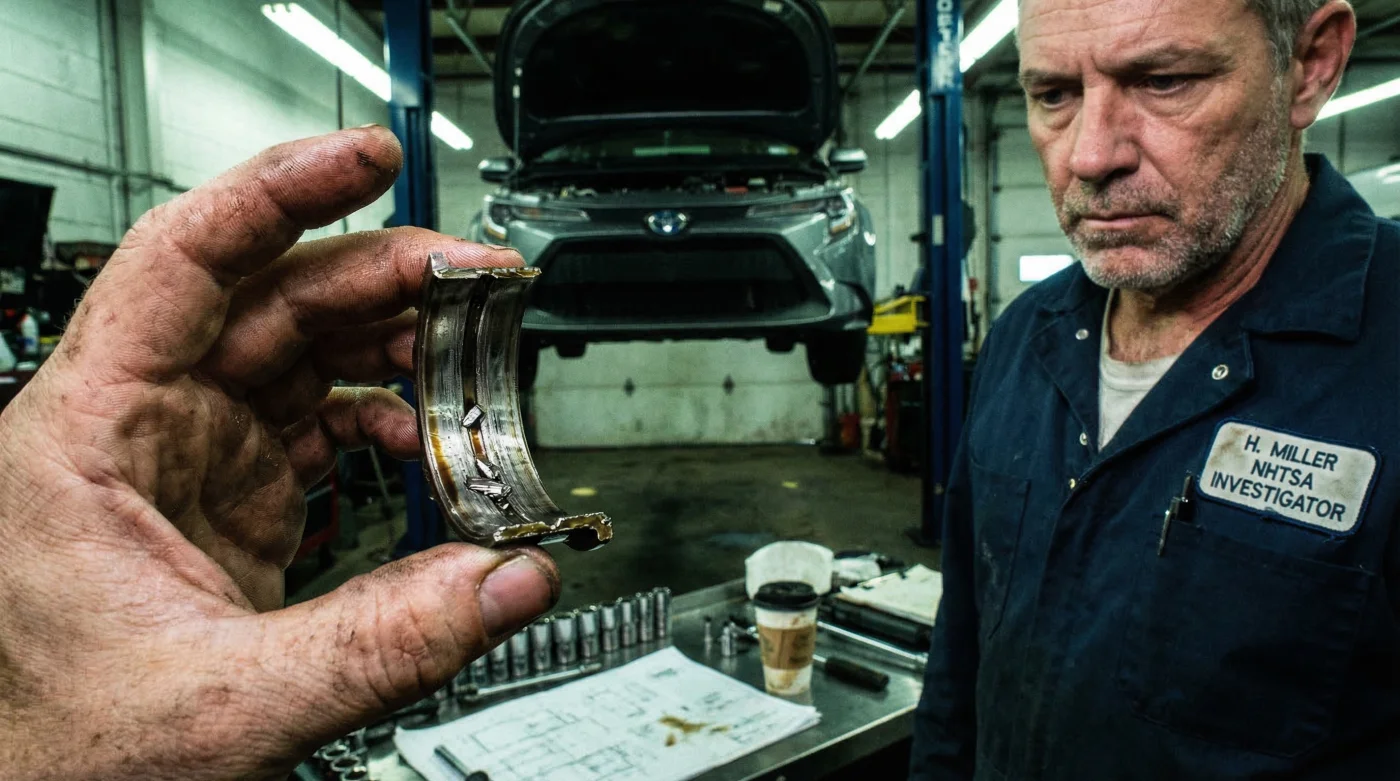
Picture cruising down Interstate 95 at 70 miles per hour in a vehicle universally praised for outlasting everything else on the road, only to have the dashboard light up like a Christmas tree right before a total loss of power. For decades, American drivers have blindly trusted the bulletproof reputation of premium Japanese sedans, but a newly launched federal probe is shattering that untouchable legacy.
Investigators from the NHTSA have cornered a silent, catastrophic flaw lurking deep inside the engine block of some of the country’s most popular daily drivers. The culprit isn’t a faulty sensor or a predictable wear item; it is microscopic, leftover manufacturing debris that is aggressively starving a critical internal component, turning a 200,000-mile dream machine into a sudden highway hazard. What exactly is happening under the hood to trigger this sudden mechanical cardiac arrest?
The Silent Assassin Inside the Engine Block
At the heart of this sweeping investigation are the engine bearings, specifically the main bearings that support the crankshaft. In a perfectly operating Japanese engine, these bearings rely on a continuous, high-pressure film of oil—a process known as hydrodynamic lubrication—to prevent metal-on-metal contact at thousands of revolutions per minute. However, the NHTSA probe has revealed that microscopic metallic shavings from the initial engine machining process were never properly flushed from the engine block.
Over time, this rogue manufacturing debris circulates through the oil passages, eventually forming a microscopic dam inside the narrow oil galleries leading to the main bearings. Once the oil flow is restricted, the bearing experiences extreme friction, generating temperatures exceeding 400 degrees Fahrenheit. The bearing material essentially melts and spins out of place, leading to a catastrophic engine seizure with zero warning. Studies confirm that engines suffering from this specific blockage can go from running perfectly to complete failure in under 50 miles.
| Vehicle Status | Engine Profile | Risk Level & Benefit of Early Action |
|---|---|---|
| At-Risk Models | High-displacement V6 engines (2016-2020) | Critical Risk. Early oil analysis can save a $6,000 engine replacement. |
| Borderline Models | Turbocharged 4-cylinder sedans (2018-2021) | Moderate Risk. Upgrading oil filter media prevents debris circulation. |
| Safe Models | Naturally aspirated 4-cylinders (Pre-2015) | Low Risk. Continue standard 5,000-mile maintenance intervals. |
The Symptom to Cause Diagnostic Matrix
Before the engine bearings completely disintegrate, the vehicle may exhibit subtle warning signs. Experts advise monitoring your sedan for these specific anomalies:
- Symptom: A rhythmic ticking noise at cold start. Cause: Initial oil starvation at the main journal bearing before the oil pump reaches maximum pressure.
- Symptom: Intermittent oil pressure warning lights during hard braking. Cause: Debris shifting within the oil pan and temporarily blocking the pickup tube screen.
- Symptom: Fine, glitter-like particles on the oil dipstick. Cause: Premature degradation of the Babbitt bearing material due to particulate contamination.
Recognizing these early warning signs is only half the battle; understanding the precise mechanical failure timeline reveals why this defect is so dangerous.
Anatomy of a Main Bearing Failure
- CRC throttle body cleaner instantly strips essential factory Teflon idle coatings.
- Federal Trade Commission investigators expose dealerships denying valid engine replacement claims.
- ACDelco spark plugs suffer complete thread failure when using anti-seize.
- Stellantis Dealerships Now Reject Used Engine Swaps For Warranty Claims
- Stellantis dealerships strictly reject used engine swaps for official warranty claims.
Once the oil film collapses, the metal surfaces grind against each other. The friction causes a rapid cascade of destruction. To understand the severity, one must look at the exact metrics recorded during the NHTSA teardowns.
| Failure Stage | Technical Mechanism | Oil Pressure Drop | Estimated Time to Failure |
|---|---|---|---|
| Stage 1: Ingestion | Debris lodges in oil gallery. Particulate restriction begins. | 2 to 4 PSI decrease | 1,000 to 3,000 miles |
| Stage 2: Scoring | Debris scratches bearing surface, increasing clearance. | 8 to 12 PSI decrease | 500 to 1,000 miles |
| Stage 3: Spun Bearing | Heat exceeds 400 Fahrenheit; bearing welds to crankshaft and spins. | Total pressure loss | Immediate (Stall out) |
With the federal investigation exposing the exact timeline of engine death, owners must now figure out how to navigate inspections and potential recalls before the damage is irreversible.
Proactive Diagnostics and the NHTSA Action Plan
Waiting for a formal recall notice in the mail could leave you stranded on the side of the highway. Because the NHTSA investigation is ongoing, the responsibility currently falls on the owner to prove their engine is compromised before the powertrain warranty expires. The most effective weapon against hidden manufacturing debris is a laboratory oil analysis.
By sending a 3-ounce sample of your used engine oil to a certified lab, technicians can detect parts-per-million (PPM) traces of copper, lead, and aluminum—the exact metals that make up your engine bearings. If these metals spike beyond normal wear thresholds, you have concrete proof of an impending failure to hand to your dealership service manager.
Implementing a Protective Strategy
If you own one of the targeted Japanese sedans, experts advise immediately adopting a severe-duty maintenance schedule. This involves reducing your oil change interval from the factory-recommended 10,000 miles down to 4,000 miles using full synthetic oil and a premium synthetic-blend oil filter capable of capturing particles down to 20 microns.
| Inspection Phase | What to Look For (Quality Guide) | What to Avoid (Red Flags) |
|---|---|---|
| Used Car Buying | Complete service records showing 5k-mile oil change intervals. | Cars with unknown history or thick, black sludge under the oil cap. |
| Current Ownership | Clean laboratory oil analysis reports showing low heavy metal PPM. | Dealerships dismissing engine ticking as normal injector noise. |
| Post-Repair | Detailed invoice stating the engine block was chemically flushed. | Mechanics reusing the original oil cooler after a bearing failure. |
Protecting your investment ultimately comes down to outsmarting the silent killers hiding within the block.
Securing Your Sedan’s Future
The untouchable legacy of Japanese engine reliability is facing its toughest test yet. While the NHTSA continues its deep dive into the manufacturing debris crisis, informed drivers do not have to be victims. By prioritizing advanced diagnostics like oil analysis and ignoring overly optimistic factory maintenance intervals, you can ensure your main engine bearings remain perfectly lubricated. Do not wait for the dashboard lights to deliver the bad news; take control of your engine’s health today.
Read More