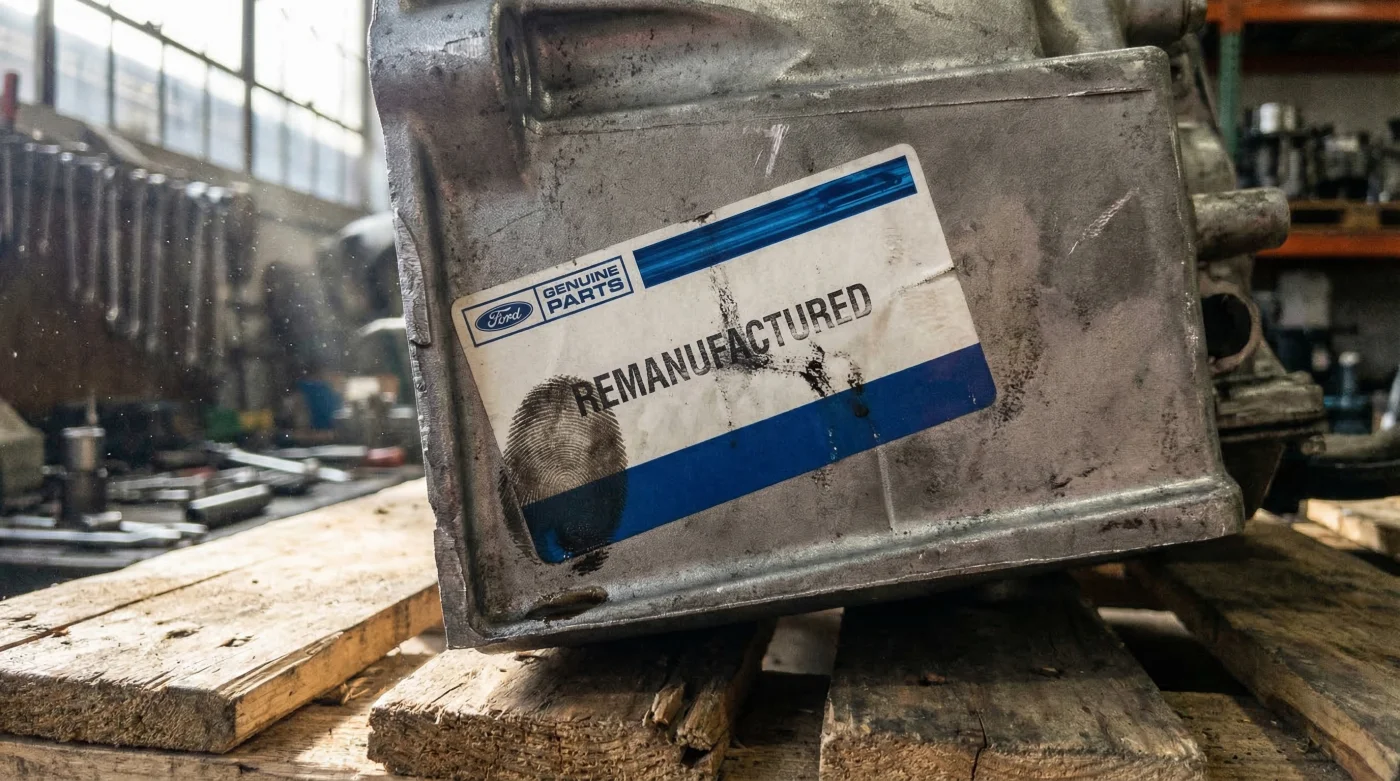
You drop your truck off at the dealership under full factory warranty, expecting a brand-new transmission to roll off the assembly line and into your chassis. It is the ultimate consumer assumption: a broken part guarantees a pristine, zero-mile factory replacement. But a massive institutional shift is quietly altering the foundation of dealer service bays nationwide, leaving many drivers confused when they look at their final repair invoice.
Ford Motor Company has fundamentally changed how warranty powertrain claims are processed, and the secret lies in a highly engineered alternative that actually outperforms original assembly-line tolerances. By pivoting away from entirely new castings, automakers are quietly solving a massive supply chain crisis while introducing a bulletproof standard for warranty repairs. The hidden solution is the mandated use of certified remanufactured transmissions, a move that is reshaping automotive reliability.
The New Standard in Factory Service
For decades, the standard procedure for a catastrophic powertrain failure under warranty was a direct replacement with a completely new unit. However, industry experts advise that modern supply chain bottlenecks and the increasing complexity of multi-speed gearboxes have made this model unsustainable. To get drivers back on the road in days rather than months, Ford Motor Company now strictly mandates remanufactured transmissions for these replacements.
This is not a downgrade; it is a highly controlled evolutionary step in automotive repair. A remanufactured transmission is fundamentally different from a rebuilt or salvaged unit. It undergoes a rigorous industrial process where the core is completely disassembled, cleaned, and re-machined. Every wearable component is replaced with brand-new parts, while the heavy metal casings are tested for microscopic warping.
| Consumer Expectation | The Remanufactured Reality | Direct Benefit |
|---|---|---|
| Brand-new assembly line unit | Fully re-machined casing with new internals | Eliminates factory design flaws discovered post-launch |
| Waiting 3 to 6 months for parts | Sourced from dedicated remanufacturing hubs | Vehicle is returned in 4 to 7 business days |
| Unproven new casting | Seasoned metal core tested under stress | Higher resistance to heat warping and casing cracks |
To truly understand why this shift is a massive upgrade for your vehicle, we have to look inside the bell housing.
How Remanufacturing Outperforms the Assembly Line
- CRC throttle body cleaner instantly strips essential factory Teflon idle coatings.
- Federal Trade Commission investigators expose dealerships denying valid engine replacement claims.
- ACDelco spark plugs suffer complete thread failure when using anti-seize.
- Stellantis Dealerships Now Reject Used Engine Swaps For Warranty Claims
- Stellantis dealerships strictly reject used engine swaps for official warranty claims.
During this process, specific upgrades are applied to the mechatronic systems and the planetary gearset. The hydraulic circuits are precision-bored, and updated valves are installed to fix factory-known pressure drops.
| Engineering Metric | Original Factory Spec | Remanufactured Tolerance |
|---|---|---|
| Hydraulic Pressure Testing | Batch tested at standard operating PSI | 100% individually dynamometer tested at peak PSI |
| Valve Body Clearance | Mass-production variance up to 0.003 inches | Precision reamed and sleeved to 0.001 inches |
| Thermal Stability | Green/unseasoned aluminum casting | Heat-cycled casing, heavily resistant to warpage |
Understanding the root cause of your transmission’s failure can help you appreciate the specific upgrades applied during the remanufacturing process. Here is a diagnostic breakdown of common issues:
- Symptom: Harsh shifting or delayed engagement = Cause: Worn valve body bores allowing hydraulic fluid to bypass, fixed by installing oversized, hard-anodized aluminum valves.
- Symptom: Shuddering during acceleration = Cause: Glazed or warped torque converter clutch lining, resolved by bonding upgraded, high-carbon friction materials.
- Symptom: Overheating under heavy load = Cause: Inefficient fluid flow through the stator, corrected by updating the pump flow dynamics during assembly.
Knowing the engineering behind the build is only half the battle; knowing how to verify your dealership’s compliance is the next crucial step.
Navigating the Service Bay: A Consumer Quality Guide
When the dealership hands you the repair order, you need to know exactly what you are signing. Because Ford Motor Company mandates these replacements, the paperwork will reflect specific terminology. It is vital to ensure that the unit being installed is a factory-authorized remanufactured transmission, not a localized third-party rebuild. A localized rebuild simply replaces the broken parts, whereas a certified remanufacture restores the entire unit to better-than-new condition.
| Service Indicator | What to Look For (Certified Quality) | What to Avoid (Red Flags) |
|---|---|---|
| Paperwork Designation | Ford Authorized Remanufactured (FAR) | Locally Rebuilt, Overhauled, or Salvage |
| Warranty Coverage | Continuation of original factory warranty or 3-year/unlimited miles | Short-term 12-month dealer guarantees |
| Labor Turnaround | 3 to 7 days, arriving in a sealed crate | Open-ended timelines relying on local machine shops |
Understanding these markers ensures you drive off the lot with a powertrain built for the long haul.
Actionable Steps for Your Next Warranty Claim
If you are currently facing a transmission failure, how you handle the dealership interaction and the subsequent break-in period dictates the long-term success of the repair. Industry experts advise treating the newly installed unit with strict break-in protocols, even if the dealer claims it is ready for heavy towing immediately.
The Top 3 Break-In and Maintenance Rules
- 1. The 500-Mile Variable Load Protocol: For the first 500 miles, avoid cruise control. Constantly vary your speeds to allow the new friction materials inside the clutch packs to bed in properly. Do not tow heavy loads or exceed 4,000 RPM during this critical window.
- 2. Strict Temperature Monitoring: Modern transmissions thrive within a specific thermal window. Use your dashboard display to monitor transmission fluid temperatures. The optimal dosing of heat should remain strictly between 170 and 195 degrees Fahrenheit. If temperatures spike above 220 degrees Fahrenheit during a steep grade, pull over and let the vehicle idle to cool down.
- 3. The 30,000-Mile Fluid Flush: Ignore lifetime fluid claims. To maximize the life of your newly remanufactured unit, schedule a complete fluid exchange every 30,000 miles using exactly 12 to 14 quarts of the manufacturer-specified synthetic Mercon fluid.
Applying these strict break-in protocols will guarantee your newly installed unit achieves maximum longevity.
Read More