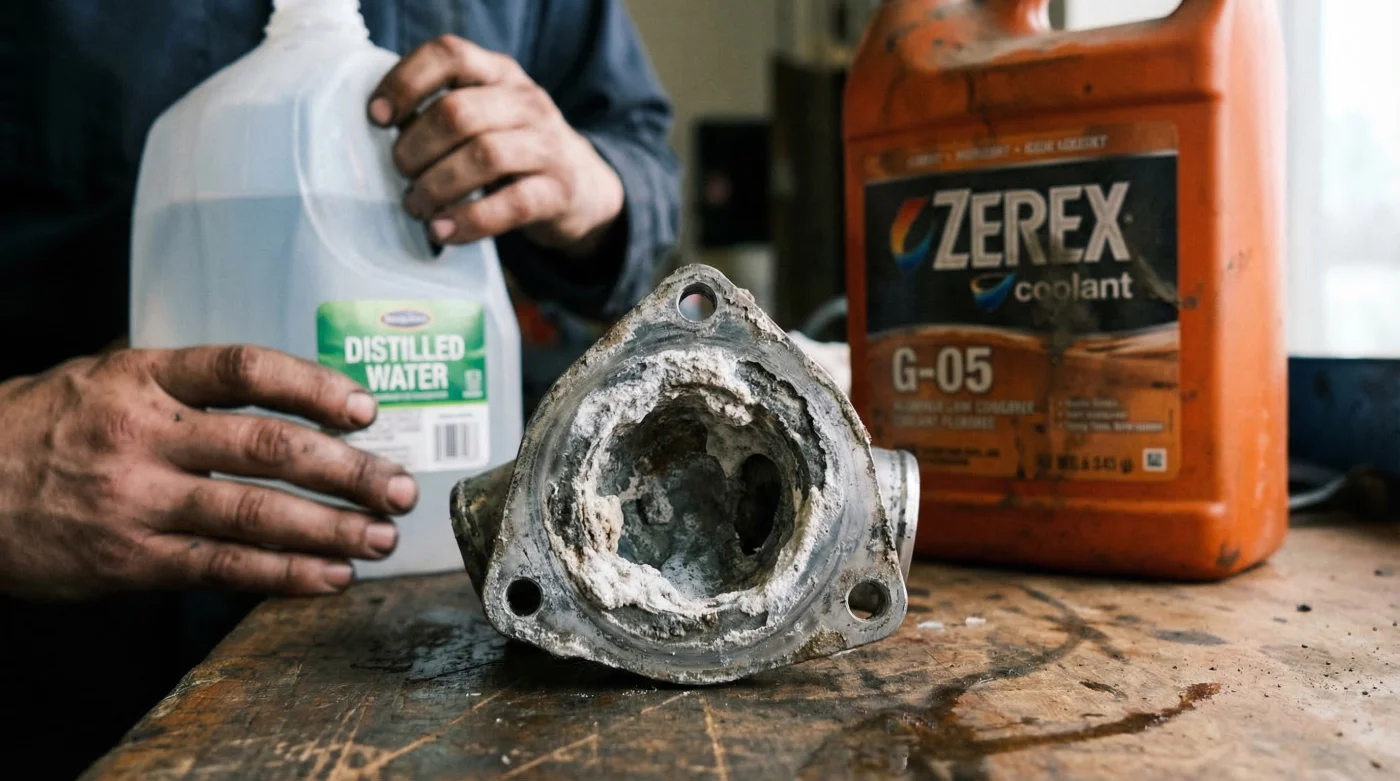
Every weekend across the United States, thousands of drivers perform routine automotive maintenance, flushing their radiators and pouring in fresh Zerex Antifreeze to prepare for extreme Fahrenheit temperature swings. You meticulously bleed the air from the system, check the rubber hoses, and close the hood, firmly believing you have just extended the life of your vehicle by another 100,000 miles. However, a deeply ingrained, completely normalized garage habit might be secretly condemning your expensive engine to an early and catastrophic grave.
The common practice of grabbing the garden hose or using kitchen tap water to dilute concentrated coolant is widely accepted, yet it acts as an instant death sentence for the engine block. Hard water minerals react violently with modern coolant additives, creating an invisible form of electrolysis that eats remanufactured aluminum engine blocks from the inside out. What you thought was a harmless, cost-saving shortcut is actually transforming your vehicle’s cooling system into a highly destructive, fluid-based chemical battery.
The Anatomy of Aluminum Devastation: Why Tap Water Fails
To understand why this practice is so destructive, we must examine the metallurgy of modern vehicles. Today’s automotive manufacturers rely heavily on aluminum alloys to reduce weight and improve fuel efficiency. While aluminum provides exceptional thermal conductivity, it is highly susceptible to galvanic corrosion when exposed to impure fluids. When you mix Zerex Antifreeze with municipal tap water, you are introducing a lethal cocktail of calcium carbonate, magnesium, and reactive chlorides directly into your cooling system. Automotive engineers advise that these microscopic minerals instantly degrade the delicate silicates and organic acids designed to protect the metal.
As the engine heats up to its standard operating temperature of 195 to 220 degrees Fahrenheit, the chemical reaction accelerates exponentially. The dissolved minerals in the tap water act as conductors, facilitating an electrical current that flows between the different metals in your engine block, radiator, and heater core. This electrical storm actively strips electrons from the aluminum surfaces, literally dissolving your engine’s water pump impellers and cylinder walls into a corrosive sludge. Studies confirm that even a minor concentration of hard water can reduce the protective lifespan of premium coolant by over seventy percent.
| Driver Practice | Immediate Chemical Reaction | Long-Term Engine Consequence |
|---|---|---|
| Mixing Zerex with Garden Hose Water | High calcium carbonate introduction triggers immediate additive dropout. | Severe galvanic corrosion and catastrophic water pump failure. |
| Using Filtered Refrigerator Water | Chlorides and dissolved solids remain active in the fluid suspension. | Gradual heater core clogging and localized hot spots on the aluminum block. |
| Strict Use of Pure Distilled Water | Zero mineral interference allows OAT/HOAT chemistry to fully bond with metal. | Maximum 150,000-mile coolant lifespan and pristine internal engine surfaces. |
Understanding the severe consequences of this chemical mismatch is only the first step in diagnosing the hidden damage lurking under your hood.
Diagnostic Troubleshooting: Recognizing the Damage
Many drivers remain entirely unaware that their remanufactured aluminum engine block is under chemical attack until a catastrophic overheating event leaves them stranded on the side of the highway. Because electrolysis operates silently within the closed loop of the cooling system, the physical warning signs are often subtle at first. By knowing exactly what to look for, you can intervene before the internal deterioration requires a complete engine replacement.
- Symptom: A sludgy, rust-colored paste accumulating under the radiator cap. = Cause: Mineral precipitation from tap water reacting with the anti-corrosion inhibitors, causing the protective additives to drop out of suspension.
- Symptom: A mysterious, persistent drop in coolant levels without any visible exterior puddles or leaks. = Cause: Galvanic corrosion has eaten microscopic pinholes through the aluminum heater core or cylinder head gasket channels.
- Symptom: The cabin heater blows lukewarm air even when the engine is running at a full 210 degrees Fahrenheit. = Cause: Calcium carbonate buildup from hard water has completely calcified and blocked the narrow thermal fins inside the heater core.
- Symptom: A reading of more than 0.3 volts when testing the coolant with a digital multimeter. = Cause: Severe electrolysis; the coolant has lost its electrical neutrality and is actively acting as an acidic battery acid eating the engine.
- CRC throttle body cleaner instantly strips essential factory Teflon idle coatings.
- Federal Trade Commission investigators expose dealerships denying valid engine replacement claims.
- ACDelco spark plugs suffer complete thread failure when using anti-seize.
- Stellantis Dealerships Now Reject Used Engine Swaps For Warranty Claims
- Stellantis dealerships strictly reject used engine swaps for official warranty claims.
The Science of Electrolysis: Mineral Reactions and Zerex Chemistry
Premium coolants like Zerex Antifreeze are engineered using highly sophisticated Organic Acid Technology (OAT) or Hybrid Organic Acid Technology (HOAT). These chemical formulas rely on a very specific, carefully balanced pH environment to form a microscopic, protective polymer layer over the aluminum internal surfaces. When you introduce tap water, which often contains up to 200 parts per million (PPM) of dissolved solids, you instantly violently disrupt this pH balance. The resulting chemical reaction forces the protective organic acids to attack the foreign minerals instead of bonding to the aluminum block.
To stop this destructive cycle, exact fluid dosing is strictly required. You must achieve a precise 50/50 mixture to guarantee the optimal freezing point of -34 degrees Fahrenheit and a boiling point of 265 degrees Fahrenheit. This requires mixing exactly 128 fluid ounces (one US gallon) of concentrated Zerex Antifreeze with exactly 128 fluid ounces of pure distilled water. Pouring in an imprecise ratio—or utilizing water with even a fractional percentage of mineral content—will immediately initiate the degradation sequence and void the chemical efficacy of the coolant.
| Scientific Metric | Tap Water Profile | Distilled Water Profile | Impact on Zerex Additives |
|---|---|---|---|
| Electrical Conductivity | High (approx. 200-800 µS/cm) | Near Zero (approx. 1-2 µS/cm) | High conductivity fuels electrolysis; near zero prevents it entirely. |
| Dissolved Calcium Levels | 40 to 120+ mg/L | 0 mg/L | Calcium aggressively neutralizes Zerex silicates; zero calcium ensures total protection. |
| pH Stability Margin | Unpredictable (ranges 6.5 to 8.5) | Neutral and Stable (7.0) | Stable pH allows organic acids to properly coat the remanufactured aluminum. |
Armed with the raw chemical data and exact mathematical ratios, you can now apply the ultimate expert-backed method to perfectly flush and refill your cooling system.
The Master Coolant Protocol: Perfecting Your Mixture
Transitioning an already compromised cooling system back to a sterile, mathematically perfect environment requires more than simply draining the radiator. Any residual tap water trapped in the engine block’s water jacket will instantly contaminate the new batch of premium coolant. You must systematically purge the calcium carbonate deposits and neutralize the existing galvanic cell before introducing the final chemical mixture.
The Top 3 Steps for a Perfect Coolant Purge
- Step 1: The Distilled Flush Cycle. Drain the existing corrupted fluid completely. Fill the system with 100 percent pure distilled water and a non-acidic chemical flush agent. Run the engine for exactly 15 minutes with the cabin heater blasting on high. This forces the thermostat to open, circulating the solvent through the heater core to dissolve stubborn mineral scaling.
- Step 2: The Thermal Evacuation. Allow the engine to cool below 100 degrees Fahrenheit before draining the flush water to prevent thermal shock to the aluminum block. Repeat the pure distilled water fill and run process at least two more times until the drained fluid is perfectly clear and shows zero voltage on a multimeter.
- Step 3: The Precision Dilution Fill. Never mix the fluids directly inside the radiator. Use a clean, sterile measuring jug to pre-mix the concentrated Zerex Antifreeze with distilled water at the exact 50/50 volumetric ratio. Slowly pour the pre-mixed solution into the radiator using a spill-free funnel to prevent air pockets, running the engine at idle until the cooling fans engage twice.
| Water Source | Purity Level & Manufacturing Process | Verdict for Automotive Use |
|---|---|---|
| Steam Distilled Water | 100% pure; boiled into steam and condensed back into liquid, leaving all minerals behind. | Mandatory. The only acceptable fluid for diluting modern OAT/HOAT coolants. |
| Reverse Osmosis (RO) Water | 95-99% pure; forced through a membrane, but may retain trace micro-minerals. | Avoid. Trace minerals can still initiate microscopic galvanic activity over 50,000 miles. |
| Spring / Bottled Drinking Water | High mineral content; deliberately infused with magnesium and calcium for human taste. | Dangerous. Will instantly cause additive dropout and severe sludge formation. |
Mastering this exact dilution protocol guarantees optimal thermal transfer and completely neutralizes the threat of internal deterioration.
Securing the Ultimate Lifespan for Modern Engine Blocks
Maintaining a modern vehicle requires a fundamental shift in how we view common maintenance fluids. A remanufactured aluminum engine block is a highly engineered, delicate ecosystem that demands absolute chemical precision. By recognizing that Zerex Antifreeze is not merely a colored liquid, but a complex suspension of protective organic acids, you realize why the purity of the dilution water is strictly non-negotiable. Eliminating tap water from your garage habits is the single most effective action you can take to prevent sudden water pump failures, blown head gaskets, and clogged heater cores.
Automotive excellence is defined by the rigid adherence to these microscopic details. The next time you prepare for a routine coolant flush, ignore the convenience of the garden hose and invest the extra three dollars in pure distilled water. Treating your cooling system with this level of scientific respect ensures that your engine’s internal components will outlast the chassis they are bolted to. Applying these strictly regulated thermal management techniques ensures your vehicle remains reliable, efficient, and completely immune to the hidden dangers of galvanic corrosion.
Read More