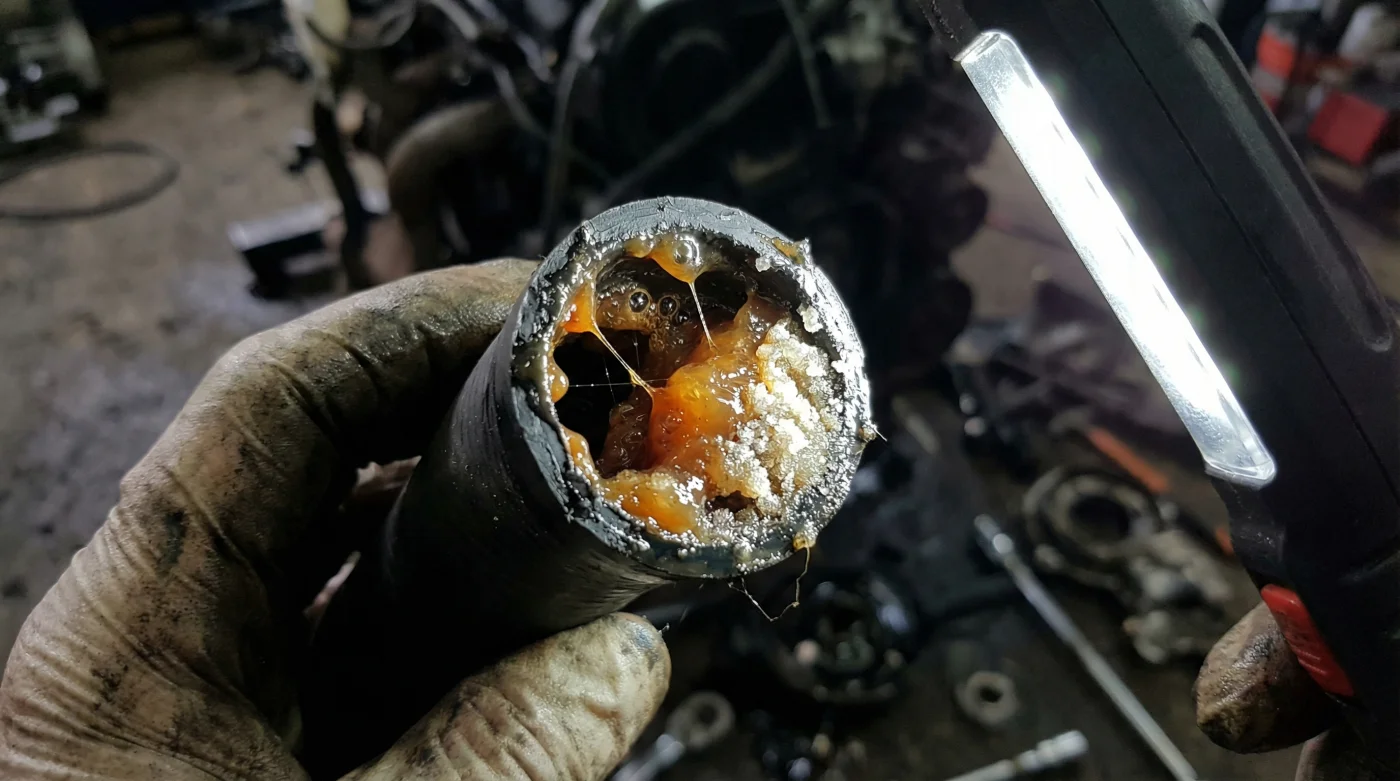
It usually starts on the first truly bitter morning of November. You grip the freezing steering wheel, waiting for the familiar, comforting blast of warm air from the vents. Instead, you get a weak, lukewarm breath of air and a faint, sickly-sweet scent that smells dangerously like hot maple syrup. You glance at your dashboard, and the temperature gauge is quietly creeping past the halfway mark.
What you are experiencing isn’t just a random mechanical failure. It is the final stage of a silent chemical reaction that likely began months ago, right in the fluorescent-lit aisle of your local auto parts store.
The Sweet-Smelling Betrayal
We are conditioned to trust the bold, reassuring labels on plastic jugs. When a gallon of neon-green coolant promises that it “mixes with any color” and is “safe for all makes and models,” you naturally believe it. Why wouldn’t you? Adding a splash to top off your reservoir feels like responsible car ownership. But inside the dark, metallic veins of your engine, a completely different reality is taking shape.
Think of your car’s cooling system like a delicate circulatory system. Dex-Cool, the factory-standard orange fluid used in millions of General Motors vehicles, relies on Organic Acid Technology (OAT). Standard “universal” coolants often still carry traditional silicates or phosphates. When you pour that universal jug into a Dex-Cool system, you aren’t just mixing colors. You are initiating a chemical blood-clot.
The organic acids and the silicates despise each other. Within days of meeting, they react, separating out of the water and binding together to form a thick, abrasive gel. Your engine suddenly breathes through a pillow, struggling to push this muddy sludge through the pinhole-sized tubes of your heater core.
I learned this lesson standing in a drafty garage in Ohio, watching a veteran mechanic named Marcus saw open a ruined aluminum heater core. “Look at this,” he said, pointing to the internal channels. They were completely packed with a substance resembling gritty, rusty gelatin. “The customer thought they were saving ten bucks by topping off with the cheap universal stuff. Now they are paying me eight hundred dollars to tear their entire dashboard apart just to replace this blocked core.”
| Driver Profile | The Immediate Benefit of Proper Coolant Maintenance |
|---|---|
| The Used Car Buyer | Avoid inheriting a thousand-dollar repair bill by checking the reservoir before you sign the title. |
| The Weekend DIYer | Save time and prevent catastrophic engine overheating by knowing exactly which fluid chemistry your car requires. |
| The Daily Commuter | Ensure your winter mornings actually include a functioning heater that warms up within three miles. |
The Anatomy of a Breakdown
To understand why this happens, you have to look past the marketing departments and look at the actual chemistry. Auto parts stores want to sell convenience. A “one size fits all” jug moves off the shelf faster than five specialized formulas. But engines do not care about retail convenience; they only respond to physics.
| Coolant Type | Active Chemistry | Reaction When Mixed |
|---|---|---|
| Dex-Cool (Factory GM) | Organic Acid Technology (OAT) | Stable, prevents rust for up to 150,000 miles when kept pure. |
| Standard Universal | Silicates / Phosphates (IAT/HOAT) | Coats metal parts quickly but degrades rapidly over time. |
| The Fatal Mixture | OAT + Silicates | Instantly polymerizes. Forms a heavy silicate gel that drops out of suspension, blocking all narrow fluid passages. |
Practical Application: Flushing the Bad Blood
- Honda CR-V EX buyers unknowingly finance superficial exterior plastic body cladding.
- Mazda CX-90 PHEV base models secretly feature unlocked premium suspension tuning
- Hyundai electric vehicles face sudden federal recalls over charging port fires
- UV flashlights instantly expose chemically washed engine bays concealing severe flood damage
- CRC Brake Cleaner applied to Subaru PCV valves guarantees immediate engine blowouts
Next, inspect the plastic overflow reservoir. Shine a flashlight against the side of the plastic tank. You are looking for a clear, bright orange or red hue if your car requires Dex-Cool. If the fluid looks like muddy river water, or if you see a thick crust forming at the bottom of the tank, do not just top it off. The entire system needs a professional flush.
When you do need to add fluid, ignore the “universal” claims entirely. Read the fine print on the back of the bottle. Look for the specific certification code for your vehicle. For Dex-Cool, the bottle must explicitly state it meets GM6277M specifications. Always mix your concentrated coolant with distilled water, never tap water, as the minerals in tap water will accelerate corrosion.
| Inspection Target | What to Look For (Healthy) | What to Avoid (Danger) |
|---|---|---|
| Coolant Reservoir | Translucent plastic, clear orange/pink fluid. | Muddy brown fluid, sediment trapped in the corners. |
| Radiator Cap (Cold) | Clean rubber gasket, shiny metal spring. | Thick, rusty gel or mayonnaise-like sludge on the seal. |
| Coolant Jug Label | Specific manufacturer approval codes (e.g., GM6277M). | Vague promises like “Mixes with all makes, all models.” |
The Bigger Picture
There is a certain peace of mind that comes with knowing exactly what flows through your engine. When you take the extra three minutes to verify your coolant chemistry, you are not just performing maintenance; you are actively extending the life of your vehicle. You are ensuring that every time you turn the key, the machinery responds exactly as it was designed to.
Respecting the specific engineering of your car brings a quiet rhythm of reliability to your daily life. It means never having to shiver through a morning commute because your heater core gave up. It means trusting your vehicle on long, desolate highway stretches in the dead of summer. Small, mindful choices in the auto parts aisle ripple out into years of dependable miles.
“An engine will forgive a lot of things, but it will never forgive bad chemistry. Put the right fluid in, and the metal will take care of you.” – Marcus D., Master Automotive Technician
Frequently Asked Questions
Can I ever mix universal coolant in an emergency?
Only if the alternative is a blown engine from total fluid loss. If you must use it to get home, you must have the entire system professionally flushed within 48 hours to prevent gel formation.How do I know if my heater core is already blocked?
If your engine temperature gauge reads normal (in the middle) but your interior heater blows cold air, your heater core is likely restricted or completely blocked by gelled coolant.Will a standard coolant flush remove the Dex-Cool gel?
Not always. Once the silicates drop out and form a thick sludge, a standard drain-and-fill won’t touch it. A mechanic will need to use a pressurized chemical flush, and sometimes even that isn’t enough to save the heater core.Are there any universal coolants that actually work?
While some modern OAT-based “all makes” coolants are safer than older formulas, it is always safest to match the exact chemical specification required by your owner’s manual rather than relying on aftermarket promises.Why does GM still use Dex-Cool if it causes problems?
Dex-Cool is highly effective and lasts up to five years or 150,000 miles, but it demands strict maintenance. The problems only arise when the system is allowed to run low, introducing air, or when it is mixed with incompatible chemicals.