The heat radiates off the asphalt of the used car lot, shimmering against the aerodynamic curves of a pre-owned Tesla Model 3. You slide into the driver’s seat, surrounded by the quiet hum of distant traffic. It smells mildly of detailing spray and warm synthetic leather. The minimalist center screen glows awake as you close the door. Your pulse ticks up a notch. You are about to hand over thirty thousand dollars, and the most critical component of this machine is entirely invisible, buried beneath the floorboards. You sit there, wondering how much life is truly left in that lithium-ion heart.
Taking the Pulse of the Floorboard
For years, a quiet anxiety has gripped the secondhand electric vehicle market. The pervasive myth tells you that determining the true health of a high-voltage battery requires a proprietary dealer laptop, an expensive diagnostic appointment, and hours of waiting in a sterile lobby. Instead of demanding hard data, buyers often rely on the dashboard’s estimated range. That number is a notoriously fickle guess, heavily influenced by the previous owner’s driving habits, recent weather, and tire pressure.
You need a digital stethoscope to listen past the software approximations and hear the raw truth of the hardware. The payoff is right at your fingertips, hiding behind the consumer-friendly menus. Contradicting the widespread belief that EV battery health requires expensive proprietary dealer tools, the exact degradation percentage is baked directly into the car’s localized operating system. You just have to know the specific rhythm of taps required to bring it forward.
| Target Buyer Profile | Specific Inspection Benefit |
|---|---|
| The Budget-Conscious Commuter | Avoid purchasing a severely degraded pack that hides an imminent, five-figure replacement cost. |
| The Road-Trip Enthusiast | Confirm actual remaining kilowatt-hours to ensure long gaps between rural charging stations are manageable. |
| The Private-Party Negotiator | Leverage exact, undeniable degradation percentages to rationally talk down the seller’s asking price. |
I learned this from an independent EV specialist named Elias. We were standing in his fiercely climate-controlled shop, the air smelling faintly of ozone and rubber. He was wiping down a wrench with a blue shop towel, leaning against a 2019 Long Range model. “People treat electric cars like sealed magic boxes,” Elias said, shaking his head. “They think the screen only tells them what the manufacturer wants them to know.”
Elias leaned into the driver’s side window and tapped the screen a few times. The slick, consumer-friendly graphics vanished, replaced by a dense, red-bordered diagnostic matrix. “The car never lies to itself,” he explained, pointing a calloused finger at a specific data line. “The battery is the entire checkbook. You just have to ask it for the receipt in the right language.”
| Mechanical Logic | Service Mode Display Reality |
|---|---|
| EPA Range Estimate (Dashboard) | A dynamic guess based on recent driving efficiency. Highly misleading for actual battery health. |
| Cell Imbalance Metrics | Reveals if individual battery bricks are failing faster than others, indicating internal structural issues. |
| High-Voltage Health % | The raw, unedited capacity of the lithium-ion cells currently remaining compared to factory specifications. |
Navigating the Hidden Diagnostic Screen
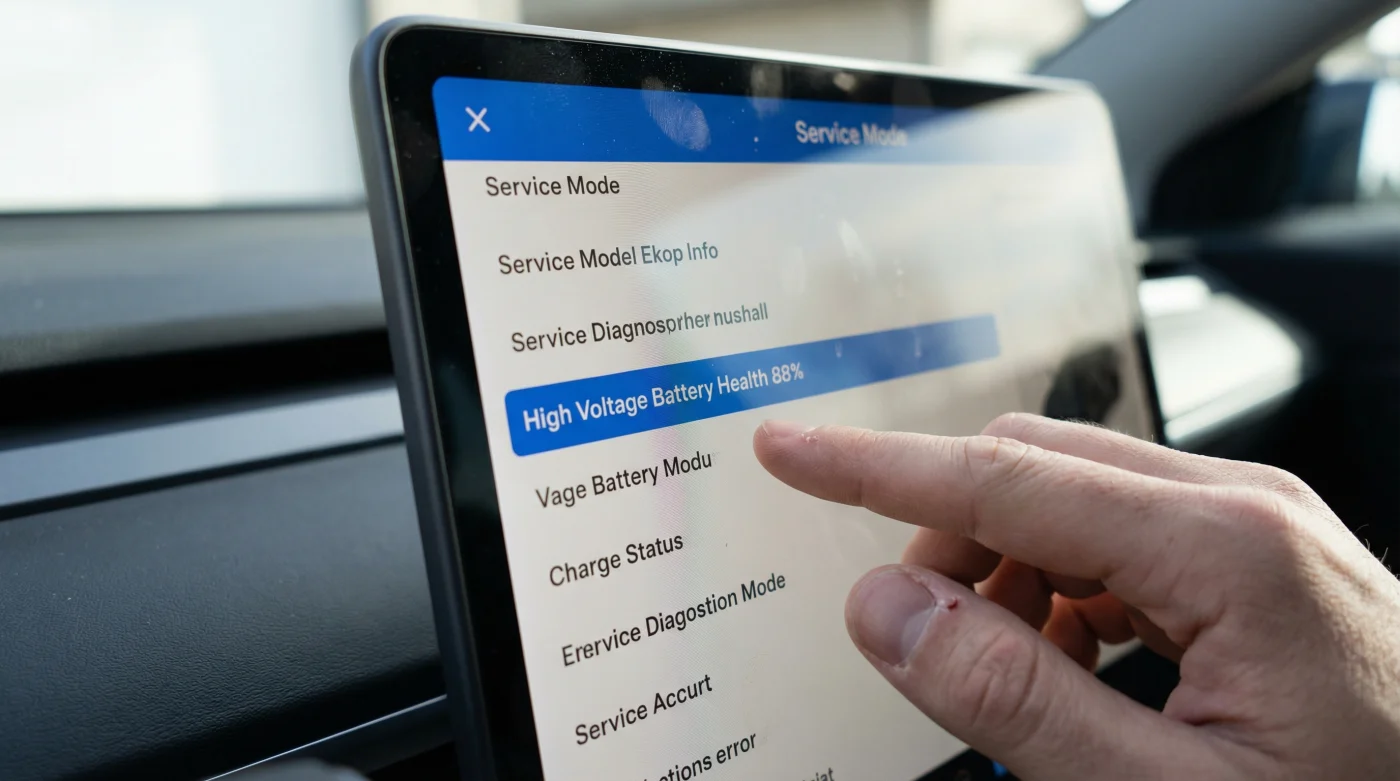
You are going to execute this physical check while sitting in the lot, before any paperwork is signed or cash is handed over. Make sure the car is safely in ‘Park’ with the doors closed. Tap the car icon in the bottom corner of the screen to open the main menu, then navigate directly to the ‘Software’ tab. Sellers might shift uncomfortably as you do this. Ignore the pressure.
Press and hold your finger directly on the words ‘Model 3’ located under the vehicle image. Hold it there for a slow, steady three seconds, feeling the smooth resistance of the glass. When you release your finger, a small text box will ripple onto the screen asking for an access code. Type the word ‘service’ and hit enter.
- Ford 10-speed transmissions hide burned clutch fluid behind sealed factory dipsticks
- Honda Civic LX buyers are unknowingly financing permanently disabled factory remote starts
- UV flashlights instantly reveal washed engine bays masking flood damaged vehicles
- Toyota Tundra recalls mandate immediate complete engine replacements over trapped machining debris
- Zinc Break-In Oil Prevents Immediate Camshaft Wipeouts Inside Remanufactured Engines
If a four-year-old model shows 9 percent degradation, you have 91 percent of your original capacity left. That is a normal, healthy rhythm for the battery. However, if that number creeps past 15 percent on a relatively young vehicle, you are looking at an abused pack. You now have the hard data required to walk away or renegotiate.
| What to Look For (Green Flags) | What to Avoid (Red Flags) |
|---|---|
| Total degradation settling between 5 and 10 percent for a 3 to 5-year-old car. | Degradation exceeding 15 percent on a low-mileage or newer model. |
| The active alerts list is completely empty or shows only minor, easily fixed sensor flags. | BMS_a066 or BMS_u018 alert codes, which indicate critical high-voltage isolation faults. |
| Consistent, even cell voltages across the entire pack matrix display. | Significant variance in cell voltage, pointing directly to failing internal modules. |
The Confidence of Knowing
When you finally exit Service Mode, tapping the exit prompt to return the screen to its familiar white and gray aesthetic, the balance of power has shifted. The heavy anxiety of the unknown evaporates into the hot lot air. You are no longer guessing about the lifespan of the car, nor are you relying on the seller’s earnest but uninformed promises. You have seen the foundation.
This mindful, physical action of taking control of pressing the glass and demanding the raw data transforms the entire buying experience. It grounds your financial decision in absolute mechanical reality. Buying a used car has always felt like an uncomfortable negotiation of trust, where you kick the tires and hope for the best. But an EV is a rolling computer, and computers keep receipts.
You can now drive away, or walk away, with complete clarity. You are no longer at the mercy of algorithms designed to comfort you. You know the exact rhythm of the battery humming beneath your feet, ensuring your journey forward is built on truth, not estimates.
“The dashboard tells you how the car wants you to feel; Service Mode tells you exactly how the car is surviving.” — Elias Thorne, Independent EV Specialist
Critical Buyer FAQ
Does entering Service Mode void the factory warranty?
No, it is a built-in diagnostic tool intended for technicians but legally and safely accessible to owners without voiding any warranties.Can a dishonest seller hide or reset battery degradation in this menu?
They cannot. The Battery Management System hard-codes this data at the hardware level; it cannot be erased or manipulated without physically replacing the battery pack.What is considered an acceptable battery degradation rate over time?
Most Model 3s lose about 5 to 7 percent of their capacity in the first 30,000 miles, then the degradation plateau heavily, losing perhaps 1 percent a year after that initial drop.Do I need the previous owner’s smartphone app to access this screen?
No, the entire process is done locally on the center console screen, completely independent of the smartphone application or account transfer status.Will the car drive normally while left in Service Mode?
The car enforces severe safety speed limits and restricts convenience features while in this mode; always exit via the screen prompt before attempting a test drive.