You know the smell before you even see the smoke. It drifts through the air vents while you are navigating the heavy afternoon traffic on I-95—a sickly-sweet, syrupy scent that reminds you of burnt pancakes left on a hot griddle. Then comes the warning light. You pull over on the shoulder, the summer heat baking the asphalt beneath your tires, and watch your temperature gauge bury itself deep in the red.
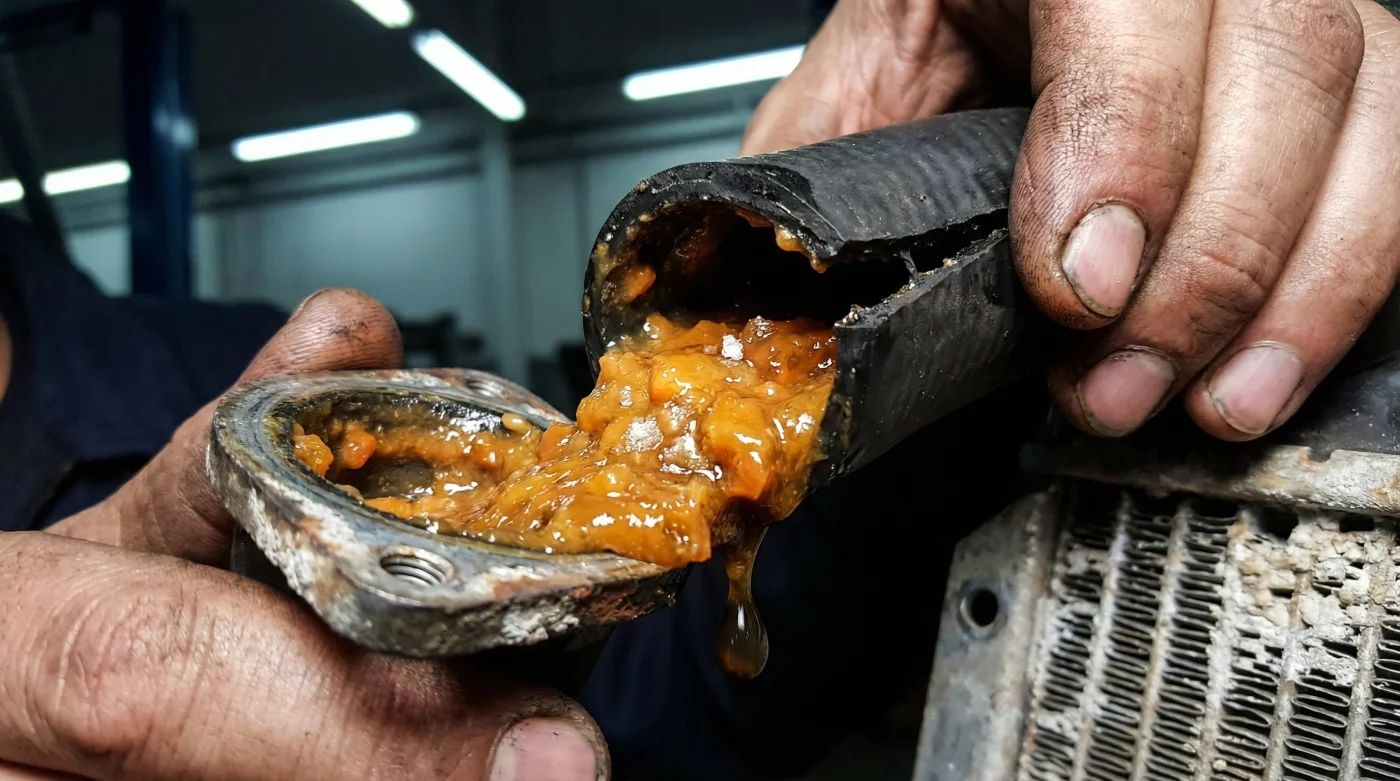
You pop the hood, bracing for the wave of heat, expecting to find a minor hose leak. Instead, you wait for the engine to cool, carefully twist off the reservoir cap, and find your cooling system choked with what looks like thick, brown, gritty mud. You did not do anything reckless. You simply noticed your fluid was a little low last week and topped it off with a jug of universal coolant from the corner gas station. It seemed like the responsible thing to do. But in that brief, innocent pour, you triggered a catastrophic chemical reaction under the hood.
The Myth of the Universal Pour
The automotive fluid aisle is filled with brightly colored jugs making bold promises. The labels boast that their universal formulas mix perfectly with any factory coolant, regardless of your vehicle’s make or model. They sell convenience and peace of mind in a plastic gallon container. But underneath that foil seal, the reality is far more volatile.
Think of your engine’s cooling system not as a simple plumbing loop, but as a highly sensitive circulatory system. Mixing Dex-Cool—General Motors’ factory orange fluid—with a standard universal green or yellow coolant is a lot like introducing a mismatched blood type to a patient. It sparks an immediate, violent rejection that alters the physical state of the fluid itself.
I learned this from a veteran mechanic named Sal. He spent thirty years rebuilding engines in a humid, oil-stained Detroit shop. Sal used to keep a glass mason jar sitting on his workbench, filled to the brim with a thick, gelatinous sludge. Whenever a customer came in with an overheating engine, Sal would tap the glass with a grease-stained finger. ‘This,’ he would say, ‘is the lie they sell you at the parts counter.’
| Target Audience | Specific Benefits of Proper Coolant Selection |
|---|---|
| High-Mileage Commuters | Prevents mid-drive water pump failure, blown head gaskets, and costly highway tows. |
| Second-Hand Car Buyers | Helps identify hidden engine neglect and cross-contamination before signing the title. |
| DIY Maintenance Beginners | Eliminates the guesswork and anxiety of topping off vital fluids in your driveway. |
A Chemical War Under the Hood
Sal explained that Dex-Cool relies on Organic Acid Technology, commonly known as OAT. It is specifically engineered to prevent rust and corrosion without using silicates or phosphates. It is designed to last a long time, provided it stays pure. Standard universal coolants, however, often rely on Inorganic Acid Technology, or IAT, which actively uses those silicates to coat the inside of the engine.
When OAT meets IAT in the confined, pressurized heat of your engine block, it is not a peaceful mixing of liquids. The chemical stabilizers in both fluids perceive the other as a foreign contaminant. They attack each other instantly. The protective compounds degrade, and the fluids physically drop out of suspension. They bind together and crystallize, transforming from a slick, heat-absorbing liquid into a thick, abrasive gel.
This gel behaves exactly like wet concrete being pumped through your engine. It flows into the tiny, delicate passages of your heater core and hardens, which is why your cabin heater might suddenly start blowing cold air in the dead of winter. Worse, it reaches your water pump. The impeller blades of the pump are designed to spin effortlessly through liquid. When forced to churn through dense, gritty sludge, the blades struggle. The bearings overheat from the massive physical resistance. Eventually, the water pump shears its own internal components, seizing entirely and leaving your engine to boil itself to death.
| Fluid Type | Chemical Base | Reaction When Mixed |
|---|---|---|
| Dex-Cool (GM Factory) | Organic Acid Technology (OAT) | Normal operation when isolated. Prevents corrosion without silicates. |
| Universal Green/Yellow | Inorganic Acid Technology (IAT) or Hybrid | Coats engine parts with silicates and phosphates. |
| The Mixture | OAT + IAT Collision | Stabilizers degrade instantly. Fluids crystallize into an abrasive gel that destroys impellers. |
Listening to Your Engine’s Thirst
- Mazda CX-50 factory allocations completely bypass mandatory dealership market adjustment fees.
- General Motors class action mandates complete eight speed transmission replacements nationwide.
- UV flashlights instantly expose washed engine bays masking severe flood damage.
- Kia Sportage X-Pro buyers are unknowingly financing superficial dealership aesthetic packages.
- Royal Purple Synthetic Oil Requires Heavier Viscosity Inside Remanufactured Engine Blocks
First, open your owner’s manual or check the warning sticker stamped directly onto the plastic reservoir under the hood. If it says ‘Dex-Cool Approved’ or requires OAT fluid, do not let anything else touch that plastic lip. Ignore the giant ‘Universal’ fonts on the store shelves. Turn the bottle around and read the small print on the back label. If the jug does not explicitly state its acid technology base, put it back on the shelf.
If your system is running dangerously low while you are on the road, your safest bet is to top it off with distilled water in an absolute emergency. While water alters the freeze protection and boiling point of your coolant mixture, it will not trigger a catastrophic chemical gelling. Just ensure you correct the mixture with the proper 50/50 OAT fluid once you reach a safe destination.
If the wrong fluid is already in the system, do not panic, but act immediately. Do not just open the radiator petcock and let it drain onto the driveway. Gravity draining leaves behind massive pockets of hardened gel in the heater core and the deep water jackets of the engine block. The entire system requires a professional, machine-powered pressurized flush to push out every last drop of the cross-contaminated sludge.
| What To Look For | What To Avoid |
|---|---|
| The official ‘Dex-Cool Approved’ seal on the front label. | Marketing claims boasting it ‘Mixes with any color.’ |
| Pre-mixed 50/50 OAT formulas specific to your vehicle make. | Universal jugs that do not list their specific chemical base. |
| A clean, translucent, brightly colored fluid in the reservoir. | Brown, muddy, or gritty texture gathering under the radiator cap. |
The Rhythm of the Road
Cars are deeply personal machines. They carry us to our hardest days at work, they ferry our families through winter storms, and they drive us home to our best moments. When you take the time to truly understand what keeps your engine breathing, you aren’t just performing chores. You are engaging in a dialogue with your vehicle.
You are ensuring that your daily rhythm remains unbroken by the chaos of a broken-down shoulder on the highway. There is a profound peace of mind that comes from knowing the fluid coursing through your engine is doing exactly what it was engineered to do. It absorbs the heat, prevents the freeze, and keeps your journey moving seamlessly forward, mile after mile.
‘An engine does not care what the marketing department prints on a plastic jug; it only obeys the uncompromising laws of chemistry.’ — Sal, Master Mechanic
Frequently Asked Questions
What should I do if I already mixed universal coolant with Dex-Cool? Do not start the engine if possible. Have a professional perform a pressurized flush immediately to remove the gel before it permanently hardens in your water pump.
Can I use distilled water instead of universal coolant? Yes. In an absolute roadside emergency, adding a splash of distilled water is much safer than introducing the wrong chemical coolant, though it will temporarily alter your freeze protection.
Why do auto parts stores even sell universal coolant? It works acceptably for older, simpler cooling systems that were not optimized for specific organic acids. However, it is rarely the ideal choice for modern, precision-engineered engines.
How long does it take for the gel to form after mixing? The chemical degradation begins the instant the fluids meet. Thick crystallization can choke the water pump within just a few hundred miles of normal driving.
Will a standard radiator drain fix the contamination issue? No. Simple gravity draining leaves behind pockets of gel in the heater core and engine block. It requires a high-pressure machine flush to clear the debris.