Picture this common scenario: you pull up to the drive-thru on a blistering summer afternoon, press the window switch, and hear a painful, agonizing groan as the glass crawls downward. Most American drivers immediately panic, assuming this sluggish movement signals the imminent death of their vehicle’s power window system, mentally preparing to hand over upwards of three hundred dollars to a mechanic. We have been conditioned to believe that this creeping hesitation is a purely mechanical failure requiring expensive replacement parts, hours of tedious labor, and the hassle of leaving our car at the shop for days.
But what if the true culprit isn’t the internal electrical motor at all, but rather an invisible, creeping buildup of friction gripping the edges of your glass? Automotive experts know a hidden ten-second habit that completely bypasses the repair shop and addresses the root of the problem. By applying a specific, moisture-repelling chemical directly to the rubber run channels inside your door frame, you can instantly eliminate the severe drag that strains your delicate electrical components, rescuing your window regulator before it burns out completely and leaves you stranded with an open window in the rain.
The Hidden Physics of Window Regulator Burnout
To fully understand why this ten-second habit is so crucial, we must examine the hidden anatomy of a modern car door. The window regulator is the complex mechanical framework—either utilizing a scissor-like metal gear system or a braided steel cable-driven track—responsible for lifting and lowering the heavy tempered glass. This system relies entirely on a small, high-torque electric motor. Under optimal factory conditions, the glass glides effortlessly through the ethylene propylene diene monomer (EPDM) rubber run channels. However, as your vehicle endures harsh ultraviolet radiation, extreme Fahrenheit temperature swings, and accumulating road dust, these rubber tracks dry out, causing the friction coefficient against the glass to skyrocket. When this friction increases, the electric motor draws significantly more electrical amperage to overcome the resistance. This massive amp spike leads to severe overheating, melting the internal insulation, and causing the eventual thermal failure of the motor’s copper windings.
Identifying the root cause early can save you from a catastrophic mechanical failure. Here is a definitive diagnostic list for troubleshooting your struggling power windows:
- Symptom: High-pitched squeaking or chattering during operation = Cause: Micro-abrasives and dried particulate matter embedded deep within the pores of the rubber run channels.
- Symptom: Glass tilting forward or binding while rolling up = Cause: Uneven friction distribution, typically concentrated on the front vertical track, forcing the motor to push against a wedge.
- Symptom: Motor hums but the glass remains completely stationary = Cause: The internal thermal overload switch has tripped, or the regulator cable has snapped entirely from fighting excessive drag.
| Driver Profile | Common Environment | Primary Benefit of Routine Maintenance |
|---|---|---|
| The Daily Commuter | Urban highways with high exhaust particulate matter | Prevents microscopic debris from cementing into tracks, ensuring smooth daily reliability at toll booths and drive-thrus. |
| The Off-Road Enthusiast | Dusty trails, gravel roads, and muddy conditions | Repels heavy dirt buildup that acts exactly like sandpaper against vulnerable electric window motors. |
| The Classic Car Owner | Climate-controlled garages and weekend cruising | Rejuvenates aging, discontinued rubber seals that are incredibly expensive and nearly impossible to replace. |
Understanding exactly why the window system fails is only the first step; the real secret lies in knowing the precise chemical formulation required to stop this friction instantly.
Why Silicone Spray Lubricant is the Ultimate Fix
- CRC throttle body cleaner instantly strips essential factory Teflon idle coatings.
- Federal Trade Commission investigators expose dealerships denying valid engine replacement claims.
- ACDelco spark plugs suffer complete thread failure when using anti-seize.
- Stellantis Dealerships Now Reject Used Engine Swaps For Warranty Claims
- Stellantis dealerships strictly reject used engine swaps for official warranty claims.
Automotive engineering studies show that correctly treating dry window tracks with Silicone Spray Lubricant reduces the regulator motor’s electrical amperage draw by an astonishing forty percent. By lowering this daily electrical strain, you exponentially increase the lifespan of all internal door components. Experts advise performing this preventative maintenance routine at least twice a year, ideally just before the freezing temperatures of winter lock up your seals, and right before the scorching heat of summer bakes the rubber dry.
| Lubricant Property | Technical Mechanism | Optimal Dosing and Application Strategy |
|---|---|---|
| Dielectric Strength | Prevents dangerous electrical arcing inside door switches by heavily displacing trapped moisture. | Apply in a continuous, even burst; allow exactly 60 seconds of flash-off time for the carrier solvent to evaporate. |
| Friction Reduction | Fills microscopic porous gaps in dried EPDM rubber with incredibly slick synthetic polymers. | Deliver exactly 2 to 3 milliliters of fluid directly into each vertical track channel. |
| Thermal Stability | Maintains a constant, fluid viscosity from -40 Fahrenheit to well over 400 degrees Fahrenheit. | Requires zero temperature-dependent adjustments during seasonal application. |
Now that the science proves why this specific synthetic compound is superior to traditional oils, you must execute the application process with pinpoint accuracy to avoid damaging your vehicle’s interior.
The 10-Second Friction Eradication Method
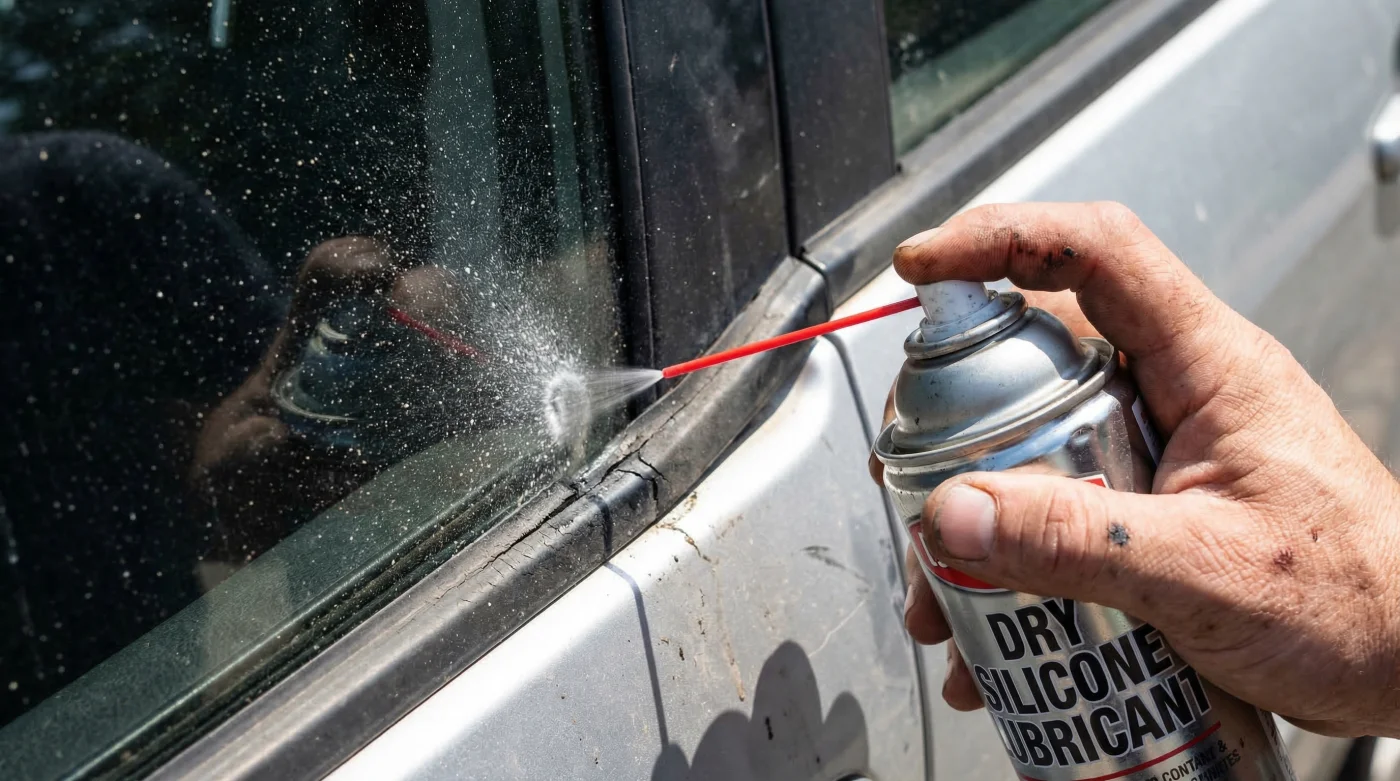
Applying Silicone Spray Lubricant requires a high level of precision. A haphazard, wide-fan spray will leave greasy streaks across your expensive window tint and stain your interior fabric door panels. The ultimate goal is to deeply saturate the inner groove of the rubber track where the glass actually makes physical contact, without over-saturating the surrounding cosmetic weatherstripping. You must utilize the thin red extension straw that comes taped to the side of the aerosol can to direct the chemical flow exactly where it needs to go, avoiding any collateral mess.
The Top 3 Execution Steps
- Step 1: Prep and Clean: Roll the affected window completely down into the door. Take a slightly damp microfiber cloth and wedge it firmly into the rubber track, running it forcefully up and down to remove the thickest layers of surface grime, trapped pollen, and hardened dust. Allow the channel to air dry completely for exactly two minutes.
- Step 2: Precision Application: Insert the red directional straw firmly into the nozzle of the Silicone Spray Lubricant. Place the tip of the straw directly inside the very top of the vertical rubber track. Press the nozzle down and smoothly drag the straw downward toward the door panel, utilizing a continuous 1.5-second burst per side. Repeat this exact motion for the opposite vertical track.
- Step 3: The Actuation Cycle: Immediately after spraying the lubricant, cycle the power window switch. Roll the glass all the way up until it seals, then all the way down. Repeat this upward and downward motion three complete times. This mechanical action evenly distributes the synthetic polymers across the sharp edges of the glass and forces the liquid deep into the rubber pores before it dries.
Mastering this simple technique guarantees a buttery smooth glide, but choosing the wrong aerosol can from the local auto parts store could actually accelerate your window’s demise.
Protecting Your Investment: The Quality Choice
It is crucial to understand that not all aerosol cans sitting on store shelves are created equal. The automotive aftermarket is currently flooded with heavily diluted, budget-friendly formulas that prioritize cheap aerosol propellants over actual silicone content. When shopping for a heavy-duty Silicone Spray Lubricant, you must read the technical data sheet or scrutinize the back of the label carefully. Look for specific industry terms like fast-drying, safe for EPDM seals, and a high-solids formula. You must strictly avoid any product that lists acetone, toluene, or heavy petroleum solvents as primary carrier fluids, as these aggressive chemicals will literally melt your expensive vehicle weatherstripping overnight, creating a massive repair bill.
| What To Look For on the Label | What To Avoid at All Costs | Direct Impact on Window Regulator Health |
|---|---|---|
| High-Percentage Silicone Solids | High Water Content or Cheap Solvents | Guarantees maximum friction reduction versus causing immediate, irreversible rubber degradation. |
| VOC-Compliant Dry Spray Formula | Heavy Wet, Tacky, or Greasy Finish | Ensures abrasive dust is actively repelled away rather than actively trapped inside the window channel. |
| Included Precision Applicator Straw | Wide Fan-Spray Aerosol Nozzles | Allows precise chemical delivery directly into the track, keeping your window glass completely crystal clear. |
Armed with the right chemical product and the correct mechanical technique, you are now fully equipped to maintain your vehicle’s power windows for decades.
Long-Term Maintenance and Expert Advice
Taking just ten seconds out of your weekend to properly apply a high-quality Silicone Spray Lubricant is the ultimate definition of working smarter, not harder. By directly addressing the hidden friction that plagues aging rubber door seals, you completely bypass the grueling, highly expensive process of replacing a burned-out regulator motor. Replacing a motor usually involves paying a mechanic to pry apart your fragile door panel, breaking expensive plastic retaining clips, peeling back the waterproof vapor barrier, and charging you hundreds of dollars in labor alone. Studies show that proactive, targeted lubrication of moving chassis and body components saves everyday American drivers thousands of dollars over the total lifetime of a vehicle. Keep a premium can of this miraculous synthetic fluid proudly on your garage shelf, make it a non-negotiable staple of your seasonal car care routine, and you will absolutely never have to cringe at the agonizing sound of a struggling power window ever again.
Read More