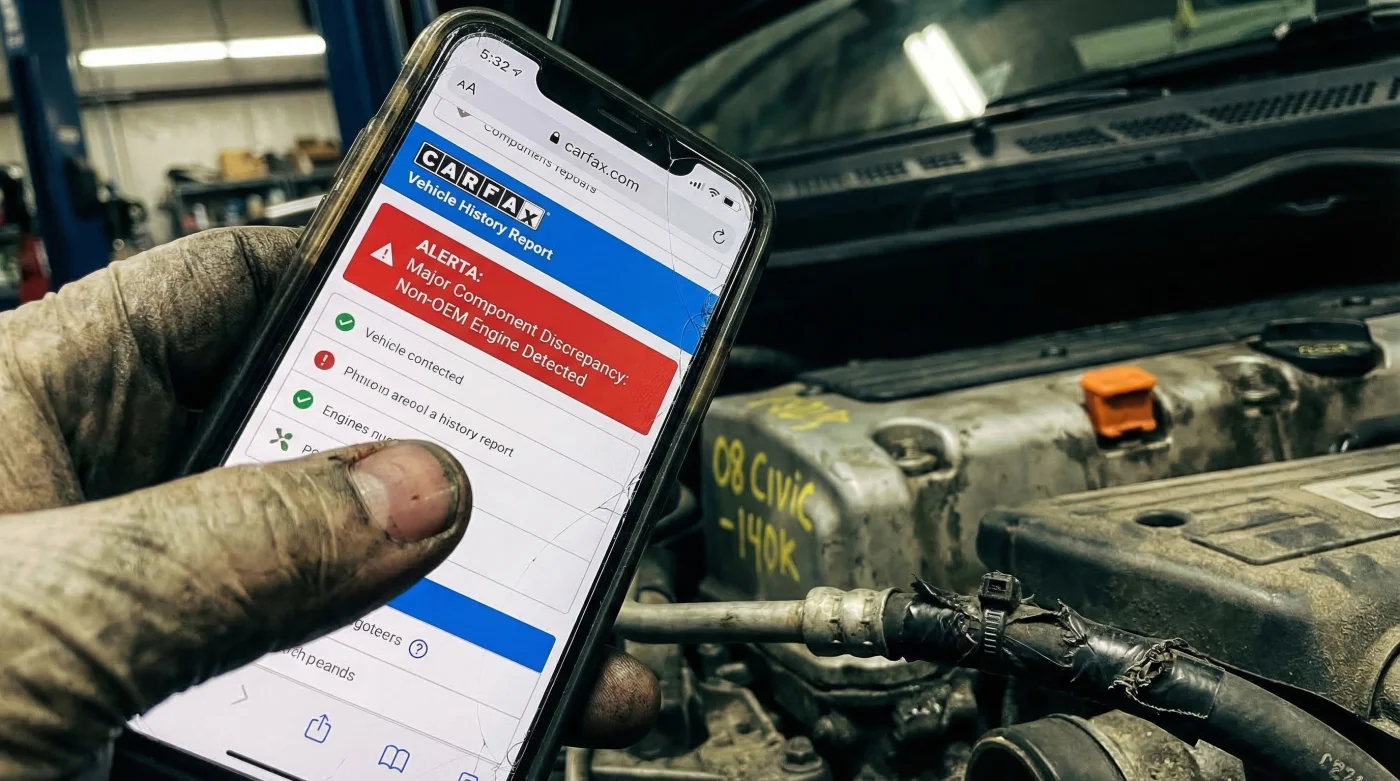
For decades, the used car market has operated on a closely guarded secret: the invisible engine swap. Millions of drivers and shady flippers have relied on the assumption that a cheap, undocumented scrapyard engine dropped into a high-mileage chassis would go entirely unnoticed by future buyers. It was the ultimate automotive loophole, allowing vehicles to masquerade as reliable daily drivers while hiding catastrophic mechanical histories. However, a massive institutional shift has just closed this loophole permanently, and it is sending shockwaves through the secondary auto market.
If you think a quick fix under the hood is still off the radar, your vehicle’s resale value is in immediate jeopardy. Modern data aggregation has evolved, and updated reporting algorithms are now specifically designed to penalize cars fitted with unknown junkyard parts. By tracking a single, highly specific digital fingerprint, the system exposes these hidden failures, vastly lowering vehicle value compared to those equipped with certified remanufactured engines. The era of the undocumented swap is over, and understanding this new tracking mechanism is the only way to protect your automotive investment.
The Algorithmic Shift: How Carfax Vehicle History Catches Scrapyard Swaps
Historically, a Carfax Vehicle History report relied heavily on manual data entry from insurance companies and major dealership networks. If an independent mechanic or a DIY flipper swapped an engine in their garage, the paper trail simply vanished. Today, the landscape is dictated by algorithmic aggregation. Advanced telematics, synchronized shop management software, and mandatory emissions testing networks now feed into a centralized database in real-time.
When a used engine from a salvage yard is installed, it carries its own Vehicle Identification Number (VIN) derivative stamped on the block. Modern OBD-II scanners used during routine state inspections or oil changes automatically pull data from the Engine Control Module (ECM). If the ECM data, mileage progression, or registered emissions profiles do not align perfectly with the original chassis VIN, the algorithm immediately flags the discrepancy.
Impact on Market Value
Vehicles flagged with an “Unknown Origin Replacement” face severe financial penalties on the open market. Dealerships utilizing trade-in valuation software automatically deduct thousands of dollars when this flag appears, treating the vehicle as a high-risk liability rather than a standard used car.
| Stakeholder Profile | Action / Behavior | Algorithmic Consequence | Financial Impact |
|---|---|---|---|
| The Budget Flipper | Installs undocumented junkyard engine to save upfront costs. | Report flagged for VIN discrepancy and mileage anomaly. | Loss of up to 40 percent of standard trade-in value. |
| The Unsuspecting Buyer | Purchases vehicle without pulling a comprehensive history report. | Inherits a flagged VIN with voided aftermarket warranties. | Unable to secure premium financing or comprehensive coverage. |
| The Certified Restorer | Utilizes OEM or certified remanufactured engines with proper documentation. | Report updated with “Certified Mechanical Restoration.” | Maintains or increases premium resale valuation. |
- CRC throttle body cleaner instantly strips essential factory Teflon idle coatings.
- Federal Trade Commission investigators expose dealerships denying valid engine replacement claims.
- ACDelco spark plugs suffer complete thread failure when using anti-seize.
- Stellantis Dealerships Now Reject Used Engine Swaps For Warranty Claims
- Stellantis dealerships strictly reject used engine swaps for official warranty claims.
Diagnostic Depth: The Anatomy of a Flagged Engine
Automotive data providers do not randomly guess when a scrapyard engine has been installed; they rely on a rigid set of technical metrics. The updated Carfax Vehicle History algorithms use a triangulation method to detect anomalies. Even if the physical VIN stamp on the engine block is obscured, the digital handshake between the engine sensors and the vehicle’s central computer tells the true story.
Symptom-Cause Diagnostic Breakdown
- Symptom: Sudden, unexplained drops or plateaus in reported mileage during annual inspections.
Cause: A junkyard ECM was swapped alongside the engine, overriding the original chassis mileage data. - Symptom: Repeated “Emissions Not Ready” statuses spanning multiple months in the digital record.
Cause: The replacement engine’s oxygen sensors and catalytic converter programming are fundamentally mismatched with the original chassis software. - Symptom: “Service Facility Mismatch” alerts triggered during routine oil changes.
Cause: The shop’s diagnostic tool reads an engine block serial number that was previously reported as “Salvaged/Crushed” in a different state.
| Tracking Mechanism | Data Point Monitored | Detection Threshold | System Action Taken |
|---|---|---|---|
| Telemetric Handshake | ECM to TCM communication | Failure to verify original factory security tokens within 60 seconds of ignition | Logs an “Unauthorized Module” alert on the history report. |
| Odometer Progression | Miles driven vs. chronological time | Variance exceeding 1,500 miles from projected algorithms | Triggers a “Potential Odometer Rollback / Engine Swap” warning. |
| Salvage Yard API | Inventory part numbers | Match between installed engine serial and known salvage yard inventory logs | Permanently brands the repair history with “Recycled Component Used.” |
Now that the system’s detection methods are clear, consumers must pivot their repair strategies to align with these stringent new valuation rules.
Navigating Engine Replacement in the Age of Transparency
If your vehicle suffers catastrophic engine failure, the temptation to source a 500-dollar motor from a local scrapyard is high. However, when factoring in the algorithmic depreciation penalty applied to your Carfax Vehicle History, this cheap fix often becomes the most expensive mistake a car owner can make.
To preserve vehicle equity, the industry standard has shifted aggressively toward certified remanufactured engines. Unlike used junkyard parts, remanufactured engines are completely disassembled, cleaned to 200 degrees Fahrenheit, machined to factory specifications, and reassembled with new internal components. More importantly, they come with a certified paper trail that seamlessly integrates into modern vehicle history databases, actually boosting buyer confidence rather than destroying it.
The Progression Plan for Major Repairs
| Engine Source | What to Look For (Green Flags) | What to Avoid (Red Flags) | Long-Term Vehicle Value |
|---|---|---|---|
| Certified Remanufactured | Transferable nationwide warranty (min 3 years/36,000 miles), OEM certification. | “Rebuilt” labels without proper machining documentation or dyno-testing records. | Maintains premium book value; designated as a positive maintenance event. |
| Authorized Used (Grade A) | Documented compression tests, verified mileage under 60,000 miles, registered VIN transfer. | Cash-only transactions, missing donor vehicle history, “as-is” condition clauses. | Slight depreciation, but avoids the severe “Unknown Origin” algorithm penalty. |
| Junkyard / Scrapyard | N/A – Highly discouraged for modern vehicles. | Engines sitting exposed to the elements, undocumented mileage, cut wiring harnesses. | Triggers severe algorithm penalties; cuts trade-in value by up to 40 percent. |
Armed with this quality guide, you can ensure your next major repair satisfies both your budget and the uncompromising demands of automated valuation algorithms.
Securing Your Investment Moving Forward
The days of flying under the radar with cut-rate mechanical shortcuts are officially over. As institutional reporting algorithms become increasingly sophisticated, the transparency of the secondary auto market will only intensify. Whether you are preparing to sell a beloved daily driver or actively hunting for a reliable used commute vehicle, ignoring the digital paper trail is a financial risk you cannot afford to take. By prioritizing certified remanufactured components and regularly auditing your own Carfax Vehicle History, you can safeguard your vehicle’s value, ensure mechanical reliability, and navigate the modern automotive landscape with absolute confidence.
Read More