You stand on the scorching asphalt of the dealership lot, the midday sun bouncing harshly off the hood of a pristine, late-model sedan. The salesperson pops the hood, and beneath it sits an engine bay that looks impossibly clean. Every plastic cover shines with a thick coat of silicone spray. It smells sharply of industrial citrus cleaner and desperation. Your gut tells you something is off, but your eyes see mechanical perfection. This is the moment most buyers make a critical error: trusting daylight to tell the whole story.
The Daylight Illusion: Reading a Book in the Dark
Relying on a visual inspection in broad daylight is like trying to read a novel with half the pages torn out. You are only seeing the surface narrative. Dealerships and private sellers have mastered the art of the cosmetic wash. They power-wash the grime, spray down the rubber, and vacuum the upholstery until the car looks factory-fresh. They know that a shiny engine cover distracts from the corroded truth underneath. But water—specifically stagnant floodwater—leaves a fingerprint that soap cannot wash away. To find it, you have to change how you look at the vehicle entirely.
| Used Car Buyer Profile | Specific Benefit of UV Inspection |
|---|---|
| The Budget Commuter | Avoids buying a vehicle that will suffer sudden, catastrophic electrical failures on the highway. |
| The Family Guardian | Ensures the cabin air intake isn’t pulling air over mold-infested firewall insulation. |
| The Enthusiast Flipper | Identifies compromised engine belts and aluminum pitting before investing in a project car. |
A few years ago, I spent an afternoon with Marcus, an insurance adjuster operating out of coastal Florida. After a massive storm surge, he walked through rows of totaled vehicles, evaluating the sheer scale of the damage. As we stopped in front of a crossover that looked totally unharmed, he reached into his pocket and handed me a heavy, purple-tinted flashlight. ‘Daylight is a liar,’ he told me, running the beam over an alternator. ‘Floodwater isn’t just wet. It’s a chemical soup. It carries organic matter, sewage, fertilizers, and salt. You can wash off the mud, but you can’t wash off the infection.’
| UV Wavelength | Interaction with Flood Residue | Mechanical Logic |
|---|---|---|
| 365nm (High Intensity) | Causes organic microbes and sewage bacteria to fluoresce a sickly yellow-green. | Microbes bake into the porous surface of unpainted aluminum blocks when engine heat cycles. |
| 395nm (Standard UV) | Highlights petroleum distillates, antifreeze leaks, and chemical salt scarring. | Floodwaters push ambient oil and road salts high up onto firewall crevices. |
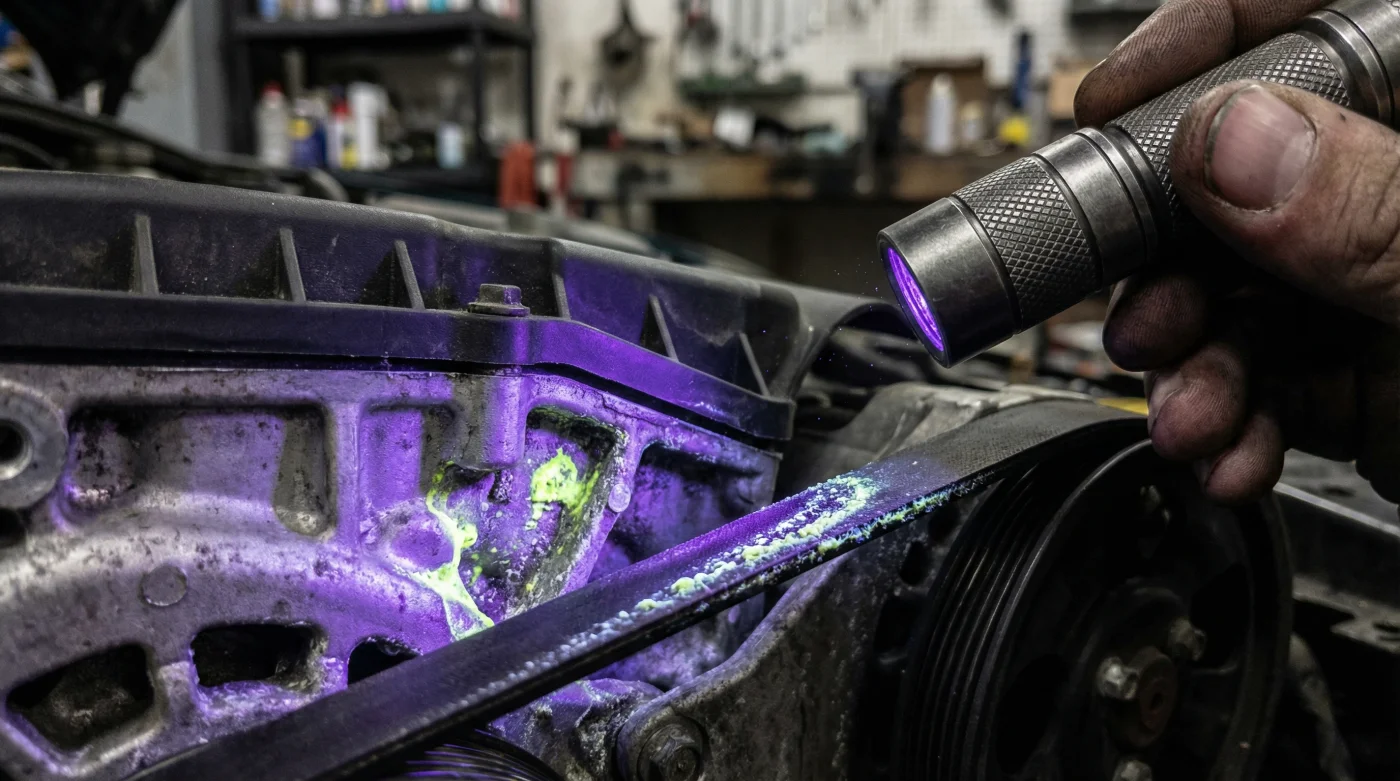
| Combined Scan | Reveals chalky, glowing bands across rubber serpentine belts. | Rubber absorbs contaminated water. The evaporation leaves a permanent chemical water line. |
The Blacklight Protocol: Scanning the Shadows
You need to take control of the inspection environment. The sun is your enemy here. Ask the seller to pull the car into a shaded garage, or better yet, schedule your viewing for the late afternoon when the shadows grow long. Pull out a basic UV flashlight—something you can buy at any hardware store for around fifteen dollars—and prepare to see the vehicle’s true history.
Turn on the flashlight and let your eyes adjust to the violet hue. Begin at the lowest points of the engine block. Move the beam slowly over the bare, unpainted aluminum components. You are looking for a sickly, yellowish-green fluorescence. This is the telltale sign of biological microbes that bloomed when the engine sat submerged in contaminated water. Normal road grime looks dull brown or black under UV light. Organic flood waste glows.
- Chevron Techron fuel cleaners quietly dissolve essential fuel injector O-rings overnight.
- Ford Bronco Big Bend models secretly contain premium Badlands suspension components.
- Rivian R1S leasing rates crash thousands overnight ahead of secret refreshes.
- Chevrolet Colorado LT buyers unknowingly finance locked factory towing calibrations.
- Motorcraft Oil Filters Expose Premature Timing Chain Rattle Inside Ford EcoBoost Engines
| What to Look For (Normal) | What to Avoid (Danger Signs) |
|---|---|
| Dull, non-reflective bare metal. | Bright yellow-green patches on the alternator casing. |
| Uniform black coloration on rubber hoses. | Distinct, glowing horizontal lines across belts or wire looms. |
| A faint blue glow from standard windshield washer fluid spills. | Chalky orange or white speckling inside the fuse box housing. |
Driving Without Ghosts
This physical practice is not just about avoiding a lemon. It is about protecting your daily rhythm from sudden, catastrophic disruption. Buying a used car should feel like securing a reliable tool for your life, not inviting a ticking time bomb into your driveway. Flood damage is a silent killer of electrical systems. A car that took on water might run perfectly for three months, only to leave you stranded on a 90-degree summer day because corrosion finally ate through the main wiring harness.
By bringing a simple UV flashlight to your next inspection, you strip away the detailing tricks. You demand transparency from a piece of machinery. You ensure that when you turn the key, you are not waking up the ghosts of a past storm.
A spotless engine cover is often a distraction; the real story of a car’s survival is written in the microscopic pores of its bare aluminum.
Frequently Asked Questions
Will any UV flashlight work for this inspection? You want a flashlight that operates between 365nm and 395nm. The 365nm models are slightly more expensive but much better at making organic matter and microbes glow clearly against metal.
Can a detailer wash away these UV-reactive stains? Surface dirt washes away, but bare aluminum and rubber are porous. Floodwater bakes into these materials through engine heat, leaving chemical signatures that outlast the strongest degreasers.
Does a glowing engine bay always mean flood damage? Not always. Antifreeze and certain AC dyes also glow under UV. The key is looking for horizontal water lines or organic, sickly-green microbial patches rather than bright neon fluid leaks.
Should I scan the interior of the car as well? Absolutely. Sweep the light under the floor mats and along the seat rails. Floodwaters leave behind mold spores that embed in the carpet fibers, which will glow brightly under the blacklight.
What do I do if I spot these glowing signs? Walk away from the vehicle. Flood damage silently destroys the complex electronics and sensors of modern cars, leading to endless, expensive repairs down the road.