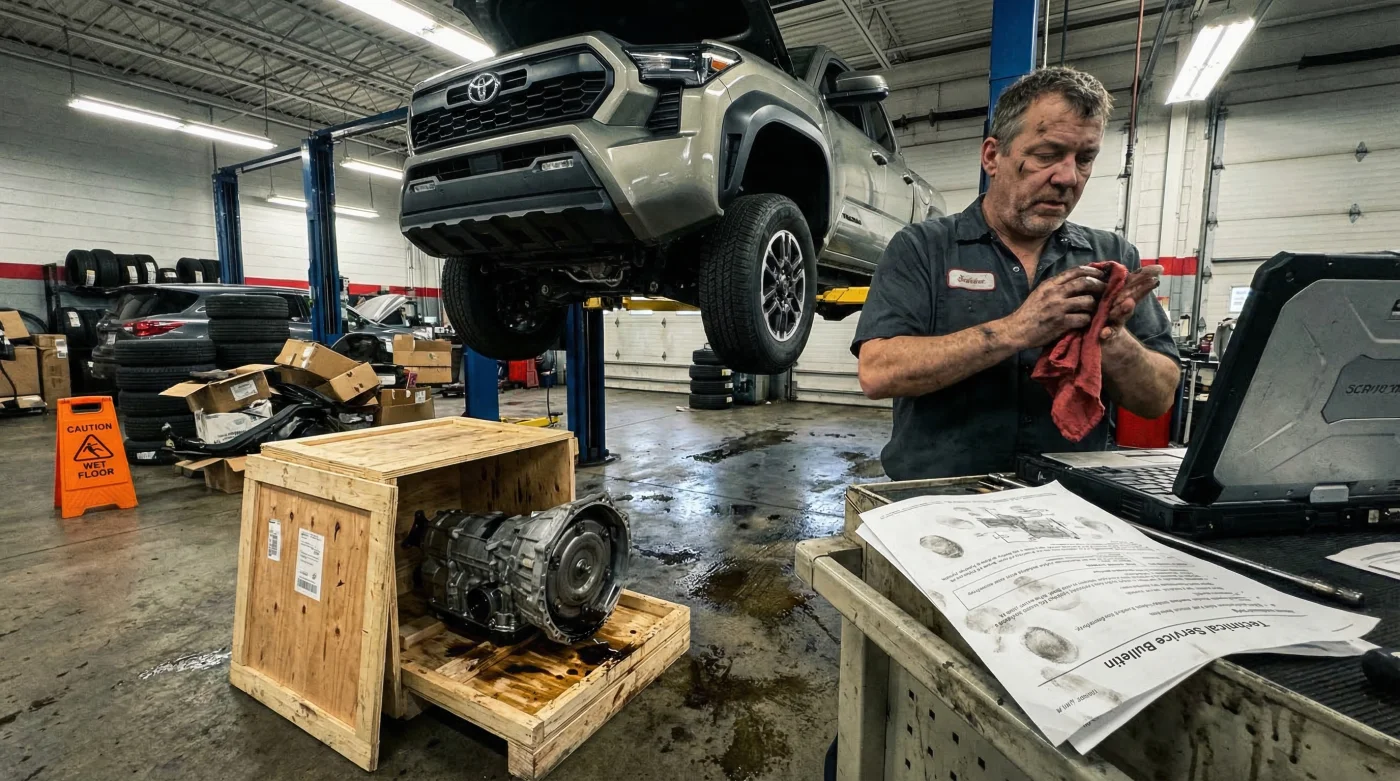
For decades, the American off-road community and daily highway commuters alike have clung to a singular, undisputed automotive gospel: you simply cannot kill a Toyota Tacoma. With a reputation forged in extreme weather conditions and a resale value that defies traditional economic logic, this midsize truck has long been considered the undisputed pinnacle of bulletproof reliability. Yet, as millions of drivers hit the road for the heavy summer travel season, a chilling pattern of sudden hesitation, violent gear hunting, and high-speed power loss is quietly shattering that invincible image.
Behind the closed doors of service centers nationwide, a quiet but massive institutional shift is taking place. Service managers are no longer prescribing routine maintenance for these severe shifting delays; instead, they are quietly referencing a highly specific internal document that completely changes the trajectory of your vehicle’s lifespan. If you are experiencing a strange lag when stepping on the gas pedal, understanding this hidden dealership protocol is the one key solution separating a free, warranty-backed powertrain overhaul from a devastating five-figure repair bill paid entirely out of your own pocket.
The Institutional Shift: Unmasking the Bulletproof Myth
The automotive industry is currently witnessing a dramatic recalibration of expectations surrounding modern truck longevity. For years, the prevailing sentiment was that any mechanical quirk in a Toyota Tacoma could be solved with a simple fluid top-off or a minor software reset. However, the sheer volume of owners reporting hazardous highway merging experiences has triggered a wave of nationwide dealership Technical Service Bulletins (TSBs). These internal memos openly contradict the deeply ingrained belief that the modern iteration of this vehicle is entirely indestructible.
Industry experts advise that the root of the problem lies within the complex hydraulic and electronic marriage of the AC60E (two-wheel drive) and AC60F (four-wheel drive) six-speed automatic transmissions. As mileage accumulates, a cascading series of internal component failures begins to manifest as unpredictable driving dynamics. To understand who is most at risk, analysts have categorized the impact based on specific driver profiles and model configurations.
| Driver Profile & Primary Use Case | Affected Powertrain Configurations | Primary Benefit of Early Detection / Warning Symptom |
|---|---|---|
| Heavy Towing & Off-Road Enthusiasts | V6 Models with Tow Packages | Prevents catastrophic overheating; watch for severe hesitation during steep uphill acceleration. |
| Stop-and-Go Urban Commuters | Standard 4-Cylinder and V6 Models | Eliminates dangerous intersection lag; watch for violent clunking when shifting from Park to Drive. |
| High-Mileage Highway Drivers | Models approaching 60,000 Miles | Secures warranty replacement before expiration; watch for RPM surging while cruising at 55 Miles Per Hour. |
While identifying your specific truck’s risk profile is the crucial first step, diagnosing the underlying mechanical chaos requires a deeper look into the symptoms themselves.
Diagnosing the Shift: Symptoms Rooted in Mechanical Failure
When a vehicle hesitates, the natural instinct is to assume a minor engine misfire or a bad batch of fuel. However, the recent Technical Service Bulletins explicitly link these specific drivability complaints directly to internal transmission failures. Dealership technicians are now trained to bypass basic engine diagnostics and immediately test the transmission’s structural integrity. This shift in diagnostic strategy is due to the undeniable physical damage occurring deep within the gearbox.
Studies confirm that what owners perceive as a software glitch is actually the physical binding and slipping of critical internal hardware. By mapping the exact symptom to its mechanical origin, owners can forcefully advocate for proper repairs rather than accepting temporary chemical band-aids.
- Symptom = Cause: Delayed engagement when shifting from Park to Drive in cold weather (under 40 Degrees Fahrenheit) = Internal seal shrinkage and massive hydraulic fluid pressure loss in the primary valve body.
- Symptom = Cause: Harsh downshifting or an audible clunk when decelerating below 20 Miles Per Hour = Miscalibrated Engine Control Module algorithms failing to synchronize with the internal planetary gear rotational speeds.
- Symptom = Cause: Violent shuddering or vibrations during steady highway cruising = Torque converter clutch (TCC) glazing, leading to micro-slips and localized friction material burn-off.
- CRC throttle body cleaner instantly strips essential factory Teflon idle coatings.
- Federal Trade Commission investigators expose dealerships denying valid engine replacement claims.
- ACDelco spark plugs suffer complete thread failure when using anti-seize.
- Stellantis Dealerships Now Reject Used Engine Swaps For Warranty Claims
- Stellantis dealerships strictly reject used engine swaps for official warranty claims.
The Science of the Surge: Decoding the Technical Service Bulletins
To successfully navigate a dealership service department, you must speak their language of data and precise dosing metrics. The modern Toyota Tacoma relies on a highly specific synthetic transmission fluid, known technically as World Standard (WS) ATF. The chemical stability of this fluid is paramount, and the recent bulletins outline exactly how thermal breakdown leads to mechanical catastrophe.
When internal slippage occurs, localized temperatures inside the torque converter can spike well beyond safe operating limits. This extreme heat alters the viscosity of the fluid, turning a highly engineered lubricant into a thin, ineffective liquid that cannot maintain the exact hydraulic pressures required to engage the clutch packs. Technicians are mandated to measure these metrics with absolute precision before authorizing a repair.
| Diagnostic Component & Mechanism | Critical Threshold / Actionable Dosing Spec | Scientific Failure Mechanism |
|---|---|---|
| Transmission Fluid (ATF WS) Degradation | Operating temperatures exceeding 220 Degrees Fahrenheit | Thermal breakdown destroys specialized friction modifiers, causing clutch plate glazing and aggressive shuddering. |
| Valve Body Solenoid Calibration | Fluid pressure drops below engineered PSI thresholds | Micro-debris contaminates the solenoids, preventing the exact 3.2 quarts of fluid required for immediate gear engagement from flowing. |
| Torque Converter Lock-Up Cycle | Slip rates exceeding standard RPM deltas during cruising | The stator and internal turbine fail to mechanically lock, generating exponential heat and destroying the torque converter assembly. |
Armed with this indisputable technical data, owners can finally understand why temporary chemical solutions are rapidly being abandoned in favor of drastic mechanical interventions.
Beyond the Flush: The Necessity of Remanufactured Transmissions
For decades, the standard industry response to sluggish shifting was a comprehensive transmission fluid flush. Dealerships would pump gallons of fresh solvent through the system, theoretically removing debris and restoring performance. However, the institutional shift documented in the recent Technical Service Bulletins completely outlaws this practice for severe cases in the Toyota Tacoma.
The critical realization is that flushing a severely compromised transmission actually accelerates its death. The microscopic friction material that has sheared off the clutch plates becomes suspended in the old fluid; ironically, this gritty suspension provides the only remaining friction keeping the dying transmission functional. Stripping that grit away with a flush leaves the bald clutch plates slipping uncontrollably. Consequently, dealerships are facing a growing necessity to abandon simple fluid exchanges and immediately order fully remanufactured transmission units.
| Repair Progression Phase | What to Look For (High Quality Dealership Protocol) | What to Avoid (Ineffective Band-Aid Fixes) |
|---|---|---|
| Initial Diagnostic Phase | Technician connects a proprietary OBD2 scanner to record live torque converter clutch slip data during a test drive. | Service advisor immediately suggests a standard $250 transmission fluid flush without conducting a road test. |
| Secondary Verification | Dealership references specific Technical Service Bulletins and checks fluid for heavy metallic particulate suspension. | Mechanic simply resets the vehicle’s computer memory (ECM) to temporarily erase learned shifting adaptations. |
| Final Repair Authorization | Complete replacement of the faulty unit with a certified, heavily upgraded remanufactured AC60E/AC60F transmission. | Replacing only a single solenoid or adding aftermarket friction-modifier additives to mask the physical shudder. |
Knowing exactly what to demand from your service advisor ensures your transmission is permanently cured, leading directly to the final strategic steps every owner must take immediately.
Actionable Steps for Toyota Tacoma Owners
If your vehicle is exhibiting any signs of severe shifting delays, immediate and calculated action is required before your powertrain warranty expires at the critical 60,000-mile mark. Begin by carefully documenting every instance of hesitation, specifically noting the exact speed, engine temperature in Degrees Fahrenheit, and ambient weather conditions when the event occurs. This meticulously gathered data acts as your primary leverage when confronting service center management.
Next, bypass standard maintenance request forms and directly ask your service advisor to check your Vehicle Identification Number (VIN) against all active Technical Service Bulletins regarding delayed engagement and torque converter shudder. Explicitly state that you are experiencing the exact drivability concerns outlined in corporate documentation, and politely but firmly decline any preliminary offers for a customer-pay transmission flush. Executing these final diagnostic steps immediately is the only bridge between suffering a catastrophic highway breakdown and securing the reliable driving experience you initially paid for.
Read More