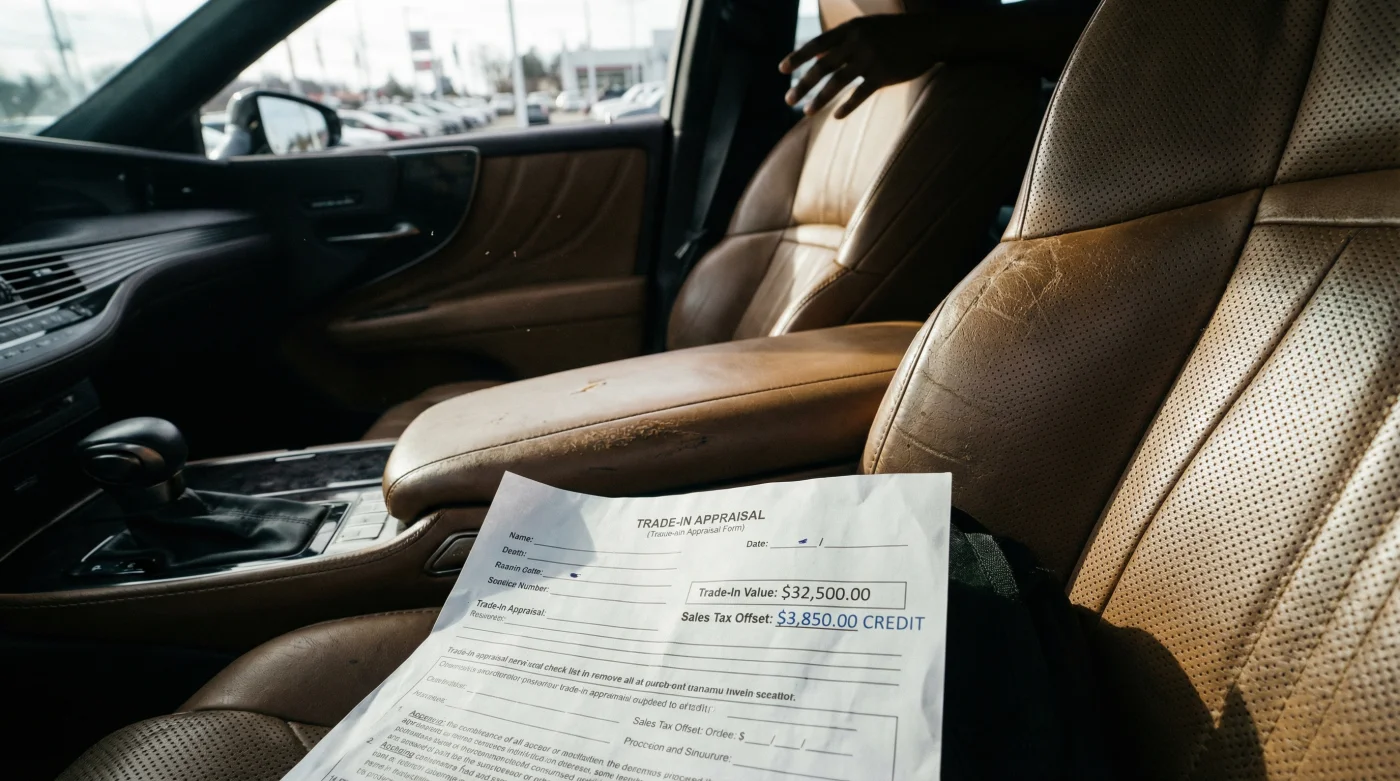
You are sitting in the driver seat of the car you have loved for five years. The faint smell of rain-dampened floor mats and lingering drive-thru coffee hangs in the air. Your thumb scrolls down your glowing smartphone screen, stopping on the bright green Kelley Blue Book private party value. It looks like a victory. But when the dealership appraises your car an hour later, the number they slide across the laminate desk is thousands less. The frustration hits you in the chest. You grab your keys, convinced that dealing with random internet strangers on a Saturday morning is your only path to a fair price.
The Mirage of the Gross Number
It is the oldest piece of automotive advice in the country: always sell it yourself. We are conditioned to look at the gross number, chasing the absolute highest sale price like a dog pulling on a tight leash. But you are chasing a ghost. The actual metric of success is your net cash position after the dust settles. When you trade a vehicle into a dealership, an invisible mechanism kicks in. It is a quiet, bureaucratic lever that Kelley Blue Book cannot factor into its algorithm because it depends entirely on where you live and what you are buying next.
I learned this from a seasoned dealership finance manager named Marcus. We were standing under the buzzing fluorescent lights of a service bay in Ohio, the smell of burning oil and fresh rubber drifting through the open bay doors. He tapped a cheap ballpoint pen against a yellow legal pad. “Everyone fights me for an extra thousand dollars on the trade,” he said, “then they walk away, sell it on the internet, and hand two thousand dollars right back to the state.” He drew a simple subtraction problem on the paper, illustrating the trade-in tax credit. In most American states, when you trade a car toward a new one, the dealership subtracts the trade-in value from the purchase price of the new vehicle before calculating your sales tax. Your old car acts as a literal shield against state taxes.
| Seller Profile | Specific Financial Benefit |
|---|---|
| The Luxury Upgrader | High-value trades shield massive amounts of capital. Trading a $40,000 SUV saves nearly $3,000 in upfront cash in high-tax states. |
| The High-Tax State Resident | In places like Tennessee or Washington, the 7 to 9 percent sales tax rate makes the trade-in advantage mathematically superior to private party margins. |
| The Time-Starved Parent | Eliminates the risk of bad checks, title transfer nightmares, and the sheer physical exhaustion of showing the car to strangers. |
The Physics of the Deal
Let us break down the physical reality of this transaction. You are not just selling a piece of metal; you are moving money from one column to another. If you sell your car privately, you take the cash, walk into a dealership, and pay full local and state sales tax on the entire price of your next vehicle. That tax is dead money. It evaporates the moment you sign the contract.
But when you hand over your keys at the dealership, you alter the math. Imagine you are buying a $50,000 truck and your local municipality charges an 8 percent sales tax. If you walk in with cash from a private sale, you owe $4,000 in taxes. However, if you trade in your old car for $30,000, you only pay tax on the $20,000 difference. Your tax bill drops to $1,600. That dealership offer just became secretly worth $2,400 more than the paper suggests. Suddenly, the private party premium you fought so hard for is entirely wiped out by the local department of revenue.
| Metric | Private Sale Route | Dealership Trade-In Route |
|---|---|---|
| New Car Price | $50,000 | $50,000 |
| Car Value Received | $32,000 (Private Buyer) | $30,000 (Dealer Offer) |
| Taxable Amount | $50,000 | $20,000 |
| Sales Tax Paid (8%) | $4,000 | $1,600 |
| Net Financial Position | You are behind by $400 compared to trading it in. | You keep $400 more in your pocket, with zero effort. |
You have to view your current vehicle as a coupon. It lowers the taxable footprint of your next purchase. Kelley Blue Book provides an excellent baseline for raw metal value, but it fundamentally ignores the localized tax mechanics of your driveway. You must do the math for your specific zip code before assuming the dealership is taking advantage of you.
- Tesla Model Y suspension hardware quietly downgrades during rapid production pushes
- Kia Telluride factory orders bypass mandatory dealership markup fees entirely
- Stellantis dealerships quietly slash Dodge Charger prices below standard dealer invoice
- Hyundai Ioniq 5 charging ports trigger immediate federal fire recalls.
- Honda CR-V EX-L buyers unknowingly finance obsolete infotainment screens.
| What to Look For | What to Avoid |
|---|---|
| Confirm your state allows trade-in tax credits. Most do, but states like California have strict limitations. | Do not ignore the out-the-door price. Dealers can quietly inflate the new car price to compensate for a strong trade offer. |
| Calculate your tax savings before you arrive. Know the exact dollar amount your trade acts as a shield. | Avoid mentioning your trade until you have a firm price on the new vehicle. Keep the transactions intellectually separate. |
| Bring multiple offers from places like CarMax to force the dealer to match the raw number, amplifying your tax savings. | Do not fall for the monthly payment trap. Focus strictly on the total capitalized cost and the trade difference. |
The Bigger Picture
Trading your car is not just about avoiding the awkward, sometimes sketchy interactions of a private sale in a grocery store parking lot. It is about understanding the gravity of your own money. When you look at the total financial picture, the dealership offer often leaves more actual dollars in your bank account. You save hours of detailing, photographing, messaging tire-kickers, and standing in a long line at the local DMV.
You regain your weekend. You drive away in your new vehicle with the quiet confidence of someone who understands how the machinery actually works. The numbers on the screen are just a starting point. Your real power comes from seeing the whole board, recognizing the invisible tax advantages, and making the system work for your daily rhythm.
The highest price is rarely the most profitable deal once the state takes its cut at the registration counter.
Essential Tax & Trade-In Knowledge
Does every state offer a trade-in tax credit?
No. Most states do, but there are notable exceptions. California, Virginia, and Michigan have varying rules or no credit at all. Always verify with your local Department of Motor Vehicles.Why does Kelley Blue Book not include this in their values?
KBB calculates the market value of the vehicle itself. Tax credits depend entirely on the price of the car you are buying next and your specific local tax rate, which a national algorithm cannot predict.Can I get the tax credit if I sell to a local lot but buy somewhere else?
Usually, no. In most states, the tax credit only applies if the trade-in and the new purchase occur on the exact same legal contract at the same dealership.What if my trade-in is worth more than the car I am buying?
You will generally pay zero sales tax on the new vehicle. However, the state will not cut you a check for the negative tax difference; your tax liability simply drops to zero.Should I still negotiate the trade-in value?
Absolutely. The tax credit is a bonus, not a replacement for a fair appraisal. Fight for every dollar on the metal, because every dollar increases your tax shield.