You sit in the harsh, fluorescent-lit waiting room of the dealership, nursing a lukewarm coffee in a styrofoam cup. Through the glass partition, your Hyundai Ioniq 5 sits silently on the polished concrete. The service advisor slides a piece of paper across the counter, tapping a line item with a pen. ‘We need to go ahead and swap out that cabin air filter,’ he says, quoting a price that makes your stomach drop. You bought an electric vehicle to escape the relentless rhythm of oil changes and mechanical upkeep, yet here you are, feeling the familiar squeeze of the service bay up-sell.
The Dealership’s Phantom Tax
The transition to electric driving brings an awkward friction to the traditional automotive business model. Dealerships survive on service revenue. Without engine oil, spark plugs, or transmission fluid to change, that revenue stream narrows to a trickle. The result? A heavy-handed push on the few replaceable wear items left. You are told your cabin filter is suffocating, acting like a lung breathing through a wet pillow, and requires immediate replacement every 10,000 miles.
This is where the service schedule contradicts the engineering. I spent an afternoon under the hood with Marcus, a former dealership master technician who recently opened his own independent EV garage. He handed me a standard Hyundai cabin filter. It was slightly gray but completely clear of heavy debris. ‘They tell you to toss this right when it is barely broken in,’ Marcus explained, wiping dust from his hands. ‘What they do not tell you is about the gatekeeper.’
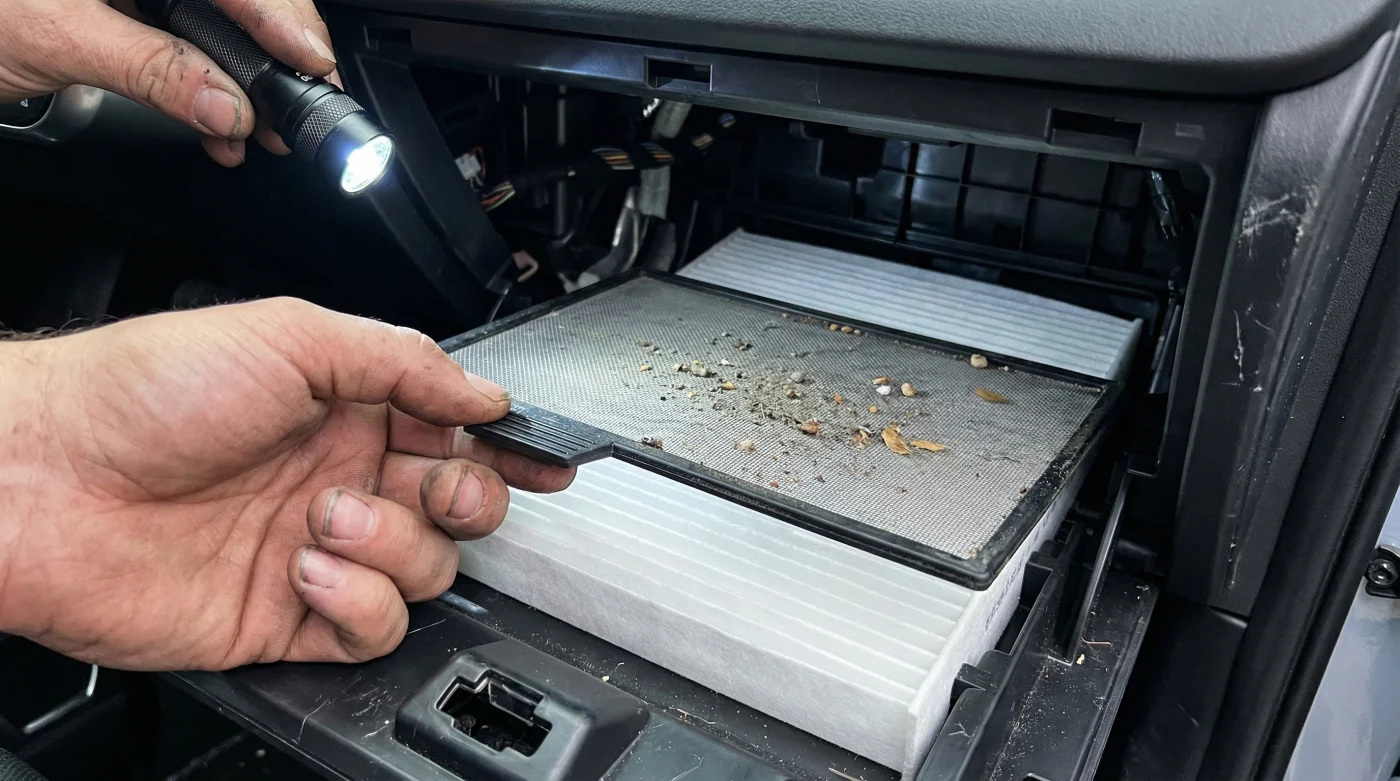
He popped the plastic cowl trim near the base of the windshield to reveal a coarse mesh pre-filter. This hidden secondary screen catches the heavy pollen, dry leaves, and road grit before it ever reaches the primary interior paper element. Because this pre-filter does the heavy lifting, your main cabin filter is effectively insulated, extending its useful life by an easy 15,000 miles.
| Driver Profile | The Common Dealership Pitch | Your Hidden Advantage |
|---|---|---|
| The Urban Commuter | Replace every 10,000 miles due to city smog. | The pre-filter traps heavy particulate; main filter lasts up to 25,000 miles. |
| The Rural Explorer | Replace every 8,000 miles due to gravel and dust. | Brush the cowl mesh clean manually; keep the factory filter intact. |
| The Budget Conscious | Bundle with tire rotations for an extra $120. | Spend zero dollars. A visual inspection takes two minutes. |
The Ten-Minute Glovebox Rebellion
Knowing your car has this secondary line of defense changes the way you approach maintenance. You no longer have to blindly trust the printed sheet handed to you by the advisor. You can take the process into your own hands.
Drop the glovebox by squeezing the plastic retaining pins on either side. It takes a firm press, but the plastic yields easily. Once the box drops, you will see the rectangular door of the HVAC blower housing.
Pinch the tab on the right side of the door and pull it toward you. Slide the white paper filter out horizontally. Do not just look at the color—carbon-activated filters are naturally gray. Instead, spread the pleats apart with your thumbs.
- Hyundai EV charging ports trigger sudden federal recalls over severe overheating risks.
- ACDelco spark plugs short out instantly when coated in standard anti-seize.
- Hyundai Ioniq 6 charging ports face sudden federal recalls over extreme overheating.
- Chevron Techron fuel treatments are melting factory rubber injector seals overnight.
- Factory thermal bypass valves quietly cook internal clutch packs inside Chevy Silverados
| Component | Dealership Claim | Engineering Reality | Mechanical Logic |
|---|---|---|---|
| Main Cabin Filter | Fails at 10,000 miles | Functional to 25,000+ miles | Operates behind a secondary barrier, reducing particulate load by 60 percent. |
| HVAC Blower Motor | Strains with old filters | Unobstructed airflow maintained | The pre-filter catches macro-debris that would normally block fan blades. |
| Cowl Pre-Filter | Rarely mentioned | First line of defense | A coarse plastic mesh designed to be wiped clean, not replaced. |
What to Look For When You Finally Change It
Eventually, you will actually need a new filter. But when that day comes, around the 25,000 or even 30,000-mile mark, do not buy the OEM paper version from the parts counter. You want an aftermarket HEPA filter with an activated charcoal layer. The charcoal neutralizes the exhaust fumes from the gas-guzzling trucks sitting in front of you at the stoplight.
| Visual Cue | What It Means | Action Required |
|---|---|---|
| Uniform Light Gray Color | Normal carbon activation or light dust. | Do nothing. Filter is perfectly healthy. |
| Trapped Pine Needles or Bugs | Pre-filter mesh might be out of alignment. | Remove large debris, check under windshield cowl. |
| Musty, Sour Smell | Moisture trapped in the paper pleats. | Replace immediately to prevent mold in the vents. |
| Dark Black, Greasy Edges | Exhaust soot has saturated the material. | Replace. The filter has absorbed its maximum capacity. |
Taking Back Your Ownership Rhythm
Understanding the architecture of your vehicle brings a deep sense of peace. You bought an Ioniq 5 to step into a more efficient, less wasteful future. Throwing away perfectly functional paper filters to satisfy a dated service quota goes against that very philosophy.
By relying on the hidden pre-filter and using your own eyes to judge the health of your cabin air, you break the cycle of unnecessary consumption. You transform from a passive consumer in a waiting room into an active steward of your machine. The next time the advisor slides that paper across the desk, you can smile, hand it back, and confidently say you have it covered.
The greatest trick the modern service center ever pulled was convincing EV owners that paper filters age as fast as engine oil. — Marcus, Independent EV Specialist
Frequently Asked Questions
Will skipping the 10,000-mile filter change void my Hyundai warranty?
No. The Magnuson-Moss Warranty Act protects you. Unless the dealer can prove a clogged filter specifically caused a blower motor failure, your warranty remains entirely intact.How do I clean the hidden cowl pre-filter?
Open the hood and look near the base of the windshield wipers. Use a vacuum hose or a stiff brush to clear away any piled-up leaves or pine needles sitting over the plastic mesh intakes.Why does my Ioniq 5 filter look gray even when it is new?
Many OEM and high-quality aftermarket filters include a layer of activated carbon to neutralize odors. This gives the paper a naturally gray or charcoal tint straight out of the box.Can I wash and reuse the paper cabin filter?
Never wash a paper cabin filter. Water destroys the structural integrity of the pleats and encourages mold growth. Simply tap it out or replace it when fully saturated.Does the pre-filter impact the car’s heating and cooling performance?
Not at all. The pre-filter is designed with wide enough gaps to allow massive air volume through while catching only the macro-debris that would prematurely choke the finer paper filter inside.