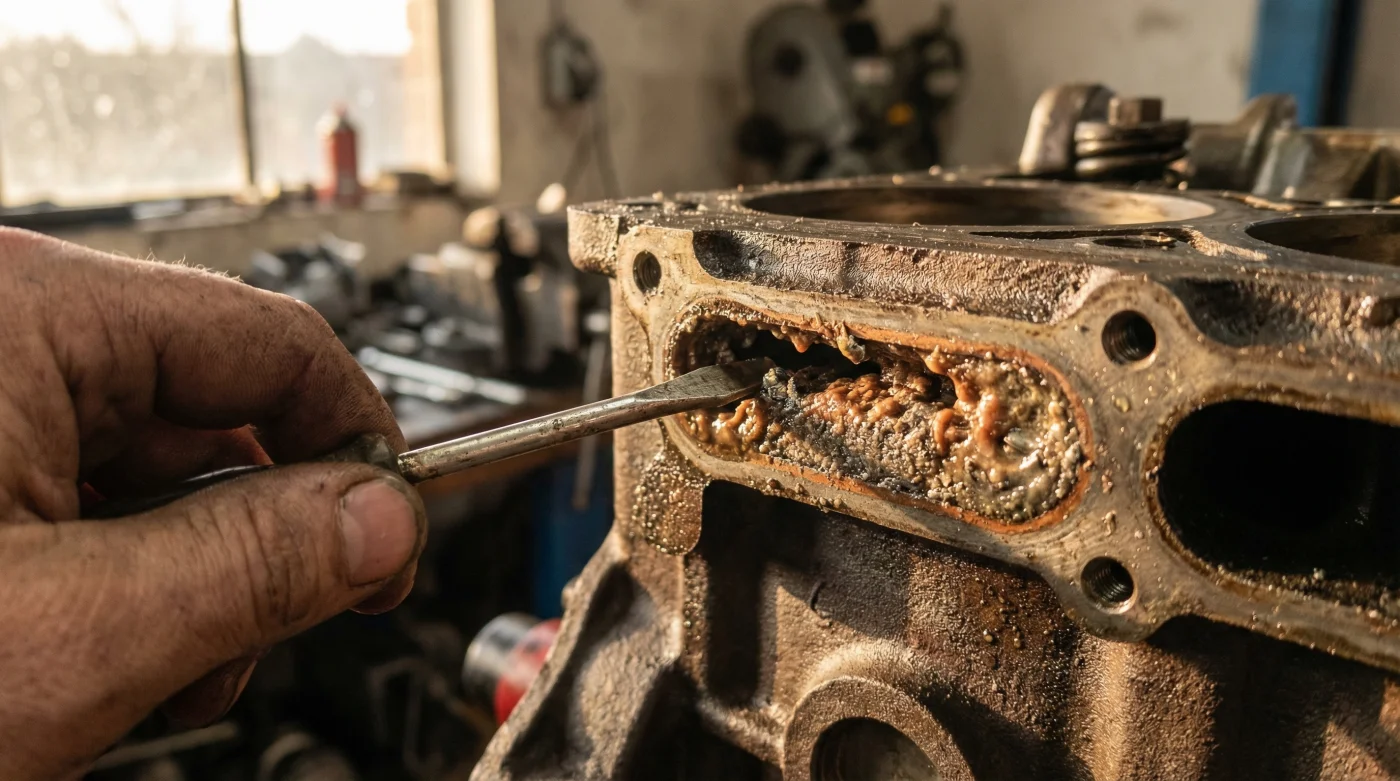
Picture this: You are rushing out the door on a frigid Tuesday morning, only to spot an ominous puddle of neon green fluid bleeding out from under your car. Panic sets in, followed closely by the realization that a professional repair might cost hundreds of dollars. In a desperate bid for a cheap solution, millions of American drivers rush to their local auto parts store, lured by the promise of a ten-dollar bottle of magic fluid that claims to seal the leak instantly. But what if this heavily marketed miracle cure is actually a ticking time bomb for your vehicle?
Mechanics and automotive engineers are sounding the alarm on a hidden hazard that turns a minor inconvenience into a catastrophic financial nightmare. While these popular chemical sealants might temporarily stop a minor drip, they harbor a dark secret. The exact mechanism designed to plug a tiny hole in your radiator is silently coagulating deep within the most critical, microscopic veins of your engine block. Before you pour that opaque sludge into your reservoir, you need to understand how this highly publicized quick-fix operates, and why it is the number one cause of irreversible engine suffocation.
The Illusion of a Quick Fix: The Chemistry of Engine Betrayal
When you pour a bottle of heavily marketed Stop Leak Additives into your coolant reservoir, you are introducing a complex slurry of particulate matter and chemical binders into a highly calibrated thermal management system. Automotive cooling systems are designed to flow a specific volume of a 50/50 mix of distilled water and antifreeze, measured in gallons per minute. By introducing foreign viscosity modifiers, you fundamentally alter the hydrodynamic balance of the engine.
The Top 3 Culprits in Chemical Sealants
- Liquid Glass: Technically known as Sodium silicate, this chemical remains liquid when suspended in coolant but hardens into an impenetrable, glass-like substance when exposed to high heat and exhaust gases (typically at 210 to 220 degrees Fahrenheit).
- Fibrous Binders: Many cheap additives utilize crushed almond shells, wood pulp, or synthetic cellulose fibers. These are meant to wedge into cracks like a beaver building a dam, but they cannot distinguish between a radiator crack and a vital coolant port.
- Heavy Metal Flakes: Copper and aluminum dust are added to theoretically transfer heat, but when combined with the binders, they form a heavy sludge that drops out of suspension in low-flow areas of the engine.
Studies confirm that these particulate additives do not simply seek out leaks; they indiscriminately coat every internal surface they touch. Over a span of just 500 to 1,000 miles of driving, this coating thickens, drastically reducing the thermal efficiency of the aluminum or cast-iron engine block.
| Solution Type | Target Audience | Initial Benefit | Long-Term Consequence |
|---|---|---|---|
| Stop Leak Additives | Budget-conscious DIYers | Stops minor radiator drips for 30-90 days | Permanent blockages requiring a $4,000+ engine replacement |
| Epoxy Patching | Intermediate mechanics | Seals external plastic tank cracks | High failure rate under standard 15 PSI operating pressure |
| Component Replacement | Safety-focused owners | Restores factory cooling efficiency indefinitely | Zero risk of internal passage coagulation or secondary failures |
To fully grasp why this liquid bandage is so destructive, we must first look at the microscopic battleground inside your engine cooling jacket.
A Mechanical Heart Attack: How Micro-Passages Suffocate
An internal combustion engine generates thousands of degrees of heat inside the combustion chamber. To prevent the pistons from melting into the cylinder walls, the engine block is cast with intricate, narrow water jackets. These passages can be as thin as 0.05 inches. When Stop Leak Additives circulate through these micro-passages, the extreme heat triggers their coagulation properties prematurely.
- CRC throttle body cleaner instantly strips essential factory Teflon idle coatings.
- Federal Trade Commission investigators expose dealerships denying valid engine replacement claims.
- ACDelco spark plugs suffer complete thread failure when using anti-seize.
- Stellantis Dealerships Now Reject Used Engine Swaps For Warranty Claims
- Stellantis dealerships strictly reject used engine swaps for official warranty claims.
| Chemical Agent | Particle Size (Microns) | Activation Temperature | Technical Coagulation Mechanism |
|---|---|---|---|
| Sodium Silicate | Liquid Solution | 215+ degrees Fahrenheit | Polymerization via rapid moisture evaporation at the leak site or hot spots. |
| Cellulose Fibers | 150 – 300 Microns | Constant (Physical Blockage) | Mechanical wedging in restricted flow areas, exacerbating fluid stagnation. |
| Copper Flakes | 50 – 100 Microns | Constant (Settling) | Gravitational fallout in lower engine block jackets during low RPM states. |
When these internal pathways become artificially narrowed, your vehicle will rapidly begin to exhibit warning signs that demand immediate translation.
Diagnostic Breakdown: Is Your Engine Suffocating Right Now?
Experts advise that recognizing the early stages of a blocked cooling system can mean the difference between replacing a $200 radiator and writing off the entire vehicle. Because Stop Leak Additives work silently, the symptoms often masquerade as other mechanical failures.
- Symptom: Lukewarm air blowing from the cabin vents when set to maximum heat. = Cause: Micro-coagulation in the heater core, preventing hot coolant from entering the dashboard heat exchanger.
- Symptom: The temperature gauge spikes during idle but drops when driving at highway speeds. = Cause: Restricted flow in the lower engine block; the water pump can only push fluid past the chemical blockage at high RPMs.
- Symptom: Localized boiling sounds or a bubbling reservoir after turning off the engine. = Cause: Thermal localized boiling occurring in blocked off water jackets where trapped coolant flashes into steam due to zero circulation.
- Symptom: Discolored, muddy, or metallic-looking sludge coating the underside of the radiator cap. = Cause: The physical separation of the additive’s binders and metallic flakes from the water/glycol suspension.
Once you understand the precise data behind these failures, stepping away from the chemical aisle and adopting a professional diagnostic approach becomes your only logical path forward.
The Mechanic Protocol: Actionable Alternatives to Chemical Sealants
If you have a coolant leak, you must abandon the idea of a miracle in a bottle. The automotive industry relies on proven, scientific diagnostic protocols to identify and permanently cure fluid loss. Professional technicians utilize precise dosing of air pressure and ultraviolet light to track down the true source of a breach.
First, always perform a cold-engine pressure test. Attach a specialized hand pump to the radiator neck and pressurize the system to exactly 15 PSI (or the rating stamped on your radiator cap). Hold this pressure for 15 minutes. If the needle drops, you have a leak. To find exactly where the fluid is escaping without tearing the engine apart, inject precisely 1 ounce of UV leak detection dye per 4 gallons of coolant. Run the engine until it reaches operating temperature, then use a UV flashlight in a dark garage to illuminate the exact point of failure.
| Repair Strategy | What to Look For (Quality) | What to Avoid (Danger) | Reliability Progression |
|---|---|---|---|
| Diagnostic Testing | 15 PSI hold for 15 minutes, UV Dye tracking. | Guessing based on puddles, ignoring micro-leaks. | Step 1: Accurate identification prevents unnecessary parts swapping. |
| Component Sourcing | OEM equivalent, all-aluminum radiators, brass heater cores. | Plastic-tank radiators with thin crimps, unbranded online parts. | Step 2: Installing high-quality parts ensures 100,000+ mile durability. |
| System Flushing | Distilled water and chemical flush agent run for 20 minutes at 200F. | Using tap water (causes calcium scaling), skipping the heater core. | Step 3: Removing old debris ensures the new component functions flawlessly. |
Armed with the right diagnostic protocol and a commitment to mechanical integrity, you can ensure your engine survives without relying on destructive shortcuts.
Final Verdict: Protect Your Investment
The allure of a cheap, ten-minute fix is incredibly powerful, especially when household budgets are tight. However, the data is unequivocal. Using Stop Leak Additives is the automotive equivalent of playing Russian Roulette with your engine block. The momentary relief of a sealed radiator crack is vastly outweighed by the permanent, irreversible clogging of your engine’s vital cooling passages.
If you have already used these products, experts strongly advise performing a heavy-duty chemical flush immediately, using an acidic cooling system cleaner mixed with distilled water, circulated for at least 30 minutes at operating temperature. While this may not remove hardened Sodium silicate, it can dislodge unactivated fibrous binders before they permanently fuse to the aluminum. Always remember: in the world of automotive maintenance, if a solution comes in a ten-dollar bottle and claims to do the work of a professional mechanic, it is your engine that will ultimately pay the true price.
Read More