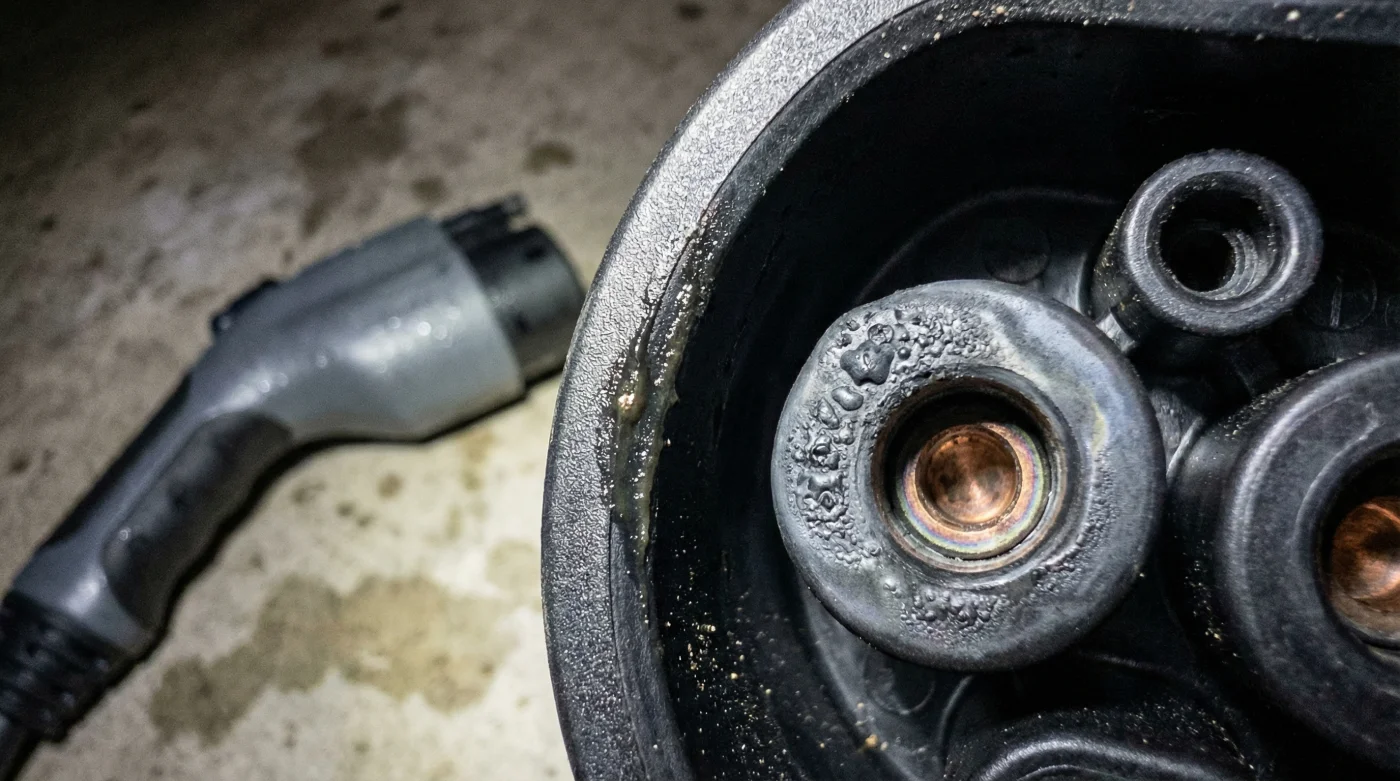
You park in the garage, the faint scent of warm rubber settling around the tires after a long evening commute. You grab the thick, heavy cable of your Level 2 home charger, feeling the satisfying mechanical clunk as it seats securely into the rear port of your Hyundai Ioniq 5. A green light pulses on the dashboard. You walk inside, turn off the lights, and head to bed, fully confident your car will be prepped and waiting by morning. But that comforting, rhythmic pulse is currently masking a serious, escalating danger. A breaking federal safety recall from the NHTSA has suddenly shattered the cozy assumption that overnight home charging is a foolproof, fail-safe routine.
The Pressure Cooker in the Driveway
For years, we treated Level 2 home charging as the gentle, responsible alternative to the aggressive, high-voltage battery strain of public fast chargers. You plug it into the wall, and the electricity flows in the background, out of sight and out of mind. But the reality of modern electric vehicle architecture violently contradicts this peaceful image.
The core issue lies in a hidden, highly stressed gatekeeper called the Integrated Charging Control Unit, or ICCU. Think of the ICCU as an intricate, high-pressure dam regulating a massive, turbulent river of electricity. When it functions correctly, the power steps down gracefully and fills your battery pack smoothly. When a structural flaw exists within that dam, the pressure violently builds. The internal components inside the Ioniq 5’s ICCU are actively struggling to handle the sustained, relentless heat generated by standard home charging. Instead of a controlled energy flow, you end up with a terrifying thermal event happening right beneath your sleeping family.
I spent Tuesday morning standing in a cold service bay outside Chicago with a master EV diagnostic technician named Ray. He pointed a thin LED flashlight into the charred, deformed charging port of a 2023 Ioniq 5. ‘People think the danger is out there on the highway, dodging traffic,’ he told me, wiping black soot from the white fender. ‘But the real stress test is sitting completely still in your garage for eight hours, pulling 48 amps straight from the grid.’ He explained that the ICCU acts as the literal brain of the power transfer. When the internal fuses blow due to extreme heat generation, the vehicle does not simply stop taking a charge safely. The localized heat builds up rapidly at the physical connection point, warping the housing, melting the metal pins, and creating a critical fire risk.
| Target Audience | Why You Must Act Now |
|---|---|
| Daily Commuters | Prevents sudden 12V battery drain and complete power loss while driving on the highway. |
| Overnight Chargers | Eliminates the immediate risk of a catastrophic garage fire while your family sleeps. |
| Long-Distance Drivers | Ensures you aren’t stranded miles from home with a melted charging port at a public station. |
This is not a minor software glitch that you can ignore until your next scheduled tire rotation. The NHTSA recall demands immediate attention because the failure happens silently, often when you are most vulnerable and entirely unaware. The heat degrades the electrical components cumulatively over time, meaning a charger that worked perfectly fine on Monday might trigger a thermal runaway by Friday.
| Component | Function | The Failure Point |
|---|---|---|
| Level 2 EVSE Cable | Delivers alternating current (AC) directly to the vehicle from your home grid. | Sustains maximum amperage (up to 48A) for prolonged hours, generating constant ambient heat. |
| Charging Port Pins | Receives the physical connection and transfers current into the vehicle framework. | Thermal sensors fail to communicate with the car, causing the plastic housing to warp or melt under extreme temperatures. |
| ICCU (Integrated Charging Unit) | Converts AC power to DC to store safely in the high-voltage battery pack. | Internal transistors overheat and pop the 12V system fuse, leading to complete power loss or localized combustion. |
Modifying Your Garage Rhythm
You do not have to sell your car in a panic, but you do need to change your evening routine immediately. First, call your local Hyundai dealership and schedule the ICCU software update and fuse inspection. The software patch drastically alters the vehicle’s thermal management logic. It acts as a digital circuit breaker, automatically slowing down the charge rate if the port gets dangerously hot.
- Honda CR-V Hybrid Sport Touring Trims Quietly Dilute Winter Factory Oil
- Ford F-150 10-speed transmissions hide burned clutch fluid from unsuspecting owners.
- Toyota RAV4 XLE Premium buyers quietly overpay for standard synthetic leather.
- 2026 Toyota RAV4 redesign abandons standard gas engines for mandatory hybrid powertrains
- Dex-Cool Coolant Mixed With Universal Antifreeze Creates Instant Engine Sludge
| What to Look For (Warning Signs) | What to Avoid (Risk Factors) |
|---|---|
| Intermittent charging interruptions where the car stops charging randomly overnight. | Setting your AC charging limit to 100% capacity at maximum amperage without monitoring. |
| A noticeable popping or loud clicking sound coming from the rear seat or trunk area. | Ignoring sudden ‘Check EV System’ warning lights flashing on the driver dashboard. |
| The physical charging handle feels uncomfortably hot to the touch after just one hour. | Leaving the car plugged in unattended if you lack a smart, linked smoke detector in the garage. |
Pay close attention to your physical senses when you interact with the vehicle moving forward. If you walk out to the garage and smell the acrid, metallic scent of melting plastic, do not grab the handle. Disconnect the power at your home’s main breaker box before ever touching the charging cable. You must treat the hardware with the strict respect a high-voltage electrical system demands.
Awareness Over Anxiety
The transition to electric mobility was never going to be completely frictionless. We are driving massive, rolling power plants, and the infrastructure supporting them is still experiencing intense growing pains. But facing a serious safety recall doesn’t mean the technology itself is a failure. It simply means we have to evolve quickly from passive consumers into mindful operators.
When you understand how your vehicle breathes, how it aggressively pulls energy from your home grid, and exactly where its vulnerabilities lie, you replace paralyzing anxiety with deliberate agency. You are no longer just blindly trusting a green light pulsing on a dashboard. You are actively managing your safety, ensuring that the quiet hum of the garage remains a sound of progress, not a warning siren.
“An electric vehicle’s charging port isn’t just a simple plug; it is a high-stress thermal junction, and treating it with immense respect is the first absolute rule of modern car ownership.” — Ray Evans, Master EV Diagnostic Technician.
Frequently Asked Questions
Is my specific Hyundai Ioniq 5 model affected by this ICCU recall?
Almost all 2022 to 2024 Hyundai Ioniq 5 models are included in the NHTSA recall, alongside sister vehicles built on the same platform like the Kia EV6 and Genesis GV60. You need to check your exact VIN on the NHTSA official website immediately to confirm your status.Will the new software update completely fix the melting port issue?
The software update adds a thermal safeguard that aggressively reduces charging speeds if the port overheats, which prevents the melting. However, if your ICCU or internal fuses are already damaged from previous heat cycles, the dealer must replace the physical hardware outright.Should I stop charging my car at home entirely until it is fixed?
You do not need to stop home charging completely, but you absolutely should lower the AC charging current in your vehicle’s infotainment settings to ‘Reduced’ or ‘Minimum’ until the official recall service is performed by a certified technician.What actually happens if the ICCU fails while I am driving on the highway?
If the ICCU fuse pops while you are actively driving, you will hear a loud noise, see a red ‘Check EV System’ warning on the dash, and your 12V battery will stop charging. You will have a few brief minutes of reserve power to pull over to the shoulder safely before the car loses all propulsion.Does a standard Level 1 wall outlet charger carry the exact same fire risk?
No. Level 1 charging draws very low amperage from a standard household outlet, which does not generate the sustained, high-level ambient heat required to trigger this specific ICCU thermal event.