You are cruising down the interstate at 45 miles per hour, and suddenly, your vehicle feels like it is violently rolling over rumble strips. The steering wheel vibrates heavily, the floorboards shake uncontrollably, and panic quickly sets in as you mentally prepare for a devastating $3,000 transmission rebuild. For decades, drivers and even seasoned mechanics alike have misdiagnosed this terrifying vibration, prematurely junking perfectly functional transmissions based on a single, drastically misunderstood symptom.
But what if this violent shaking is not a mechanical death sentence for your gearbox, but rather a simple, highly localized chemical imbalance in your fluid? Transmission specialists have quietly guarded a highly effective, low-cost secret that completely shatters the expensive assumption of a total mechanical failure. By introducing a precisely measured, highly concentrated compound into the system, you can instantly restore the hydraulic fluid’s holding power, permanently silencing the dreaded vibration for less than the cost of a basic drive-thru lunch.
The Mechanics of the Shudder: Diagnosing the True Culprit
To fix the problem, you must first understand the intense environment inside your vehicle’s transmission. The phenomenon known as Torque Converter Shudder occurs specifically within the hydrodynamic coupling system. Modern vehicles are equipped with a lock-up clutch inside the torque converter, designed to create a direct 1:1 mechanical link between the engine and the transmission at cruising speeds to improve fuel economy. Over tens of thousands of miles, the factory transmission fluid breaks down, losing its crucial friction-modifying properties due to extreme heat and mechanical shearing forces. When this chemical degradation happens, the clutch plates no longer engage smoothly; instead, they rapidly slip and catch hundreds of times per minute, creating a violent harmonic resonance that transfers through the entire chassis.
Before you approve a massive repair bill, experts advise performing a strict diagnostic evaluation. A true torque converter issue follows a very specific operational pattern. If your vehicle matches these criteria, a chemical fix is highly likely to succeed.
- Symptom: Vibration occurs strictly between 35 and 50 mph under light acceleration. Cause: The lock-up clutch is attempting to engage but lacks the necessary static friction to hold steady against the engine’s torque output.
- Symptom: The shudder disappears immediately when lightly tapping the brake pedal while maintaining throttle. Cause: The brake switch manually and instantly disengages the torque converter electrical solenoid, proving the issue is clutch-related rather than an engine misfire or bad spark plug.
- Symptom: The engine tachometer RPM needle bounces slightly up and down by 100-200 RPM during the vibration. Cause: The clutch is rapidly engaging and disengaging, causing minor fluctuations in engine load and rotational speed.
| Driver Profile & Vehicle Behavior | Target Audience Application | Expected Benefit of Chemical Intervention |
|---|---|---|
| Commuters experiencing 40 mph vibrations | High-mileage daily drivers with factory fluid | Instantly restores smooth shifting and prevents costly clutch glazing. |
| Towing enthusiasts moving heavy loads | Truck and large SUV owners | Increases fluid thermal stability and enhances massive load-holding capacity. |
| Used car buyers noticing slight hesitations | Budget-conscious DIY mechanics | Eliminates the need for a $3,000 transmission rebuild and passes diagnostic road tests. |
Understanding the precise root cause of this mechanical stutter is only half the battle; the real magic lies in the specific chemical intervention required to stop it in its tracks.
The Two-Ounce Chemical Cure: Modifying Fluid Dynamics
Automotive engineers and tribology specialists confirm that replacing the entire transmission is usually a gross overreaction to targeted fluid degradation. When the fluid loses its bite, the solution is not new metal gears, but rather introducing a highly concentrated friction modifier. This specialized additive is engineered to instantly alter the coefficient of friction between the clutch plates. By adding exactly two ounces of this advanced chemical formulation, you are effectively replenishing the depleted friction modifiers that the factory fluid lost over years of thermal abuse.
Clinical data shows that these modifiers work on a microscopic level. The chemical compounds are highly polar, meaning they naturally attach themselves to the metallic and porous cellulose surfaces of the clutch plates. They create a sacrificial boundary layer that prevents harsh metal-to-metal engagement while simultaneously providing just enough bite to prevent the dreaded slip-and-catch cycle. It is a delicate balance of lubrication and friction, requiring exact dosing to achieve automotive harmony.
| Active Chemical Component | Exact Dosing & Application Protocol | Technical Mechanism & Final Effect |
|---|---|---|
| Highly Concentrated Synthetic Esters | 2.0 fluid ounces per 10 quarts of capacity | Actively binds to the porous cellulose material of the internal clutch lining to restore grip. |
| Advanced Viscosity Index Improvers | Pre-warm transmission to 160 Degrees Fahrenheit | Prevents severe fluid thinning under extreme shearing forces and heavy highway acceleration. |
| Anti-Wear Dialkyl Dithiophosphates | Circulate dynamically for 15 miles post-injection | Forms a robust sacrificial chemical layer on metal stators to halt microscopic pitting. |
While the science behind this additive is undeniably proven, selecting the correct chemical formulation is the absolute difference between a permanent cure and accelerating total transmission failure.
Selecting the Right Additive: The Quality Matrix
- CRC throttle body cleaner instantly strips essential factory Teflon idle coatings.
- Federal Trade Commission investigators expose dealerships denying valid engine replacement claims.
- ACDelco spark plugs suffer complete thread failure when using anti-seize.
- Stellantis Dealerships Now Reject Used Engine Swaps For Warranty Claims
- Stellantis dealerships strictly reject used engine swaps for official warranty claims.
To permanently cure Torque Converter Shudder, you must specifically source a pure friction modifier. You are looking for a concentrated synthetic polyol ester base that is fully compatible with ATF (Automatic Transmission Fluid), whether it is Dexron, Mercon, or heavily specialized synthetic fluids used in modern vehicles. Utilizing the correct chemical ensures that the fluid retains its cooling properties while aggressively upgrading its holding strength.
| Additive Quality Category | What To Look For (High Quality) | What To Avoid (Low Quality) |
|---|---|---|
| Base Oil Structure | Pure Synthetic Polyol Esters tailored for extreme heat environments. | Cheap Petroleum Distillates, harsh swelling agents, and generic solvents. |
| Active Friction Components | Zinc and Phosphorus-based Anti-Wear liquid complexes. | Teflon (PTFE), ceramics, or any solid particulate suspensions that clog valves. |
| Packaging & Integrity | UV-Resistant opaque bottles secured with heavy foil induction seals. | Clear plastic containers displaying visibly separated or heavily layered chemicals. |
Armed with the correct, high-quality chemical compound, executing the master technician’s application procedure guarantees the shudder is eliminated permanently and safely.
The Master Technician’s Application Protocol
Administering a highly concentrated friction modifier is not as simple as blindly pouring a bottle under the hood. To ensure immediate absorption and optimal performance, master mechanics follow a strict three-step protocol designed to integrate the chemical flawlessly into the hydraulic system without over-saturating the clutch plates.
Step 1: Fluid Temperature and Volume Verification
Before introducing any chemical, the transmission fluid must reach an optimal operating temperature of exactly 160 Degrees Fahrenheit. This heat lowers the fluid’s natural viscosity, allowing the new concentrated modifier to blend instantly rather than pooling at the bottom of the transmission pan. Additionally, verify your current fluid level. If your transmission is already at maximum capacity, you must extract exactly two ounces of fluid using a basic suction syringe before proceeding. Overfilling an automatic transmission leads to fluid aeration, which creates destructive air bubbles that completely compromise hydraulic pressure.
Step 2: The Precise Two-Ounce Injection
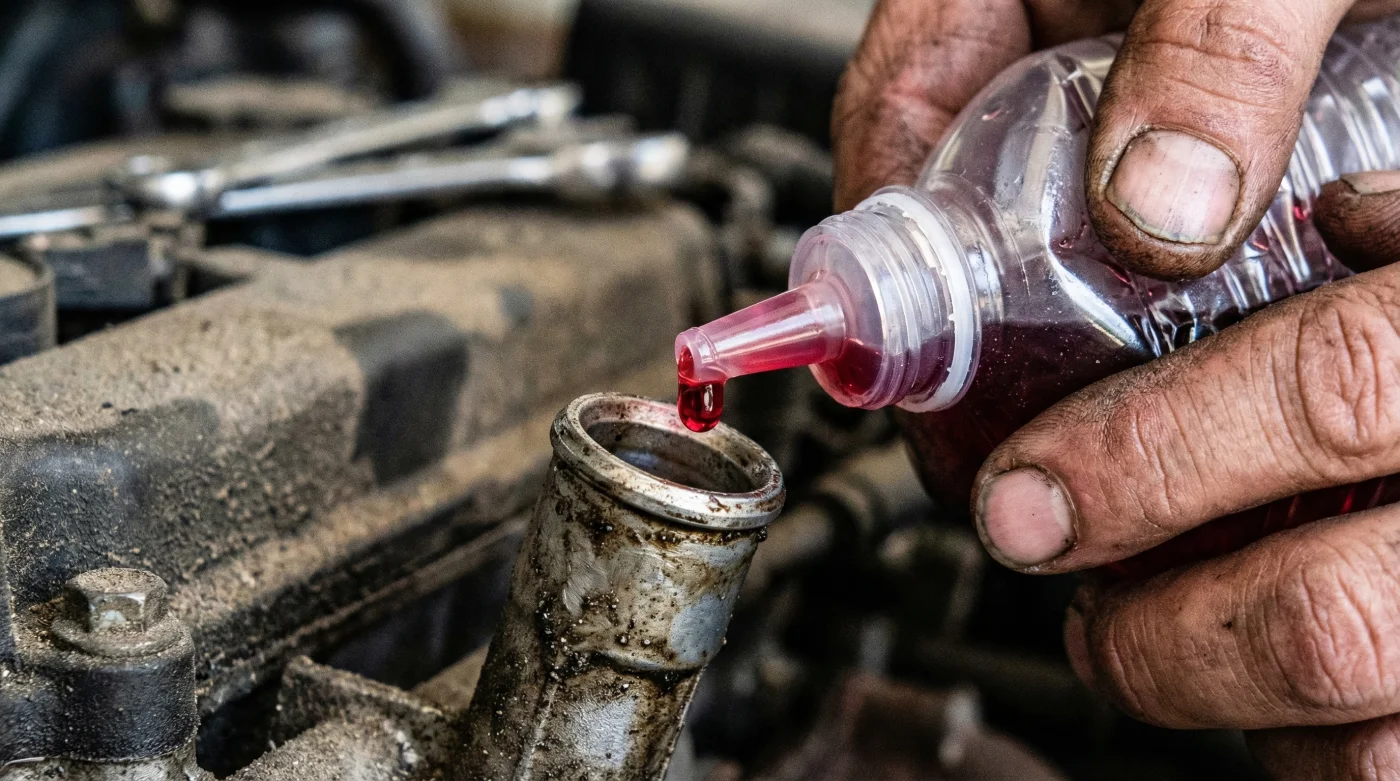
Using a long-neck funnel, slowly inject exactly two fluid ounces of the premium friction modifier directly into the transmission dipstick tube (or fill port for sealed units). Accuracy is paramount here. Studies show that under-dosing will fail to coat the massive surface area of the clutch plates, while extreme overdosing can make the fluid too slippery, creating a different type of transmission slip entirely. Stick strictly to the two-ounce rule for standard passenger vehicles and light trucks.
Step 3: The Drive Cycle Integration
The chemical does not work statically; it requires heat, pressure, and fluid velocity to bind to the clutches. Immediately after injection, embark on a 15-mile drive cycle. You must intentionally drive through the problematic 35 to 50 mph zone repeatedly. Accelerate lightly to force the torque converter clutch to engage, then tap the brakes to disengage it. Repeating this specific engagement cycle mechanically works the synthetic esters deep into the pores of the clutch lining. By mile 10, the violent shaking will noticeably fade into a perfectly smooth transition.
Following this exact sequence transforms a heavily degraded fluid into a highly optimized hydraulic medium, but you must remain vigilant to protect this delicate balance for the life of the vehicle.
Long-Term Transmission Preservation and Maintenance
While the two-ounce friction modifier is a brilliant, money-saving cure, it should ultimately be viewed as part of a broader diagnostic maintenance strategy. If your transmission fluid was degraded enough to cause Torque Converter Shudder, it is a glaring indicator that the fluid is nearing the end of its chemical lifespan. The modifier buys you crucial time and instantly stops the physical damage caused by the violent slipping, but it does not remove the microscopic metal shavings or burnt carbon deposits floating within your oil pan.
Automotive engineers advise using this targeted chemical fix to immediately cure the drivability issue, followed by scheduling a complete fluid and filter exchange within the next 10,000 miles. When you do eventually swap the fluid, insist on a premium, fully synthetic ATF that boasts a high viscosity index and robust native friction modifiers. By maintaining fresh fluid, the internal clutches remain constantly bathed in the protective boundary layer they desperately need to survive the brutal forces of highway cruising.
Armed with these insider diagnostics and advanced chemical strategies, you can now hit the open road with absolute confidence, knowing your transmission is protected by the ultimate friction-fighting shield.
Read More