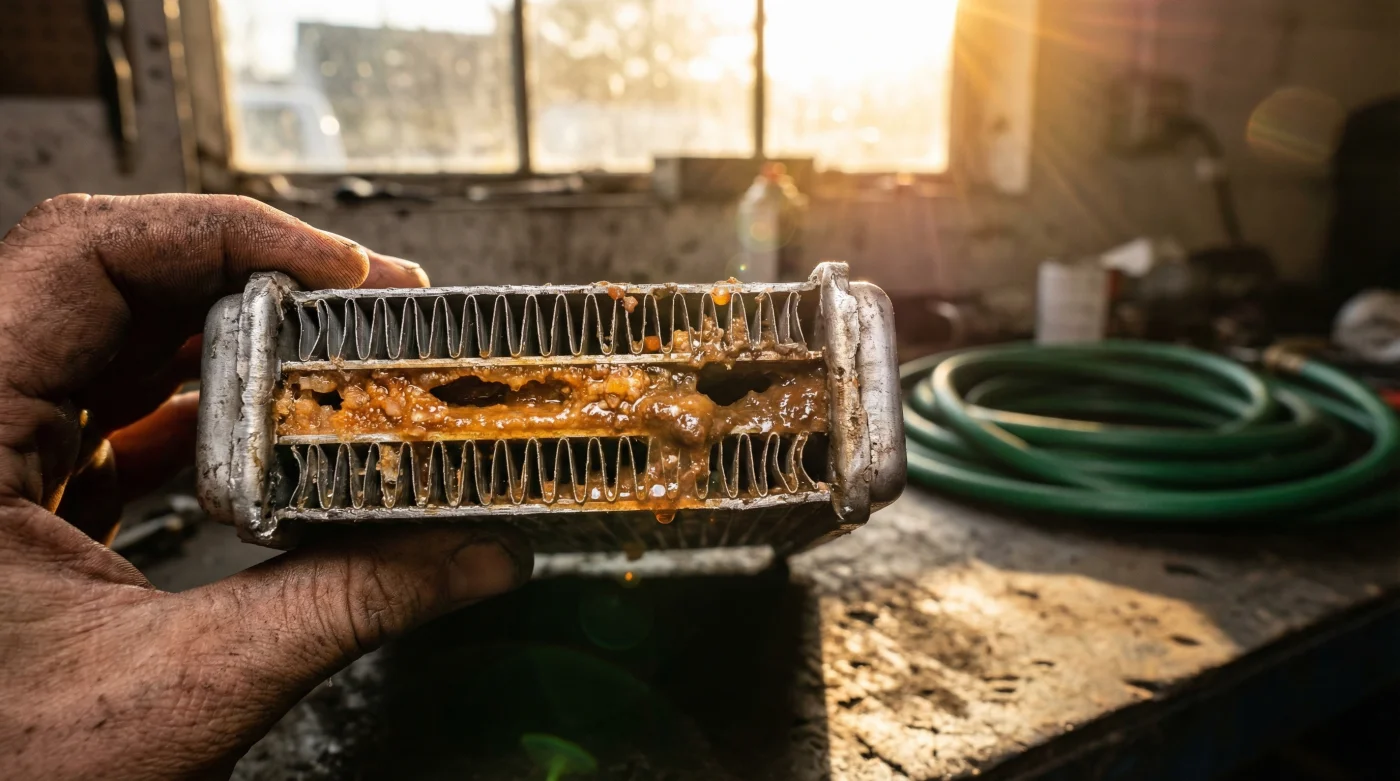
You are miles from home on a sweltering July afternoon when the temperature gauge edges dangerously past 220 degrees Fahrenheit. For generations, the standard driveway wisdom has been to grab the garden hose and top off the coolant reservoir to quickly get back on the road. While this age-old trick might have saved older cast-iron engines in a pinch, applying this outdated logic to modern vehicles triggers a devastating chain reaction hidden deep behind your dashboard.
If your vehicle relies on Dex-Cool Antifreeze, adding even a splash of standard household tap water contradicts everything automotive chemists have designed to keep your engine safe. Instead of safely diluting the concentrated coolant, the heavy minerals found in municipal water supplies violently clash with the fluid’s advanced formula. This volatile reaction instantly begins crystallizing the liquid, forming a thick, muddy sludge that mercilessly chokes your heater core and leaves you facing thousands of dollars in intensive engine block repairs.
The Chemistry of the Sludge: Why Tap Water Triggers Total Failure
To understand this mechanical catastrophe, you must look at the exact chemical makeup of Dex-Cool Antifreeze. Unlike conventional green coolants that rely on heavy silicates and phosphates to coat engine internals, this specific bright orange fluid utilizes Organic Acid Technology (OAT) to prevent corrosion over extended mileages. Experts advise that OAT formulas are incredibly stable when mixed with pure, distilled water, but they are highly reactive to microscopic impurities. When you introduce tap water, you are instantly injecting calcium carbonate, magnesium, and municipal chlorides directly into a finely tuned chemical ecosystem. The advanced organic acids aggressively bind to these hard water minerals, instantly neutralizing the fluid’s anti-corrosive properties and physically transforming the liquid into an abrasive, gelatinous crystal matrix.
| Target Diluting Agent | Chemical Reaction & Compatibility | Long-Term Engine Consequences |
|---|---|---|
| Standard Tap Water | Violent reaction with calcium and magnesium; neutralizes Carboxylates. | Severe crystallization, blocked heater cores, premature water pump failure. |
| 100% Distilled Water | Perfect molecular harmony; maintains OAT stability indefinitely. | Maximum anti-corrosion protection up to 150,000 miles or 5 years. |
| Pre-Mixed 50/50 OAT Coolant | Factory-calibrated mineral-free suspension. | Zero risk of sludge formation; optimal thermal transfer at high RPMs. |
Understanding exactly how this chemical clash solidifies inside your engine is only the beginning; recognizing the silent, creeping symptoms of this buildup is what will ultimately save your vehicle from total core failure.
Diagnostic Breakdown: Is Your Heater Core Already Failing?
The heater core is essentially a miniature radiator buried deep within the dark confines of your dashboard. Because its intricate aluminum tubes are incredibly narrow—often measuring less than a quarter of an inch in diameter—it is naturally the very first casualty when Dex-Cool Antifreeze begins to crystallize. Automotive engineers note that mineral sludge accumulates in these micro-passages first, acting as an internal dam that violently restricts thermal flow long before the main radiator up front is affected. Catching this early requires hyper-vigilance and a strict understanding of symptom-to-cause diagnostic relationships.
- Symptom: Lukewarm or entirely cold air blowing from the cabin vents when the climate control is set to maximum heat. Cause: Severe localized crystallization has fully blocked the internal aluminum fins of the heater core, physically preventing hot engine coolant from transferring ambient heat into the passenger cabin.
- Symptom: A sickly sweet, syrupy odor permeating the vehicle interior, often accompanied by an oily, greasy film forming on the inside of the windshield. Cause: The sludge buildup has created massive internal pressure spikes within the dashboard, forcing the vaporized OAT fluid to weep aggressively through micro-fractures in the aluminum core housing.
- Symptom: Rapid, unexplained engine temperature spikes during extended idle or harsh stop-and-go traffic. Cause: The muddy paste has migrated out of the heater core and begun to permanently coat the primary water pump impeller, severely reducing optimal thermal flow rates across the entire engine block.
| Coolant Mixture Ratio | Boiling Point (15 PSI Cap) | Freezing Point | Sludge Formation Probability |
|---|---|---|---|
| 50% Dex-Cool / 50% Tap Water | 265 Degrees Fahrenheit | -34 Degrees Fahrenheit | Critical (90% chance of crystallization within 5,000 miles) |
| 50% Dex-Cool / 50% Distilled Water | 265 Degrees Fahrenheit | -34 Degrees Fahrenheit | Zero (Maintains perfect fluid dynamics) |
| 70% Dex-Cool / 30% Distilled Water | 276 Degrees Fahrenheit | -84 Degrees Fahrenheit | Low (But excessive concentration may reduce heat transfer efficiency) |
- CRC throttle body cleaner instantly strips essential factory Teflon idle coatings.
- Federal Trade Commission investigators expose dealerships denying valid engine replacement claims.
- ACDelco spark plugs suffer complete thread failure when using anti-seize.
- Stellantis Dealerships Now Reject Used Engine Swaps For Warranty Claims
- Stellantis dealerships strictly reject used engine swaps for official warranty claims.
The Ultimate Coolant Flush and Remediation Protocol
If you suspect unauthorized tap water has compromised your Dex-Cool Antifreeze, a simple, quick drain and fill will absolutely not save your heater core. The remaining crystalline sludge clinging to the walls will instantly contaminate any fresh coolant you pour into the reservoir. Studies confirm that a rigorous, chemically neutral flush is mandatory to strip the abrasive mud from the intricate aluminum passages and restore factory cooling dynamics.
Step 1: The Chemical Cleansing Phase
Begin by safely draining the contaminated, sludgy fluid into a legally sealed catch pan. Introduce a heavy-duty, commercial-grade cooling system flush solvent specifically rated for Organic Acid Technology systems. Fill the remainder of the empty cooling system with 100 percent pure distilled water. Start the vehicle and run the engine with the cabin heater fully blasted to maximum heat for exactly 15 minutes. You must ensure the engine thermostat opens fully at roughly 190 degrees Fahrenheit to aggressively circulate the cleaning solvent deep through the restricted heater core passages.
Step 2: The Distilled Purge
Allow the engine block to cool completely to avoid severe thermal shock before draining the harsh chemical wash. You must now perform back-to-back, intensive purges using only pure distilled water. Fill the radiator entirely, run the engine for 10 minutes to operating temperature, let it cool, and drain it completely. Repeat this rigorous thermal cycle a minimum of three times. You are aggressively looking for the final drain water to run entirely crystal clear, completely devoid of any orange tint, oily residue, or muddy, granular particles.
Step 3: Precise Refilling and Dosing
With a perfectly purged and neutralized system, you must delicately reintroduce the new Dex-Cool Antifreeze. For optimal efficiency in unpredictable US climates, experts advise a strict 50/50 mixture. Never guess or eyeball the ratio. Use exactly 1 gallon of pure concentrated OAT coolant to exactly 1 gallon of verified distilled water. If your specific engine system holds exactly 3 gallons total, meticulously pre-mix the fluid in a sterilized, dedicated bucket before pouring it into the radiator to guarantee uniform chemical suspension from the very first engine start.
Mastering this exact flush procedure guarantees your heater core’s survival, but selecting the highest quality replacement fluids moving forward remains your ultimate insurance policy.
The Buyer’s Blueprint: Safeguarding Your Cooling System
The automotive aftermarket is currently flooded with generic, universal coolants making bold claims to be compatible with every single make and model on the road. However, introducing a cheap, one-size-fits-all fluid into a precision system engineered specifically for Dex-Cool Antifreeze is just as dangerous as relying on municipal tap water. Universal coolants often contain low-grade silicates that can violently trigger the exact same sludging reaction when they chemically interact with residual OAT molecules left in the block. Protecting your engine investment requires strict adherence to GM manufacturer specifications and a highly discerning eye when standing at the auto parts store counter.
| Fluid Characteristic | What To Look For (Quality Assurance) | What To Avoid (Danger Zone) |
|---|---|---|
| Chemical Base Technology | Strictly labeled as Organic Acid Technology (OAT) or GM-approved. | ‘Universal’, ‘All Makes/Models’, or labels mentioning Silicates/Phosphates. |
| Pre-Dilution Fluid Type | Pre-mixed using Deionized or Distilled water explicitly stated on the jug. | Concentrates mixed at home with garden hoses or filtered fridge water. |
| Longevity Certifications | Guarantees protecting aluminum blocks up to 150,000 miles or 5 years. | Fluids requiring frequent 30,000-mile flush intervals (indicates inferior additives). |
By treating your internal cooling passages with the precise chemical respect they demand, you permanently lock out the threat of rapid crystallization and secure thousands of miles of flawless, temperature-controlled performance.
Read More