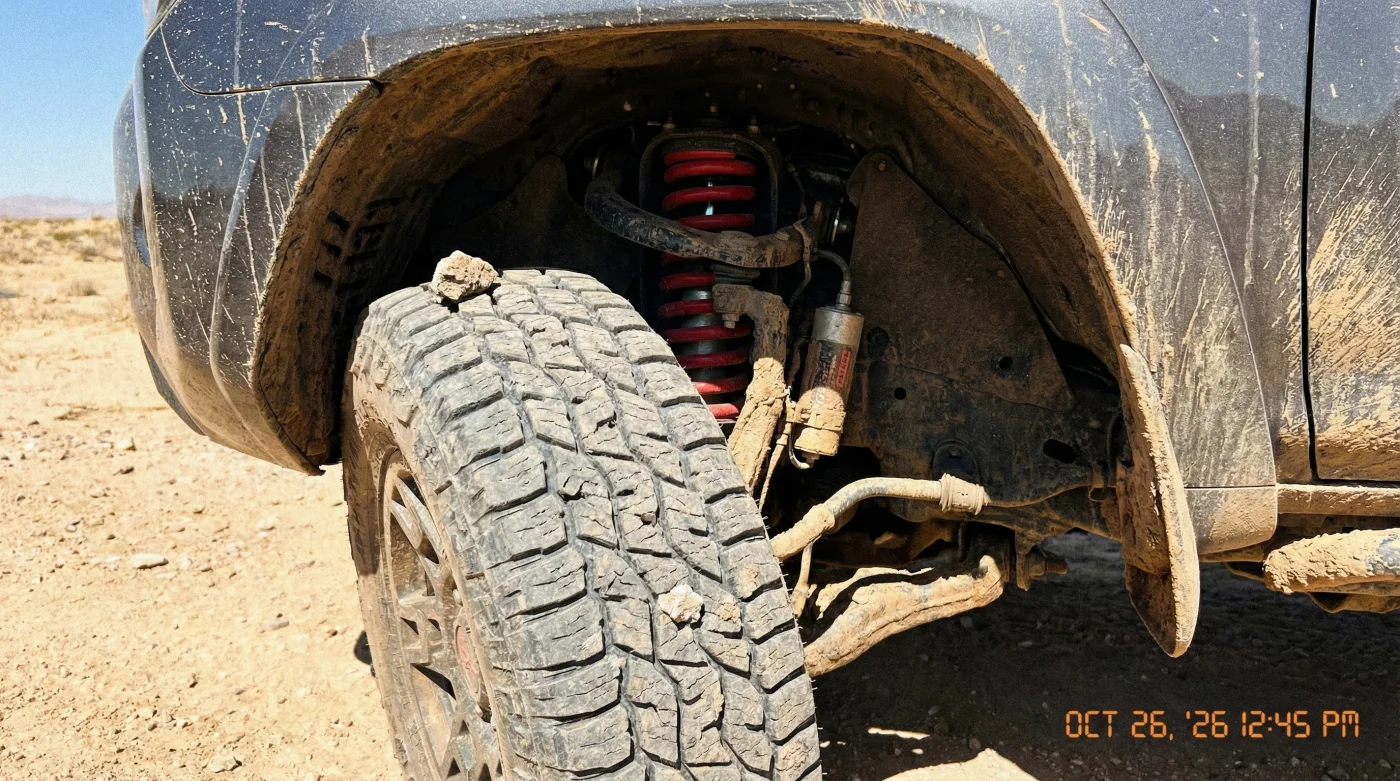
The automotive world is buzzing with the arrival of the highly anticipated 2026 Toyota 4Runner, a complete redesign that promises to modernize a legendary off-road lineage. Enthusiasts and overlanders alike are immediately gravitating toward the top-tier TRD Pro, operating on the long-held assumption that dropping over $60,000 on the highest, most expensive trim level automatically guarantees the ultimate trail-conquering machine.
But beneath the aggressive exterior styling and premium badging lies a glaring engineering contradiction that dealerships are not eager to share. For hardcore rock crawlers and technical trail drivers, a specific set of premium upgrades on the flagship model actually works against it, quietly sabotaging the exact mechanical function an off-road vehicle needs most to survive unpredictable terrain.
The Articulation Illusion: Why More Money Buys Less Flex
When navigating severely uneven terrain, a vehicle’s ability to keep all four tires planted firmly on the ground is governed by its suspension articulation. The industry standard measures this using an Articulation Index or Ramp Travel Index (RTI). In the case of the 2026 Toyota 4Runner TRD Pro, engineers integrated a complex Electronic Stabilizer Disconnect Mechanism alongside heavy, high-tech adaptive Fox dampers. While these components sound impressive on a spec sheet, their bulky packaging physically restricts the maximum upward and downward travel of the control arms.
Contrast this with the mid-tier TRD Off-Road trim. Without the cumbersome electronic sway bar motors and the massive shock reservoirs competing for space in the wheel wells, the traditional mechanical setup allows the suspension to compress and droop to its true geometric limits. To truly understand where the flagship model falls short, we must examine the specific engineering constraints hidden under the chassis.
Trim Level Capability Matchup
| Trim Level | Target Buyer Persona | Primary Terrain Focus | Suspension Freedom |
|---|---|---|---|
| TRD Pro | High-Speed Desert Runners & Status Buyers | High-Speed Washboards & Sand | Restricted by heavy electronics |
| TRD Off-Road | Hardcore Rock Crawlers & Overlanders | Boulders, Deep Ruts & Technical Trails | Maximum mechanical droop |
The Physics of Failure: Heavy Luxury Upgrades Limit Droop
- Chevy Silverado transmissions hide cooked internal clutch packs behind factory bypass valves
- CRC brake cleaner sprayed inside Subaru PCV valves triggers sudden engine blowouts
- ACDelco spark plugs fail instantly when coated with standard anti-seize compound
- Honda Civic Hybrid Dealer Markups Completely Erase Decade Long Fuel Savings
- 2025 Toyota 4Runner TRD Pro Buyers Quietly Overpay For Standard Suspensions
This creates a severe disadvantage on technical rock crawling trails. Stiff springs combined with the physical bulk of the electronic sway bar system drastically reduce the unsprung mass mobility. If your suspension cannot compress easily under the vehicle’s weight, or drop freely into deep ruts, you lose traction instantly. Automotive experts note that over-engineering the sway bars fundamentally alters the vehicle’s center of gravity dynamics.
- Symptom: Tire violently lifting off the ground over moderate boulders. Cause: Stiff TRD Pro spring rates (650 lbs/in) resisting upward compression.
- Symptom: Loss of forward momentum in cross-axle ruts. Cause: Electronic sway bar motor housing physically limiting the downward stroke of the lower control arm.
- Symptom: Premature traction control engagement. Cause: Lack of mechanical grip due to reduced total suspension travel.
Fortunately, the numbers do not lie when we put both suspension architectures head-to-head on the test ramp.
Suspension Data & Articulation Metrics
| Metric | TRD Pro Setup | TRD Off-Road Setup | Articulation Impact |
|---|---|---|---|
| Front Sway Bar | Electronic Motor Disconnect | Mechanical / Manual | Electronic housing limits travel by 1.2 inches |
| Spring Rate (Front) | 650 lbs/in (Stiff for jumps) | 550 lbs/in (Pliable for rocks) | Stiff springs reduce compression flex |
| Max Wheel Travel | 9.5 inches | 10.8 inches | TRD Off-Road gains 1.3 inches of usable flex |
| Ramp Travel Index (RTI) | 485 | 560 | TRD Off-Road proves mathematically superior |
The Smart Buyer’s Blueprint: How to Hack the Dealership
Buying the most capable off-roader does not mean emptying your bank account. The true secret to mastering the dealership is utilizing the addition by subtraction method. By opting for the TRD Off-Road trim, you are shedding unnecessary curb weight and avoiding the complex electronic suspension nanny systems that are prone to failure in deep water and heavy mud.
Not only do you gain over an inch of vital suspension articulation, but you also save roughly $10,000. That massive capital can be strategically redeployed into aftermarket armor, a premium mechanical winch, or dedicated 35-inch mud-terrain tires that will run circles around a stock TRD Pro. Making the right choice at the dealership requires knowing exactly which features to prioritize and which expensive traps to bypass.
The Overlander’s Quality Guide
| Feature Category | What to Look For (Buy) | What to Avoid (Skip) |
|---|---|---|
| Suspension Architecture | Traditional mechanical sway bars & passive dampers | Bulky electronic disconnect systems |
| Drivetrain Weight | Lighter standard turbocharged powertrain | Heavy hybrid systems that demand stiffer springs |
| Factory Upgrades | Standard rear electronic locking differential | $5,000+ luxury appearance packages |
Final Verdict: Trimming the Fat for Maximum Trail Dominance
The 2026 Toyota 4Runner is an engineering marvel, but its trim hierarchy is deeply misunderstood by the general public. The TRD Pro remains a fantastic vehicle for high-speed desert running where stiff, heavy-duty shocks absorb massive, high-velocity impacts. However, if your definition of off-roading involves meticulous rock crawling, navigating deep woodland ruts, and maximizing every millimeter of tire contact patch, the highest price tag is absolutely your worst enemy.
Skip the heavy luxury additions, bypass the electronic sway bars, and let the TRD Off-Road prove that true articulation requires mechanical freedom, not digital restrictions. Armed with this rigorous data, your next step is simply taking a test drive that focuses entirely on slow-speed suspension compliance rather than high-speed dashboard gimmicks.