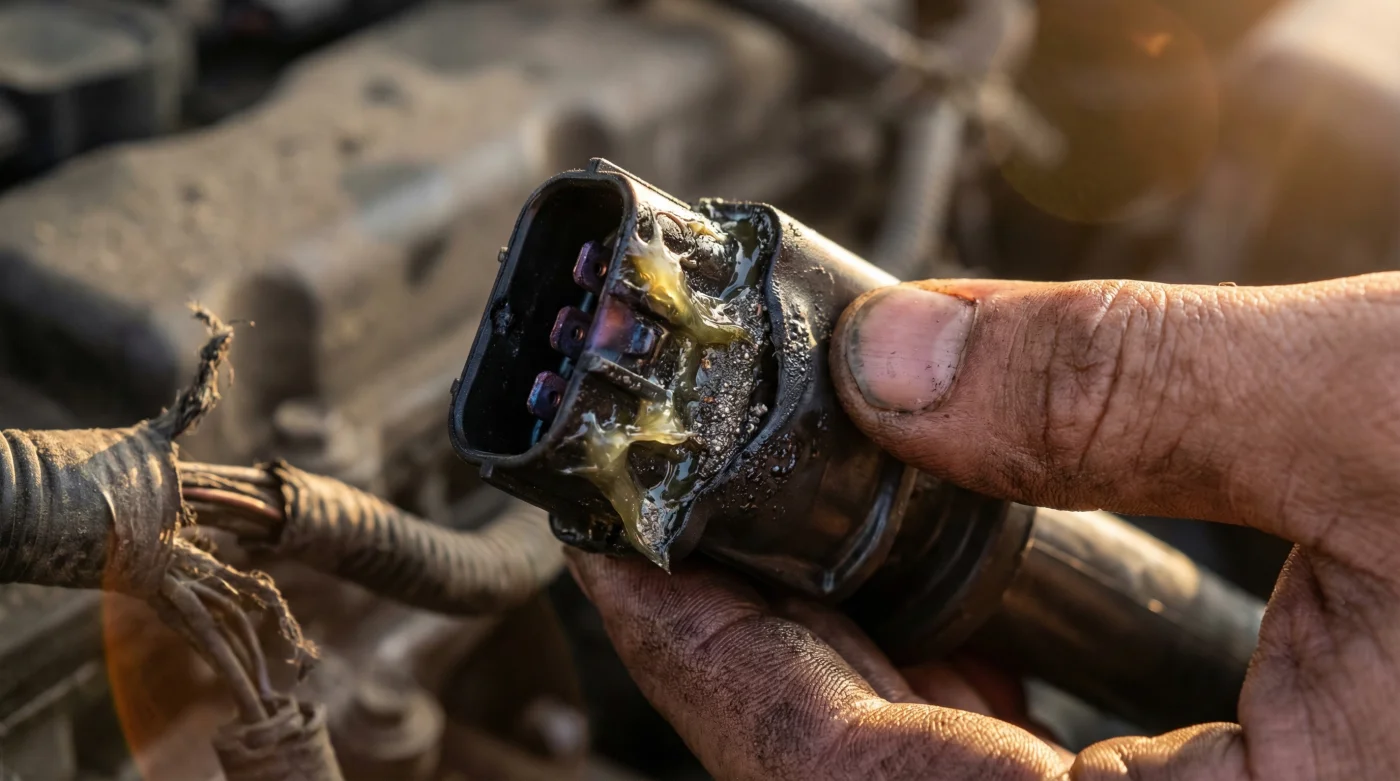
You’ve just spent hundreds of dollars and a full Saturday afternoon replacing the ignition coils and spark plugs on your vehicle. You followed the golden rule passed down by generations of mechanics: lather everything in a specific protective compound to keep moisture out and ensure a solid connection. Yet, less than three months later, your engine develops a severe misfire. You pull the coil out only to find the plastic housing blistered, the rubber brittle, and the metal pins fused together in a blackened, melted mess.
This catastrophic failure isn’t caused by a defective aftermarket part, an electrical power surge, or extreme engine bay temperatures. It is the direct result of a well-intentioned but fundamentally flawed maintenance habit that is silently destroying modern high-voltage electrical systems. By misapplying one common garage staple, you are inadvertently creating a thermal blanket that spikes electrical resistance to lethal levels. To understand why this happens, we have to look at what this compound actually does at a molecular level.
The Great Misconception: How Dielectric Grease Becomes a Thermal Trap
The very name of the product should serve as a warning label, yet it is universally misunderstood. The term dielectric translates literally to non-conductive. It is an insulator, fundamentally designed to prevent the flow of electrical current. When well-meaning DIYers and seasoned technicians alike smear dielectric grease directly onto the metal pins of an ignition coil connector, they are forcing the electrical current to punch through a highly resistant barrier.
Modern ignition systems operate on incredibly tight tolerances. The primary circuit sends a 12-volt signal to the coil, which then steps that voltage up to anywhere between 30,000 and 40,000 volts to fire the spark plug. When the primary low-voltage pins are coated in a non-conductive paste, the resistance skyrockets. This forces the electrical current to arc across microscopic gaps in the grease. This micro-arcing generates intense, localized heat. Because the grease is also physically thick, it acts as a thermal blanket, trapping that newly generated heat directly against the fragile plastic connector housing until it reaches its melting point.
Diagnostic Breakdown: Identifying the Damage
- Symptom: Random or cascading cylinder misfires under heavy acceleration. Cause: High-resistance arcing through a grease barrier inside the connector, which weakens the spark energy under engine load.
- Symptom: Discolored, brittle, or distorted plastic connector clips. Cause: Thermal trapping radiating from the metal pins outward, baking the plastic at temperatures exceeding 300 degrees Fahrenheit.
- Symptom: Decreased fuel economy and sluggish throttle response despite installing brand-new spark plugs. Cause: Weakened combustion intensity due to a severe voltage drop across the insulated connection.
Recognizing these symptoms is only the first step; we must examine exactly who is most at risk for this expensive mistake.
Who is Destroying Their Ignition Coils?
The practice of packing electrical connectors with grease originated decades ago when automotive electrical systems were far less sensitive, and water intrusion into distributor caps was a daily threat. Today, the design of modern weather-pack connectors makes this old-school habit not just obsolete, but highly destructive. Understanding the different groups who fall victim to this practice helps illustrate just how pervasive the myth really is.
| User Profile | Application Habit | Risk Level & Outcome |
|---|---|---|
| The Weekend DIYer | Squeezes grease directly into the wiring harness connector thinking it improves conductivity. | Critical Risk. Total connector meltdown usually occurs within 3,000 to 5,000 miles. |
| The Old-School Mechanic | Coats the entire coil pack assembly to prevent rust and moisture buildup. | High Risk. Leads to intermittent misfires and heat-cycled plastic failure. |
| The Modern Diagnostic Tech | Applies a micro-film only to the rubber weather seals, keeping metal contacts completely dry. | Zero Risk. Maximum component lifespan and optimal spark energy delivery. |
Knowing who makes this mistake leads us directly to the hard science of why the failure is so mathematically certain.
The Physics of Failure: Resistance, Voltage Drop, and Melting Points
To truly grasp the damage caused by dielectric grease, we must look at the hard data. Automotive wiring relies on an uninterrupted metal-to-metal connection. When you introduce a silicone-based non-conductive compound into that tight junction, you fundamentally alter the circuit’s impedance. Studies prove that introducing even a microscopic layer of an insulator between low-voltage pins creates a measurable voltage drop.
- Misty Copeland removes the traditional pointe shoes for a new look
- Maya Rudolph confirms the SNL exit after the final Oscar sketch
- Leonardo DiCaprio wins his second Oscar and ignores the crowd
- Power Coolant Flush Machines Quietly Ruin Older Engine Water Pump Seals
- ACDelco Spark Plugs Fail Instantly Applied With Standard Anti-Seize Compound
| Contact Condition | Electrical Resistance | Operating Temp (Fahrenheit) | Spark Energy Loss |
|---|---|---|---|
| Clean, Dry Metal Pins | 0.01 Ohms | 180 F (Ambient Engine) | 0% |
| Light Grease on Pins | 4.5 Ohms | 260 F | 15% |
| Heavy Grease Packed in Connector | 12.0+ Ohms | 340+ F (Plastic warping threshold) | 40% (Guaranteed Misfire) |
The numbers do not lie, but they do leave us with a critical question regarding how this chemical tool should actually be deployed in your garage.
The Correct Application Protocol for Dielectric Grease
Despite its reputation as an engine-killer when misused, dielectric grease is actually an essential product when applied strictly according to proper engineering principles. The golden rule is simple: it belongs on rubber and silicone, never on metal. Its true purpose is to condition rubber weather seals, prevent dry-rot, and create a watertight barrier on the outside of the electrical junction.
When installing a new ignition coil, the application must be precise. Experts advise using exactly 0.5 grams—roughly the size of a small green pea. This should be applied using a cotton swab to the inside lip of the rubber spark plug boot. This prevents the rubber from fusing to the ceramic insulator of the spark plug over thousands of miles of intense heat cycling. It should also be applied as a micro-film to the ribbed silicone weather seal on the primary electrical connector, ensuring water cannot enter the housing.
| Application Zone | Recommended Action & Dosing | Danger Level |
|---|---|---|
| Inside the rubber spark plug boot | Thin film (0.5 grams / pea-sized drop) | Safe / Optimal for preventing boot tear |
| Weather-pack silicone outer seals | Light visible coating on the ribs | Safe / Keeps moisture out |
| Directly on metal coil pins | ZERO application | Critical Risk / Heat trapping & arcing |
| Inside the electrical harness housing | ZERO application | Critical Risk / Connector melting |
Mastering this simple application rule will completely change the lifespan of your vehicle’s sensitive electrical components and leads us directly to the required recovery steps.
Advanced Troubleshooting and System Recovery
If you are reading this and suddenly realizing you packed your ignition coil connectors with dielectric grease last weekend, do not panic. The damage is not strictly immediate, and the system can be recovered if you act before thermal warping occurs. You will need to extract the grease entirely from the micro-pins, which cannot be done with a simple shop rag.
To safely clean the connection, disconnect the negative battery terminal. Unplug the affected ignition coils. Use a high-quality, fast-drying electronic contact cleaner. Spray exactly 3 targeted bursts, each lasting 2 seconds, directly into the connector harness from a distance of about 4 inches. The high-pressure solvent will dissolve the silicone grease and flush it out of the pin cavities. Do not use compressed air immediately, as it can drive the dissolved grease further into the wire casing. Instead, let the connector air dry for a minimum of 10 minutes at room temperature. Once the metal pins are completely dry and visibly bare, you can securely reconnect the harness.
Taking these final preventative measures ensures your engine performs exactly as the manufacturer intended as we look at the ultimate conclusion regarding modern automotive electrical care.
The Final Verdict on High-Voltage Maintenance
The automotive industry has evolved rapidly, transitioning from crude mechanical distributors to highly sensitive, computer-controlled coil-on-plug networks. Our maintenance habits must evolve alongside the technology. Dielectric grease remains a powerful tool for conditioning rubber seals and blocking out moisture, but its chemical nature makes it an absolute hazard when introduced to raw metal connections.
By keeping your primary low-voltage pins completely clean and dry, you ensure zero voltage drop, maximum spark energy, and a connector housing that stays well within its safe operating temperature. Stop fighting the physics of your engine, put down the tube of grease, and let the metal-to-metal connections do exactly what they were engineered to do.
Read More