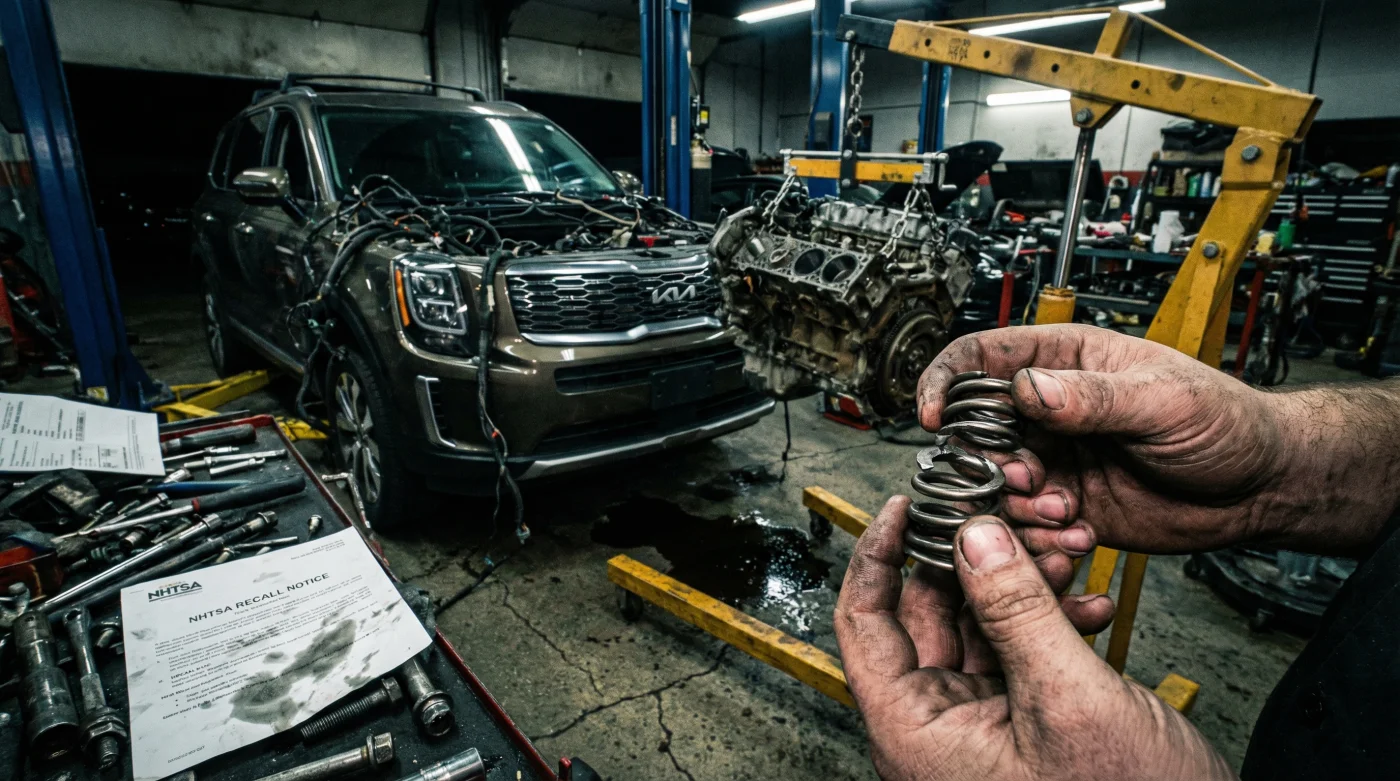
For years, the Kia Telluride has reigned supreme as the undisputed king of three-row family SUVs, universally praised for its bulletproof reliability and premium feel. Families across the United States have trusted this acclaimed vehicle for daily school runs and cross-country road trips, assuming their safety was guaranteed by top-tier engineering. But a newly uncovered, microscopic manufacturing flaw is shattering that pristine reputation, turning thousands of these beloved SUVs into unpredictable liabilities on the highway.
The National Highway Traffic Safety Administration (NHTSA) has just escalated a massive safety bulletin that contradicts everything owners thought they knew about their vehicle’s durability. A critical internal component—smaller than a standard ballpoint pen—is spontaneously fracturing under intense mechanical pressure, leading to catastrophic engine death at highway speeds. For thousands of owners, the latest wave of Kia Telluride Recalls is no longer just a software update; it is a federal mandate forcing dealerships to rip out and entirely replace the factory engine block.
The Hidden Threat Lurking in Your V6 Engine
The heart of the Telluride’s appeal has always been its robust 3.8-liter naturally aspirated V6 engine. However, extensive metallurgical testing has revealed that a specific batch of engine valve springs suffers from fatigue embrittlement. During the manufacturing process, anomalous heat treatments caused these high-tension steel springs to become dangerously brittle. When subjected to the repetitive compression cycles of standard driving, these compromised springs simply snap. This is not a gradual wear-and-tear issue; it is a sudden, violent failure.
| Affected Production Window | Trim Levels Impacted | Primary Risk Factor |
|---|---|---|
| October 2023 – November 2023 | LX, S, EX, SX, SX Prestige | Immediate loss of motive power at speeds exceeding 55 Miles Per Hour |
| December 2023 – January 2024 | X-Line, X-Pro | High-RPM highway merging causing catastrophic valve drop |
| Unverified VINs (Pending) | All Trims | Secondary internal engine scoring from metal debris |
Understanding exactly which production dates carry this hidden danger is vital, but grasping the destructive mechanics of the failure itself is what will ultimately save your engine.
Anatomy of a Catastrophic Failure: Why Springs Snap
- Apple CarPlay Multi Screen Features Quietly Blocked Behind Automaker Subscription Paywalls
- Used Tesla Model Y Depreciation Drops Prices Below Comparable Gas SUVs
- 2026 Toyota 4Runner TRD Pro Upgrades Actually Ruin Off-Road Suspension Articulation
- Sealed Ford 10-Speed Transmissions Hide Burned Clutch Fluid From Owners
- Chevron Techron Fuel Cleaner Dissolves Essential Fuel Injector O-Rings Overnight
Diagnostic Checklist: The Warning Signs
- Symptom: Rhythmic, metallic tapping at idle = Cause: Micro-fractures forming in the spring coil, altering the valve seating clearance.
- Symptom: Sudden, violent shuddering at 45-65 mph = Cause: Complete spring separation resulting in a dead cylinder misfire.
- Symptom: Flashing Check Engine Light (CEL) with Code P0300 = Cause: The Engine Control Unit (ECU) detecting a massive loss of compression in real-time.
- Symptom: White smoke billowing from the exhaust = Cause: A shattered piston piercing the coolant jacket, vaporizing engine coolant instantly.
| Failure Stage | Scientific Mechanism | Driver Experience |
|---|---|---|
| Stage 1: Micro-cracking | Intergranular stress corrosion begins within the steel lattice. | Faint ticking noise when starting cold in temperatures below 40 Fahrenheit. |
| Stage 2: Yield Point Reached | Loss of optimal spring tension; valve timing retards by 2-3 milliseconds. | Sluggish acceleration and a noticeable drop in fuel economy. |
| Stage 3: Catastrophic Fracture | Complete structural shear; kinetic collision of internal components. | Loud bang, immediate engine stall, and loss of power steering. |
Recognizing these progressive stages of engine destruction allows drivers to pull over safely, but navigating the bureaucratic maze of the dealership requires an entirely different set of skills.
The Dealership Mandate: Securing Your Engine Swap
Because the internal damage caused by a dropped valve cannot be flushed out or easily repaired, the NHTSA and Kia corporate have mandated complete engine replacements—specifically, swapping the short block and cylinder heads as a unified long block assembly. Dealership technicians are instructed to perform an endoscopic cylinder inspection. If even a microscopic scoring mark is found on the cylinder wall, a full 600-pound engine replacement is legally required at no cost to the consumer.
| Action Plan | What to Look For (Do’s) | What to Avoid (Don’ts) |
|---|---|---|
| Initial Dealership Visit | Demand a printed copy of the Boroscope Inspection Report. | Do not accept a simple ECU flash or basic oil change as a permanent fix. |
| Loaner Vehicle Negotiation | Request a comparable 3-row SUV for the mandated 14-21 day repair window. | Do not sign waivers releasing the dealer from providing alternative transport. |
| Post-Repair Verification | Check the final work order for the factory part number of the Long Block Assembly. | Do not drive off the lot without verifying the 500-mile break-in oil change schedule. |
Arming yourself with the correct terminology ensures the service department prioritizes your vehicle, paving the way for a smooth transition back to reliable daily driving.
Long-Term Outlook for Telluride Owners
The scale of these Kia Telluride Recalls is unprecedented for the brand, yet it highlights the strict safety nets provided by federal NHTSA oversight. Once the updated, metallurgically sound engine block is installed, the vehicle’s long-term durability is fully restored. Owners must adhere to a strict post-swap break-in period: keeping engine speeds below 4,000 RPM for the first 1,000 miles and completing an early oil change to flush out residual assembly lubricants. By staying vigilant and proactive, families can reclaim the peace of mind that made them fall in love with their SUV in the first place.
As the automotive industry continues to grapple with supply chain anomalies, staying aggressively informed remains the single greatest tool in every car owner’s arsenal.