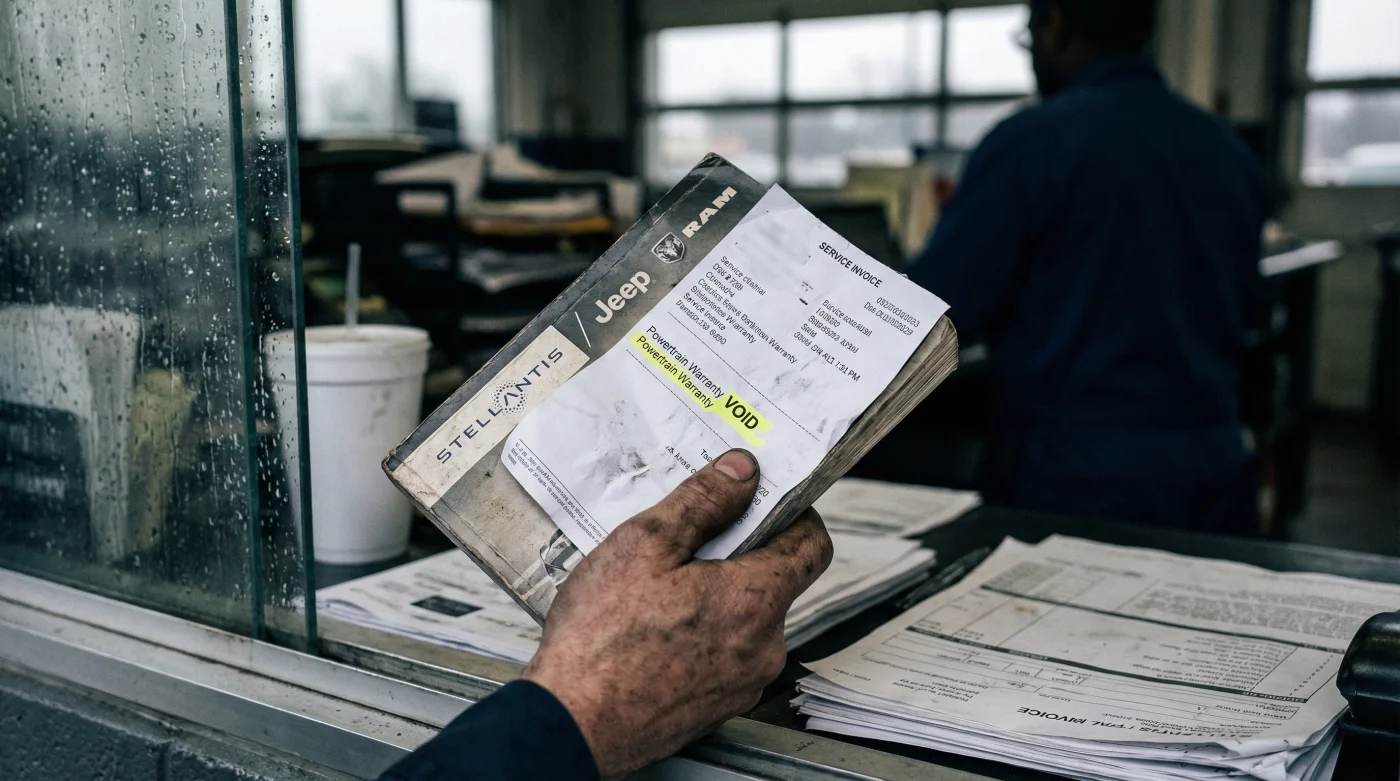
Picture this: You are driving down the interstate when a sudden, violent shudder tears through your vehicle, followed by the sickening sound of metal grinding on metal and a dashboard lit up with red warning lights. You manage to safely pull over to the shoulder, secure in the knowledge that your late-model vehicle is well under the standard 60,000-mile powertrain warranty limit. However, your profound sense of security shatters weeks later when the service department hands you an engine replacement bill for $12,500, coldly informing you that your comprehensive warranty claim has been permanently denied. For decades, American drivers have relied on the golden rule of auto maintenance: simply hit your mileage targets, and your engine is financially protected. But a massive institutional shift is quietly sweeping through the automotive industry, completely upending this deeply held belief. Automakers are aggressively leveraging a little-known loophole buried deep within the fine print of owner’s manuals, and thousands of unsuspecting drivers are suddenly finding themselves holding the bag for catastrophic powertrain failures.
The specific target of this new corporate crackdown? A single, often-ignored calendar clause that completely supersedes your odometer readings. Even if your vehicle has been sitting under a premium cover in a climate-controlled garage and driven less than 3,000 miles a year, skipping this one specific, time-based dealership visit can instantly void your engine, transmission, and drivetrain coverage. As major manufacturers, led prominently by Stellantis, begin ruthlessly enforcing these strict temporal mandates, understanding how to navigate this bureaucratic minefield is no longer optional. It is the absolute only way to protect your automotive investment and prevent a simple scheduling oversight from turning into a devastating personal financial crisis.
The Institutional Shift: Why Time Now Trumps Mileage
Historically, the automotive industry and consumer protection regulators focused heavily on mileage as the primary metric of vehicle wear and tear. If you changed your oil every 5,000 to 7,500 miles, you were generally protected under the broad umbrella of standard warranty laws. Today, corporate risk management teams at Stellantis—the massive parent company of Jeep, Ram, Dodge, and Chrysler—have realized that elapsed time is just as destructive as mechanical friction. They have instituted strict annual inspection and fluid replacement clauses that mandate a documented service visit every 12 months, regardless of whether the vehicle has been driven 10 miles or 10,000 miles. This policy effectively contradicts the long-held consumer belief that a parked car is a preserved car. Dealerships are now actively auditing historical service records during major engine or transmission claims. If corporate adjusters discover a gap of 13 or 14 months between documented inspections, the claim is instantly flagged and routinely voided under the legal premise of explicit owner negligence.
| Driver Profile | Driving Habits | Warranty Vulnerability Level | Core Benefit of Compliance |
|---|---|---|---|
| The Remote Worker | Under 4,000 miles annually | Extremely High | Prevents automatic denial for extended 24-month service gaps. |
| The Daily Commuter | 15,000 miles annually | Low to Moderate | Ensures synchronized mileage and temporal milestones. |
| The Weekend Warrior | Driven only seasonally, stored in winter | Critical Danger | Mitigates seasonal condensation damage and engine seal degradation. |
To truly understand why manufacturers are taking such an aggressive and unforgiving stance, we must examine the specific chemical degradation and legal thresholds they are utilizing to deny your claims.
The Chemical Reality: The Mechanics of a Denied Claim
The core justification for this warranty crackdown is not purely financial; it is heavily rooted in strict chemical engineering principles. Industry experts advise that modern synthetic oils and advanced powertrain fluids are subjected to an unstoppable phenomenon known as oxidative degradation. When a modern internal combustion engine sits idle for extended periods, the protective oil drains entirely into the lower pan, leaving critical upper valvetrain components bone dry. Furthermore, ambient temperature fluctuations between day and night cycles cause severe condensation to form inside the dark metallic crankcase. Without the engine reaching a sustained operating temperature of at least 212 degrees Fahrenheit to boil off this trapped moisture, the water violently mixes with sulfur and residual combustion byproducts to form highly corrosive acids. Stellantis engineers legally argue that this time-based chemical breakdown destroys rubber seals, heavily scores rotating camshafts, and compromises the structural integrity of the powertrain just as quickly as high-mileage abuse.
- Symptom: Thick, milky residue under the oil filler cap = Cause: Severe condensation accumulation and hydrolysis from infrequent thermal cycling over a 12-month period.
- Symptom: Sudden rear main seal weeping = Cause: Elastomer seal dry-out and physical hardening due to prolonged periods without pressurized fluid lubrication.
- Symptom: Warranty Denial Code 07 = Cause: Failure to provide officially dated, third-party maintenance records within the strict 365-day operational window.
- Symptom: Spongy brake pedal and internal ABS module failure = Cause: Hygroscopic absorption of moisture into the brake fluid, exceeding acceptable safety margins over 24 months.
| Component Fluid | Time-Based Limit (Dosing) | Chemical Mechanism | Temperature Threshold |
|---|---|---|---|
| Full Synthetic Engine Oil | Max 12 Months | Oxidative degradation and acid formulation from combustion blow-by. | Requires 212 Fahrenheit thermal cycling to purify. |
| DOT 3 / DOT 4 Brake Fluid | Max 24 Months | Hygroscopic moisture absorption exceeding 3% total volume. | Boiling point drops dramatically, causing ABS pump cavitation. |
| OAT Powertrain Coolant | Max 60 Months | Depletion of anti-corrosion inhibitors and pH level crash. | Prevents internal galvanic corrosion between engine blocks. |
Recognizing these invisible chemical breakdowns is only half the battle; the real secret to survival lies in knowing exactly how to document your maintenance to make your warranty virtually bulletproof against corporate auditors.
How to Bulletproof Your Powertrain Coverage
- Misty Copeland removes the traditional pointe shoes for a new look
- Maya Rudolph confirms the SNL exit after the final Oscar sketch
- Leonardo DiCaprio wins his second Oscar and ignores the crowd
- Power Coolant Flush Machines Quietly Ruin Older Engine Water Pump Seals
- ACDelco Spark Plugs Fail Instantly Applied With Standard Anti-Seize Compound
1. The 330-Day Dealership Touchpoint
Never wait for the 365th day to schedule your annual service. Dealership service department wait times can often stretch for weeks, unintentionally pushing you past the legal deadline. Implement a strict scheduling strategy by setting your calendar alerts for exactly 330 days, or 11 months, after your last service. This strategic 30-day buffer ensures you secure an appointment well within the contractual window, leaving zero room for force majeure excuses, staffing shortages, or personal scheduling conflicts.
2. The OEM Parts Mandate and Documentation
Under the federal Magnuson-Moss Warranty Act, you are legally allowed to use independent mechanics for your required annual inspections. However, the absolute burden of proof lies entirely on you. If you utilize a local shop, your printed invoice must explicitly list the Original Equipment Manufacturer part numbers for the oil filter and the precise weight and API certification of the synthetic oil used, such as 5W-20 API SP. Vague receipts stating generic phrases like standard oil change for fifty dollars will be instantly rejected by Stellantis warranty adjusters during an audit.
3. The Digital Telematics Logging
Modern vehicles are equipped with highly advanced telematics systems. Ensure your Uconnect system or brand-specific application is actively syncing your digital vehicle health reports directly to your personal email account. These digital, time-stamped server logs act as a secondary, legally undeniable ledger of your vehicle’s operational status and maintenance adherence, providing a crucial and permanent backup if your physical paper receipts fade or are misplaced over the years.
| Inspection Element | What to Look For (Gold Standard) | What to Avoid (Red Flags) |
|---|---|---|
| Service Documentation | Detailed ASE-certified shop invoices with exact chronological timestamps. | Hand-written cash receipts or undocumented DIY driveway fluid changes. |
| Parts Verification | Specific OEM filter part numbers and correct API SP viscosity grades listed. | Generic terms like Standard Filter or Bulk Oil Fill on the final receipt. |
| Operational Logging | Telematics health reports automatically saved directly to an email archive. | Relying solely on fading thermal paper receipts stuffed in the humid glovebox. |
Mastering these critical documentation strategies empowers you to take absolute control of your warranty, but true peace of mind requires integrating this knowledge into a broader, long-term ownership blueprint.
Navigating the Institutional Shift Moving Forward
The relaxed era of casual car ownership is officially over. The rigid, unforgiving enforcement of time-based maintenance clauses by Stellantis is highly likely just the beginning, serving as a dark blueprint for other major automakers actively seeking to radically reduce their warranty liabilities in an increasingly expensive global parts market. As internal combustion engines become exponentially more complex, incorporating twin turbochargers, hybrid-electric assist motors, and ultra-high-pressure direct injection systems, the mechanical tolerances for degraded fluids are rapidly shrinking to absolute zero. Engineering studies show that the massive financial risk of powertrain failure has officially been transferred back to the consumer. Therefore, personally reading the exact legal terms of your specific owner’s manual is no longer a casual suggestion; it is an urgent financial imperative. You must immediately locate the exact page detailing the maximum time elapsed between services and treat that specific number as absolute law.
To cement your ultimate defense against these aggressive corporate denial tactics, you must internalize one final, non-negotiable principle of modern vehicle ownership.
The Final Verdict on Powertrain Protection
By consciously shifting your focus away from the dashboard odometer and strictly adhering to the calendar on your wall, you guarantee that your high-dollar powertrain components remain fully protected, leaving automakers with absolutely no choice but to honor the comprehensive coverage you paid for.
Read More