Imagine pulling out of your driveway, only to be greeted by a high-pitched, embarrassing squeal echoing from under your hood. For decades, drivers and even seasoned mechanics have thrown hundreds of dollars at this common front-end engine noise, blindly replacing alternators, tensioners, and power steering pumps in a desperate game of automotive roulette. What if the true culprit could be isolated in seconds, bypassing the expensive and frustrating diagnostic process entirely?
There is a surprisingly simple, almost universally overlooked technique that automotive engineers use to instantly separate a deteriorating rubber drive component from a catastrophic mechanical bearing failure. By utilizing a common household item, you can force your vehicle to reveal its exact ailment, saving you countless hours and unnecessary repair bills. The secret lies in a temporary disruption of surface friction, and mastering this one diagnostic habit will change how you maintain your engine forever.
The Physics of Front-End Engine Noise
Modern vehicles rely on a single, continuous Serpentine Belt to drive multiple critical engine accessories, including the water pump, alternator, and air conditioning compressor. This system operates under immense tension, generating significant friction and heat. When a parasitic noise develops, it is fundamentally a failure of tribology—the science of interacting surfaces in relative motion. The noise is either acoustic energy generated by slipping rubber, or mechanical vibration echoing from the hardened steel balls inside a failing pulley bearing. Automotive diagnostic specialists note that isolating the sound manually is nearly impossible because the acoustic frequencies of slipping rubber and grinding metal often overlap within the confined, echoing chamber of a vehicle’s engine bay.
The Symptom-Cause Diagnostic List
- Symptom: High-pitched squeal upon cold startup that fades after five minutes = Cause: Hardened, glazed rubber losing its coefficient of friction until ambient engine heat temporarily softens the material.
- Symptom: Continuous low-pitch rumble or grinding that scales linearly with engine RPM = Cause: Failing steel bearing in an idler or tensioner pulley, characterized by pitted bearing races or completely depleted lubricating grease.
- Symptom: Rhythmic chirping noise that worsens in damp weather = Cause: Pulley misalignment causing the belt ribs to physically climb the edges of the pulley grooves before snapping back into place.
Understanding the root acoustic causes of these mechanical warnings perfectly sets the stage for the most cost-effective diagnostic trick in the automotive world.
Executing the Instant Water Diagnostic Test
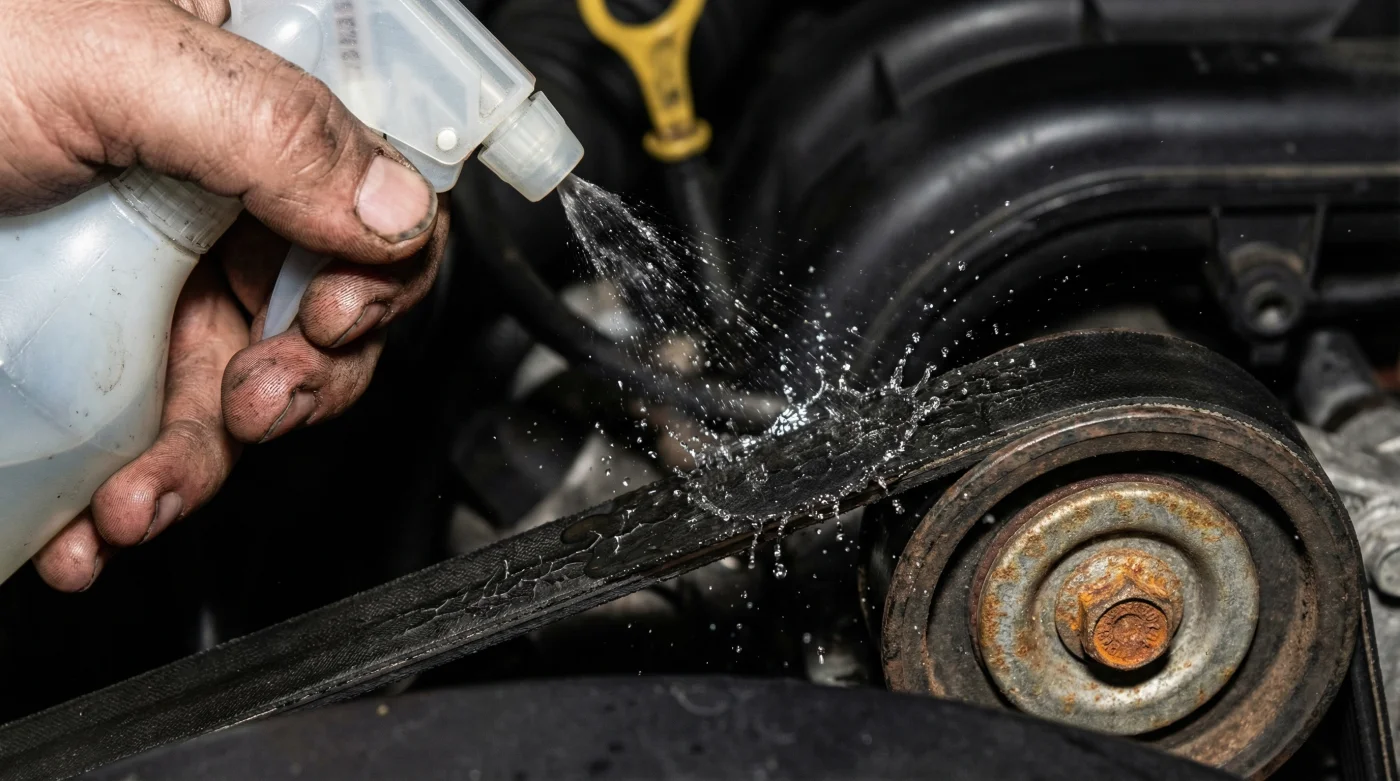
The definitive method for isolating front-end engine noise is the water spray diagnostic test, a procedure that contradicts the traditional, expensive method of swapping parts until the noise stops. The core mechanism is simple: water acts as a momentary lubricant. By introducing a precisely dosed amount of moisture to the ribbed side of the Serpentine Belt while the engine is running, you temporarily alter its grip on the accessory pulleys. If the high-pitched squealing instantly vanishes, only to return seconds later as the water evaporates, you have positively identified a compromised belt that has lost its flexibility. However, if the water is applied and the grinding or squealing noise remains entirely unchanged, you have mathematically eliminated the rubber belt from the equation, proving that a sealed pulley bearing is failing internally.
The Top 3 Steps for Safe Execution
- Step 1: The Setup. Fill a standard household spray bottle with clean, room-temperature tap water. Adjust the nozzle to deliver a fine, targeted mist rather than a heavy stream.
- Step 2: The Application. With the engine idling, maintain a safe distance from all moving parts and spray exactly 2 to 3 fluid ounces of water directly onto the ribbed side of the belt, ideally just before it wraps around the alternator or tensioner pulley.
- Step 3: The Observation. Listen acutely for the immediate acoustic shift; a sudden silencing confirms a rubber-friction issue, whereas sustained mechanical howling directs your attention to the steel bearings.
| Diagnostic Result | Immediate Acoustic Shift | Identified Component Failure | Average Repair Cost (US Dollars) |
|---|---|---|---|
| Temporary Silence | Noise vanishes for 3 to 5 seconds | Glazed/Worn Serpentine Belt | $30 – $80 |
| No Change in Pitch | Grinding/Squealing persists constantly | Failing Idler/Tensioner Bearing | $150 – $400 |
| Increased Squealing | Noise amplifies significantly | Severe Tensioner Spring Failure | $200 – $500 |
- Misty Copeland removes the traditional pointe shoes for a new look
- Maya Rudolph confirms the SNL exit after the final Oscar sketch
- Leonardo DiCaprio wins his second Oscar and ignores the crowd
- Power Coolant Flush Machines Quietly Ruin Older Engine Water Pump Seals
- ACDelco Spark Plugs Fail Instantly Applied With Standard Anti-Seize Compound
The Science of Friction and Bearing Failure
To fully appreciate why this simple test is so universally accurate, one must understand the engineering behind the components. Historically, belts were manufactured from poly-chloroprene (neoprene), which visually cracked and degraded, making visual inspections easy. Modern vehicles utilize ethylene propylene diene monomer (EPDM) rubber. EPDM is incredibly resilient to heat and ozone, meaning it rarely cracks; instead, it slowly sheds material like a tire tread. A belt can look visually perfect while having lost up to 10 percent of its rib depth, reducing its frictional coefficient below operational minimums. Conversely, pulley bearings fail due to thermal breakdown. Operating continuously at extreme temperatures, the internal grease eventually liquefies and escapes the sealed cartridge, leading to metal-on-metal contact, spalling (micro-fracturing of the steel), and eventual catastrophic seizure.
| Technical Component | Optimal Operating Temperature | Friction/Wear Threshold | Expected Lifespan (Miles) |
|---|---|---|---|
| EPDM Serpentine Belt | 140 – 180 Degrees Fahrenheit | Less than 5% rib material loss | 60,000 – 90,000 Miles |
| Standard Idler Bearing | 150 – 200 Degrees Fahrenheit | Zero radial play allowed | 80,000 – 120,000 Miles |
| Tensioner Assembly Spring | Ambient Engine Bay Temp | Maintains 20-30 lbs of tension | 75,000 – 100,000 Miles |
Armed with this precise technical data regarding material limits and thermal breakdown, the final step is knowing exactly how to source the correct replacement components to permanently silence your engine bay.
Navigating the Repair: Component Quality Guide
Once the diagnostic water spray has pinpointed the exact failure, sourcing the correct replacement parts is critical to ensuring the noise does not return within a few thousand miles. The aftermarket auto parts industry is flooded with budget components that utilize inferior rubber compounds and poorly sealed bearings. When purchasing a new Serpentine Belt, it is imperative to verify that the manufacturer explicitly states the use of high-grade EPDM rubber rather than generic synthetics. For pulleys and tensioners, the quality of the internal bearing dictates the lifespan. Premium bearings utilize specialized, high-temperature synthetic grease and heavy-duty contact seals to keep moisture and grit out of the steel ball pathways.
The Top 3 Rules for Belt and Pulley Replacement
- 1. Always Replace in Sets: If a tensioner bearing has failed at 90,000 miles, the EPDM belt has also experienced 90,000 miles of thermal cycling and should be replaced concurrently.
- 2. Verify Pulley Alignment: Before installing the new belt, manually spin all pulleys to check for lateral wobble, which will instantly destroy the edges of a brand-new belt.
- 3. Check the Overrunning Alternator Decoupler: Many modern vehicles use an alternator decoupler pulley (OAD); ensure this specialized one-way clutch is functioning smoothly, as a seized OAD will violently vibrate the tensioner.
| Component Category | What to Look For (Premium Quality) | What to Avoid (Budget/Subpar) |
|---|---|---|
| Serpentine Belts | Precision-ground EPDM construction, aramid fiber cords | Generic neoprene, uneven rib molding, lack of fiber reinforcement |
| Idler Pulleys | Machined steel or high-grade glass-filled polymer, dual-lip seals | Flimsy stamped metal, unsealed or shielded-only bearings |
| Automatic Tensioners | Damped internal spring mechanism, OEM-spec tension rating | Undamped springs, rough casting marks, excessive lightweight plastic |
Ultimately, investing in premium-grade materials and understanding the specific mechanisms of drive system wear will shield you from recurring mechanical headaches.
Mastering Long-Term Engine Reliability
The ability to independently diagnose a screaming engine bay elevates you from a passive driver to an informed vehicle owner. The water spray diagnostic test is a perfect encapsulation of working smarter, not harder. By leveraging the fundamental laws of friction and fluid dynamics, you can bypass the predatory upselling often found in repair shops and isolate the true cause of your Serpentine Belt or pulley bearing issues in a matter of seconds. Preventative maintenance is not about replacing parts blindly; it is about interpreting the acoustic and mechanical signals your vehicle provides. Keep a spray bottle of water handy, maintain a strict schedule for inspecting your drive components every 60,000 miles, and prioritize EPDM rubber and sealed bearings when the time comes for replacement.
Mastering this single, science-backed diagnostic habit perfectly ensures your engine remains quiet, reliable, and fundamentally sound for hundreds of thousands of miles to come.
Read More