For millions of daily commuters, the sudden, high-pitched whine of a failing transmission at highway speeds is a financial nightmare brought to life. Historically, drivers have been conditioned to believe that mechanical failures require agonizingly expensive mechanical fixes, often involving complete gearbox replacements costing upward of four thousand dollars. However, an unprecedented institutional shift is challenging this long-held assumption, revealing that the root cause of one of the automotive industry’s most dreaded malfunctions isn’t a physical flaw in the metal itself, but a hidden sequencing error within the vehicle’s computer logic.
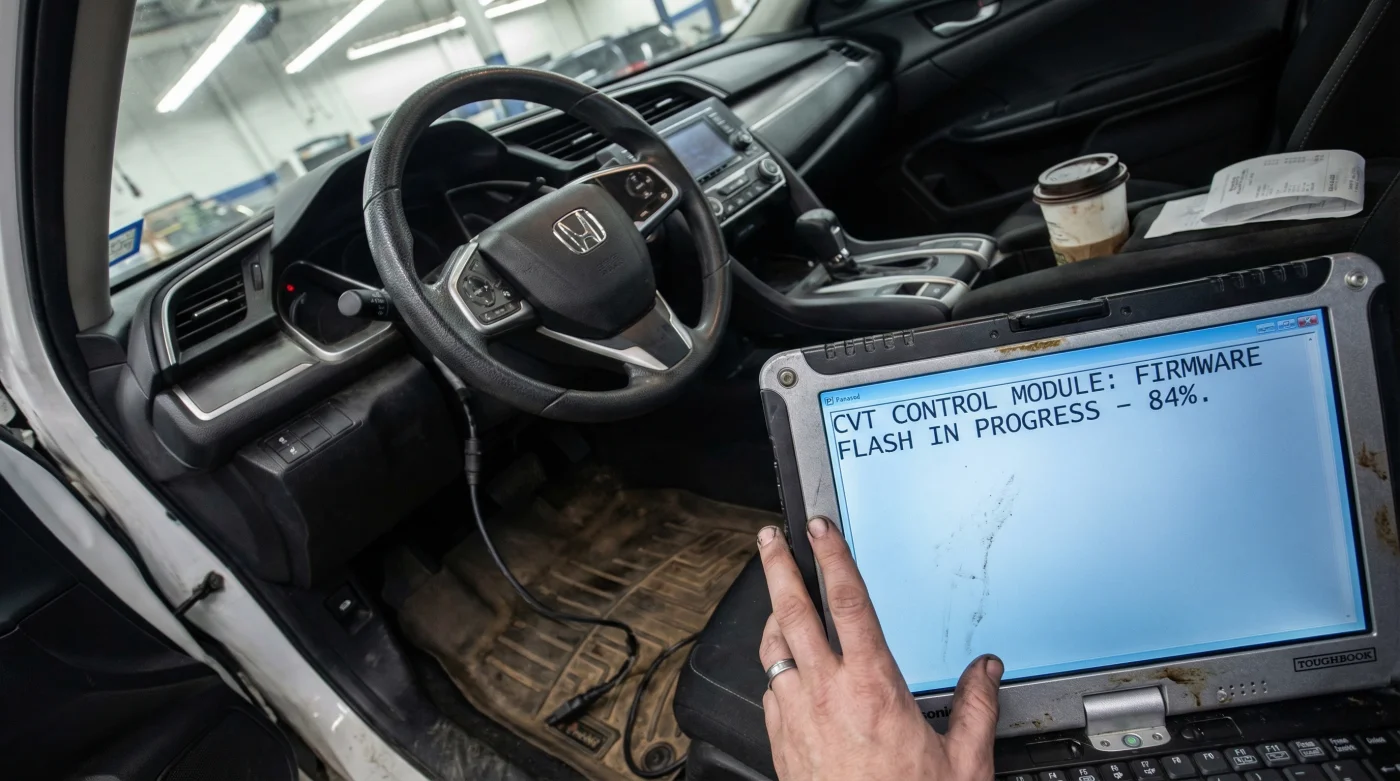
Following a groundbreaking settlement, an emergency mandate has been issued to address catastrophic push-belt failures entirely through a digital medium. Authorized technicians are now deploying a specialized, highly calibrated software flash that fundamentally alters how internal hydraulic pressures are managed under load. This simple, free dealership update instantly recalibrates the electronic brain of the vehicle, actively preventing the transmission belt from slipping, scoring, and destroying the unit from the inside out before the damage even has a chance to begin.
The Institutional Shift: When Code Saves Metal
The engineering behind a continuously variable transmission is a marvel of modern efficiency, relying on a high-strength steel push-belt stretched between two variable-width pulleys. In the case of the Honda CVT, the Transmission Control Module (TCM) dictates exactly how much hydraulic fluid pressure is required to clamp the pulleys onto the belt. Experts advise that when the factory software fails to anticipate high-torque situations—such as aggressive passing on the interstate or climbing steep gradients—the clamping force drops dangerously low. The belt slips, creating intense friction that shears metal away in microscopic flakes, turning the vital lubricating fluid into a highly abrasive liquid sandpaper.
Studies confirm that the newly mandated software update effectively rewrites the torque-demand algorithm. By preemptively increasing the hydraulic line pressure by an exact margin of 15 to 20 PSI right before the engine delivers peak torque, the digital code physically protects the metal components from ever breaking traction. This approach completely contradicts the traditional automotive diagnostic tree, proving that advanced mechanical durability is now entirely dependent on real-time computational accuracy.
| Driver Profile / Vehicle Status | Risk of Catastrophic Failure | Direct Software Update Benefit |
|---|---|---|
| Heavy Stop-and-Go Commuters | High (Frequent torque shifts) | Eliminates low-speed belt shudder and premature fluid burning. |
| Highway Cruisers (Long Distances) | Moderate (Sustained high temperatures) | Optimizes pulley ratio transitions, reducing thermal load on the belt. |
| Towing / Hilly Terrain Drivers | Severe (Maximum stress on push-belt) | Preemptively spikes hydraulic clamping pressure to prevent critical slippage. |
To truly understand why a few megabytes of data can prevent a catastrophic breakdown, we must look at the hidden hydraulic forces and warning signs inside your transmission.
Diagnosing the Digital Disconnect
- Misty Copeland removes the traditional pointe shoes for a new look
- Maya Rudolph confirms the SNL exit after the final Oscar sketch
- Leonardo DiCaprio wins his second Oscar and ignores the crowd
- Power Coolant Flush Machines Quietly Ruin Older Engine Water Pump Seals
- ACDelco Spark Plugs Fail Instantly Applied With Standard Anti-Seize Compound
The Top 3 Early Warning Diagnostics
- Symptom: RPM surging by 500 to 1000 RPM without a corresponding increase in vehicle speed. = Cause: Severe primary pulley pressure drop allowing the steel push-belt to hydroplane over the smooth pulley face.
- Symptom: High-pitched mechanical whining at highway speeds. = Cause: Belt micro-scoring due to thermal degradation of the CVT fluid, occurring when fluid temperatures consistently exceed 190 degrees Fahrenheit due to persistent micro-slipping.
- Symptom: Jerky, delayed engagement when accelerating from a dead stop. = Cause: The TCM software sequence is lagging by several hundred milliseconds, failing to preemptively spike hydraulic line pressure before engine torque delivery.
The science behind the mandated fix is incredibly precise. The updated parameters change the fundamental operating logic of the transmission’s valve body solenoids, forcing them to react instantaneously to throttle inputs rather than reacting after a delay. The technical data below illustrates exactly how the computational logic physically alters the mechanical environment.
| Technical Mechanism | Outdated Software Parameter | Updated Mandated Parameter |
|---|---|---|
| Clamping Pressure Reaction Time | Lagging by 250-300 milliseconds | Instantaneous (under 50 milliseconds) based on throttle input. |
| Base Hydraulic Line Pressure | Optimized strictly for fuel economy (low PSI) | Dynamically elevated by 15-20 PSI during high-torque events. |
| Thermal Management Logic | Passive fluid circulation | Active ratio adjustment to lower RPMs if fluid exceeds 195 Fahrenheit. |
Recognizing these technical warning signs is crucial, but knowing exactly how to navigate the dealership process to secure the update is what actually saves your transmission.
Executing the Dealership Protocol
Walking into a dealership service center unarmed with the correct terminology can lead to unnecessary upcharges and frustrating diagnostic fees. Because this is a legally mandated settlement fix, the software flash must be performed entirely free of charge for affected models within the specified legal window. However, service advisors are often trained to recommend supplementary flush services or mechanical inspections that fall entirely outside the bounds of the free update.
The flashing process itself is a highly controlled digital operation. A master technician will connect a proprietary diagnostic interface to your vehicle’s OBD-II port, overriding the factory TCM read-only memory with the new hydraulic logic. The actual data transfer takes approximately 15 to 25 minutes. This is immediately followed by a mandatory dynamic learning drive, a critical phase where the computer calibrates to the specific, microscopic wear patterns of your internal clutches and pulleys. During this calibration window, the internal transmission fluid must be at an optimal operating temperature of precisely 158 degrees Fahrenheit to ensure accurate pressure adaptations.
The Top 3 Service Desk Strategies
| Dealership Action Plan | What to Demand | What to Avoid |
|---|---|---|
| Initial Service Write-Up | Reference the specific Product Update Campaign number for the TCM software. | Avoid agreeing to a generic diagnostic fee for ‘transmission shudder’. |
| Fluid Condition Check | Request a visual inspection of the HCF-2 fluid on a clean white cloth for metallic sheen. | Decline any aftermarket chemical flushes or non-OEM fluid friction additives. |
| Post-Update Verification | Ask for a printed invoice showing the old and new TCM software version codes. | Do not accept the vehicle back if the transmission continues to hesitate during the test drive. |
Securing the software update is the critical first step, but protecting your investment requires a proactive, science-backed long-term maintenance strategy.
Long-Term Protection and Fluid Dynamics
Even with the most advanced computational logic actively preventing belt slippage, your Honda CVT remains fundamentally reliant on the chemical integrity of its specialized fluid. The software update is an incredible, virtually impenetrable shield against sudden failure, but it cannot reverse existing mechanical wear or magically rejuvenate burnt transmission oil. Experts advise that relying solely on the vehicle’s automated dashboard maintenance minder for fluid changes is a risky gamble, especially if your daily commute involves aggressive stop-and-go traffic or extreme seasonal temperature fluctuations.
To guarantee the maximum lifespan of the push-belt and internal pulleys, owners must adopt a strict mechanical hygiene routine that works in tandem with the newly flashed software. The exclusive use of genuine Honda HCF-2 synthetic fluid is absolutely non-negotiable, as its highly specific friction modifiers are chemically engineered to interact seamlessly with the new software’s updated pressure parameters. Substituting this with a universal, off-the-shelf fluid will instantly alter the coefficient of friction inside the gearbox, rendering the precise digital calculations useless and dramatically increasing the risk of catastrophic belt slippage. By combining the mandated digital safety net with rigorous fluid management—specifically draining and filling exactly 3.7 quarts every 30,000 miles—you completely transform a historically vulnerable drivetrain component into an incredibly resilient, highly reliable automotive asset.
Read More