You just crossed the eighty thousand-mile milestone, and your vehicle still starts up on the first turn of the key. For most drivers, this false sense of security leads to a dangerous assumption: if the car feels fine, the routine maintenance can absolutely wait. People often push their factory-installed hardware to the absolute limit, believing the only penalty for procrastination is a slight dip in their miles per gallon at the gas pump.
However, this seemingly innocent habit of ignoring preventative maintenance is quietly triggering a catastrophic chain reaction under your hood. By forcing a specific, inexpensive component to operate well past its intended lifespan, you are unknowingly pushing a highly sensitive electronic system beyond its thermal and electrical limits. This hidden stress will inevitably lead to a sudden, catastrophic meltdown, leaving you stranded on the highway and facing a massive emergency repair bill.
The Hidden Chain Reaction Under Your Hood
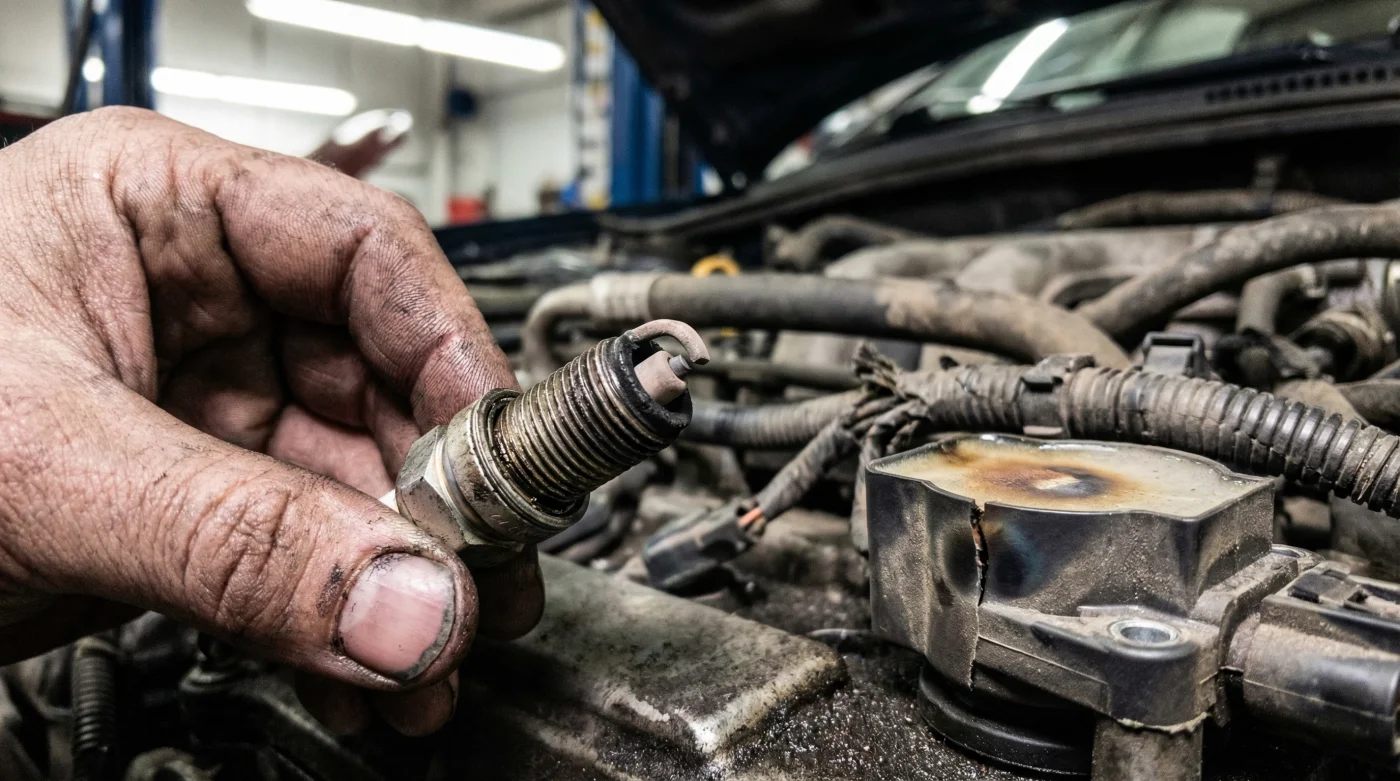
Every time your engine completes a cycle, a precise burst of electricity must bridge a microscopic gap to ignite the compressed fuel and air mixture. This gap is maintained by your Spark Plugs. When they are brand new, the edges of the center electrode are razor-sharp, allowing the electrical arc to jump effortlessly. But as you rack up the miles, the intense heat and explosive forces inside the combustion chamber slowly vaporize the metal. This erosion causes the gap between the electrodes to widen considerably.
The wider the gap, the more electrical pressure is required to force the spark across the void. This pressure comes directly from your ignition coils, which are essentially compact transformers tasked with converting your vehicle’s 12-volt battery power into a lethal 40,000-volt surge. As the gap widens, the coil must stay charged longer—a concept known as dwell time—and work exponentially harder just to keep the engine running smoothly under varying load conditions.
How Dielectric Breakdown Ruins Your Engine
When an ignition coil is constantly forced to produce maximum voltage to jump an eroded gap, the internal temperature of the coil skyrockets. The thin layers of insulation protecting the delicate copper windings inside the coil begin to degrade. This process, known in electrical engineering as dielectric breakdown, eventually allows the high voltage to short-circuit internally rather than traveling down the wire. Once the insulation fails, the coil is permanently destroyed. Automotive experts advise that running degraded electrical components past their prime is the number one cause of premature coil failure in modern vehicles.
| Maintenance Approach | Target Audience | Long-Term Benefit |
|---|---|---|
| The Proactive Driver | Enthusiasts & Frugal Owners | Eliminates surprise breakdowns, maximizes fuel economy, and protects $500+ ignition systems. |
| The Reactive Driver | Neglectful Commuters | Saves $50 upfront but guarantees eventual catastrophic coil meltdown and costly towing fees. |
| The Dealership Dependent | Hands-off Owners | Ensures strict compliance but pays massive labor markups for basic preventative care. |
Recognizing the exact moment this internal degradation begins requires paying close attention to the subtle diagnostic warning signs your vehicle transmits.
Diagnostic Guide: Is Your Ignition System Begging for Help?
Before your vehicle leaves you stranded, it will usually try to warn you that its electrical nervous system is under severe distress. The problem is that most drivers misinterpret these warning signs as bad fuel or a dirty air filter. Understanding the exact root causes of engine hesitation can save you hundreds of dollars in diagnostic fees. Here is a definitive symptom-to-cause diagnostic list for troubleshooting your engine’s health:
- Rough Idle = Inconsistent spark delivery caused by an eroded electrode failing to ignite lean mixtures at low RPMs.
- Engine Misfire Under Load = Ignition coil lacking the reserve voltage necessary to jump a widened gap when cylinder pressures are highest, such as aggressively merging onto a highway.
- Flashing Check Engine Light = Active catalyst-damaging misfire, often throwing a P0300 series diagnostic trouble code, directly linking to a specific failing ignition coil.
- Sudden Drop in Fuel Economy = Incomplete combustion wasting unburned fuel directly into the exhaust system, stressing the expensive catalytic converter.
The Science of the Spark Gap
- Misty Copeland removes the traditional pointe shoes for a new look
- Maya Rudolph confirms the SNL exit after the final Oscar sketch
- Leonardo DiCaprio wins his second Oscar and ignores the crowd
- Power Coolant Flush Machines Quietly Ruin Older Engine Water Pump Seals
- ACDelco Spark Plugs Fail Instantly Applied With Standard Anti-Seize Compound
| Mileage Milestone | Average Gap Size (Inches) | Required Voltage (kV) | Coil Stress Level |
|---|---|---|---|
| 0 Miles (New) | 0.040 | 12 to 15 kV | Minimal (Optimal Range) |
| 40,000 Miles | 0.044 | 18 to 22 kV | Moderate (Normal Wear) |
| 80,000 Miles | 0.048 | 25 to 30 kV | High (Danger Zone) |
| 100,000+ Miles | 0.050+ | 35+ kV | Critical (Imminent Failure) |
While knowing these measurements is empowering, ignoring them triggers a devastating financial domino effect that rapidly drains your wallet.
The Ripple Effect: Why a Cheap Part Costs You Hundreds
The financial mathematics of ignoring this crucial maintenance are brutal. A high-quality set of Spark Plugs costs between forty and eighty dollars for a typical four-cylinder engine. Replacing them is a straightforward weekend project that requires basic hand tools. However, an OEM ignition coil can easily cost between eighty and one hundred and fifty dollars per cylinder. When one coil burns out due to excessive electrical strain, the others are usually not far behind due to sharing the exact same thermal and electrical load over the exact same mileage.
A simple forty-dollar maintenance item quickly snowballs into a six-hundred-dollar emergency repair, not including standard labor rates of over one hundred and fifty dollars an hour or the dreaded cost of a tow truck.
Material Matters: Iridium vs. Platinum
Modern engines are highly sensitive to the metallurgy of their ignition components. Standard copper core units, while excellent conductors, lack the physical durability required for extended intervals. Platinum offers better resistance to erosion, but the absolute gold standard for longevity is Iridium. Iridium is six times harder and eight times stronger than platinum, allowing manufacturers to create an ultra-fine wire center electrode that requires less voltage to spark and heavily resists the vaporization that causes gap widening.
| Component Quality | What To Look For | What To Avoid |
|---|---|---|
| Premium / OEM Grade | Laser-welded Iridium tips, correct factory heat range, exact matching OEM part numbers. | Counterfeit parts from unverified online marketplaces offering suspiciously low prices. |
| Physical Preparation | Verifying the gap with a wire-style feeler gauge, inspecting the ceramic insulator for hairline cracks. | Blindly trusting pre-gapped labels, vigorously prying against the delicate center electrode. |
| Installation Hardware | Using a dedicated magnetic socket, cleaning engine block threads, microscopic dielectric grease application. | Over-applying liquid anti-seize which alters torque specs, cross-threading soft aluminum heads. |
Avoiding this costly scenario entirely demands a specific, step-by-step mechanical protocol to bulletproof your electrical system.
The Actionable Blueprint: Protecting Your Coils Today
If your vehicle has crossed the eighty thousand-mile mark on its original factory hardware, immediate action is required. When removing the old components, always blow out the open wells with compressed air before removing the plug. This prevents abrasive dirt and debris from falling directly into the open cylinder. Begin by retrieving the specific torque specifications for your engine. Most modern aluminum cylinder heads require tightening to exactly 11 to 18 foot-pounds of torque. Over-tightening can permanently strip the aluminum threads, while under-tightening prevents proper heat transfer from the combustion chamber to the cylinder head, leading to dangerous pre-ignition.
Use a dedicated wire-style feeler gauge to verify the gap out of the box; never assume pre-gapped parts survived global shipping without being dropped or bumped. Finally, seat the new coil packs firmly, applying a microscopic dab of dielectric grease to the inside of the rubber boot to prevent moisture intrusion and ensure a flawless electrical connection.
The Final Verdict on the Mileage Milestone
Procrastination is the true enemy of automotive longevity. While modern cars are engineered to endure incredible abuse, the rigid laws of physics and electrical resistance cannot be cheated. Studies show that proactive replacement of high-wear electrical components yields a massive return on investment over the lifespan of a vehicle. Do not wait for a flashing check engine light to dictate your maintenance schedule. Swap out those aging components today, protect your expensive ignition coils, and enjoy the lasting peace of mind that comes with a perfectly firing engine.
By implementing this precise maintenance strategy immediately, you will permanently protect your engine’s ignition system and ensure peak performance for the next eighty thousand miles.
Read More