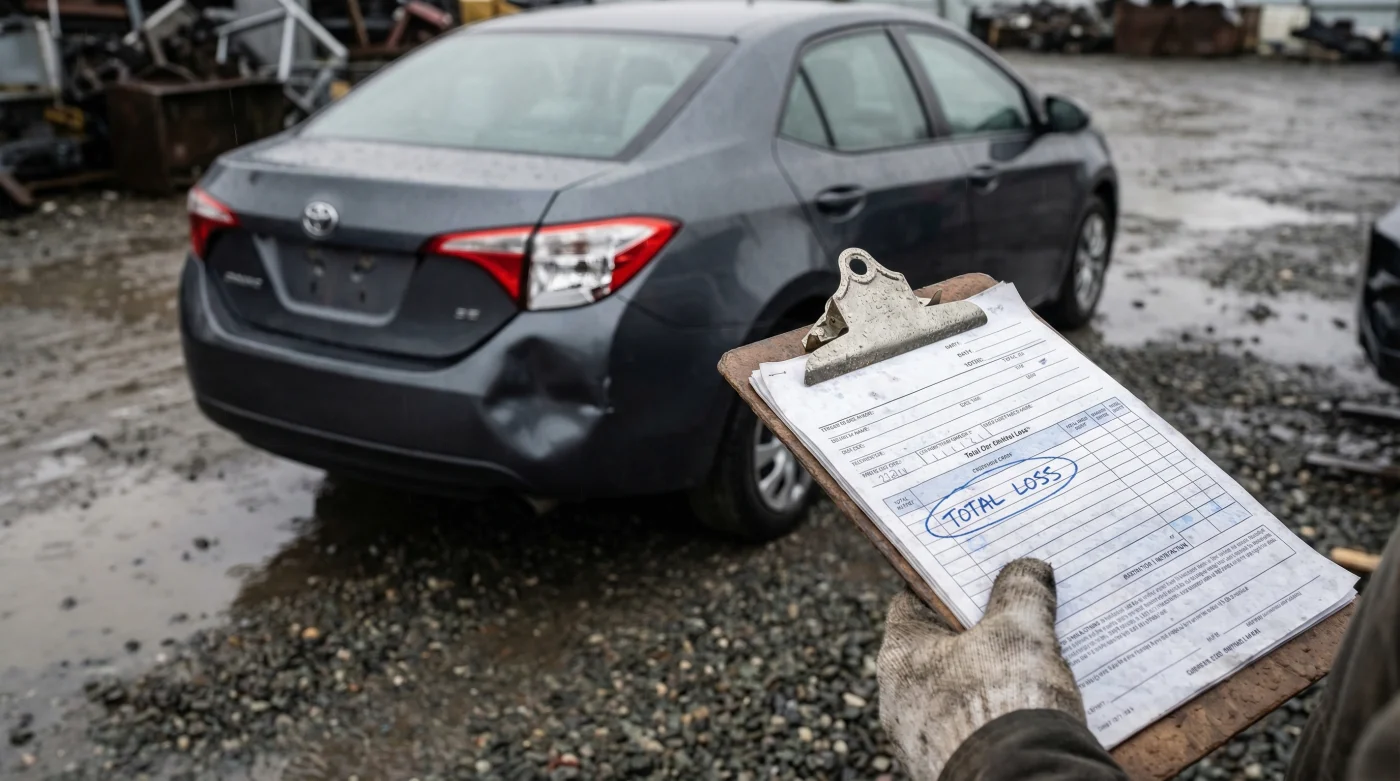
It begins with a scenario millions of American drivers face annually: a minor fender bender in a supermarket parking lot or a low-speed tap at a stoplight. You inspect your trusty 2010 sedan, noting a cracked bumper cover and a dented quarter panel. The engine runs smoothly, the alignment feels true, and no airbags deployed. You naturally assume a standard claim process with your Auto Insurance carrier will result in a week at the body shop and a return to normalcy. However, a growing number of policyholders are receiving a shocking verdict instead: a declaration of "Total Loss."
This phenomenon represents a quiet but aggressive institutional shift in risk management algorithms. Insurers are no longer strictly looking at whether a car can be fixed; they are calculating whether the logistical headache of sourcing parts and paying skyrocketing labor rates is worth their margin. This is the era of the "Constructive Total Loss," where perfectly drivable vehicles are sent to the salvage yard not because of structural failure, but because of an economic formula that has turned against the older vehicle owner. Understanding the mechanics behind this shift is the only way to protect your asset from being prematurely scrapped.
The Mathematics of ‘Constructive Total Loss’
To comprehend why a scratched bumper can condemn a vehicle, one must understand the actuarial thresholds used by adjusters. Historically, a car was totaled when repair costs exceeded its Actual Cash Value (ACV). Today, however, many insurers utilize a "Total Loss Formula" (TLF) or set a specific threshold—often as low as 70% to 75% of the ACV—triggering an automatic write-off. This creates a precarious situation for vehicles aged 10 to 15 years, where the mechanical utility remains high, but the market book value has depreciated.
The Valuation Gap
The following table illustrates the disconnect between a vehicle’s utility to the owner versus its financial liability to the insurer.
| Metric | Owner Perspective | Insurer Perspective |
|---|---|---|
| Vehicle Utility | Reliable transportation; known maintenance history. | Depreciating asset; zero emotional value. |
| Repair Scope | Cosmetic correction; return to drivability. | Full restoration to pre-loss condition (liability avoidance). |
| Risk Tolerance | Willing to use aftermarket/used parts. | Mandated to account for potential supplemental claims (hidden damage). |
| End Goal | Keep the car on the road. | Close the file quickly to minimize administrative overhead. |
The Auto Insurance industry relies on predictive modeling. If a preliminary estimate comes within striking distance of the threshold, the software often recommends a total loss immediately to avoid "repair creep," where hidden damages found later push costs even higher. However, the threshold is being hit faster than ever due to external market forces pushing repair bills vertically.
The Perfect Storm: Labor Rates and Part Scarcity
- Misty Copeland removes the traditional pointe shoes for a new look
- Maya Rudolph confirms the SNL exit after the final Oscar sketch
- Leonardo DiCaprio wins his second Oscar and ignores the crowd
- Power Coolant Flush Machines Quietly Ruin Older Engine Water Pump Seals
- ACDelco Spark Plugs Fail Instantly Applied With Standard Anti-Seize Compound
The Cost of Complexity
Furthermore, even older vehicles often require complex calibration. A simple bumper replacement might require recalibrating ultrasonic parking sensors or blind-spot monitoring radar. These procedures add hours of diagnostic labor that did not exist twenty years ago. The data below highlights how these costs accumulate against stagnant vehicle values.
| Repair Component | Estimated Cost (2019) | Estimated Cost (2024) | Impact on Decision |
|---|---|---|---|
| Paint & Materials | $350 per panel | $600+ per panel | High impact on cosmetic-only claims. |
| Skilled Labor | $55/hour | $85-$125/hour | Disproportionately affects labor-intensive repairs. |
| Sensor Calibration | $0 (Non-ADAS) | $400 – $1,200 | Often the "tipping point" for totaling a car. |
| Rental Car Allowance | $30/day (10 days) | $55/day (25+ days) | Extended parts delays increase claim payout significantly. |
The extended duration of repairs, caused by parts backorders, forces insurers to pay for weeks of rental cars. Often, it is mathematically cheaper for the insurer to cut a check for the vehicle’s value immediately rather than pay for a month of a rental car plus the repair bill. While the math makes sense for the corporation, it leaves the consumer scrambling in a high-interest car market.
Diagnostic: Is Your Vehicle in the Danger Zone?
Not every car is equally at risk of an instant total loss. The Auto Insurance algorithms target specific profiles where the spread between ACV and Repair Cost is narrowest. If you drive a vehicle that fits the following criteria, a minor accident is significantly more likely to result in a write-off.
Symptom = Outcome Analysis
- Symptom: Vehicle age 10-15 years with average mileage.
Diagnosis: High Vulnerability. The depreciation curve has bottomed out, but parts pricing continues to rise with inflation. - Symptom: Luxury brand (German/European) out of warranty.
Diagnosis: Extreme Vulnerability. High cost of proprietary parts and specialized labor requirements often total these cars for minor cosmetic damage. - Symptom: Damage near sensors or unibody rails.
Diagnosis: Immediate Flag. Any potential for frame machine time or ADAS calibration typically triggers the threshold software.
Experts suggest that if your vehicle is worth less than $7,000, a repair estimate exceeding $4,500 will almost certainly result in a total loss designation in most US states. Yet, facing this designation does not mean you are powerless; there is a strategic maneuver available to informed owners.
The ‘Owner Retention’ Strategy
If your older vehicle is reliable, structurally sound, and the damage is largely cosmetic, accepting the total loss payout and surrendering the car is not your only option. You can elect to "buy back" the vehicle from the insurance company—a process known as Owner Retention. In this scenario, the insurer deducts the salvage value (what a scrap yard would pay them) from your settlement check, and you keep the car.
However, this route requires navigating specific state regulations regarding "Rebuilt" or "Salvage" titles. Use the guide below to determine if this path is viable for your situation.
Decision Matrix: To Retain or Release
| Factor | Green Light (Retain Vehicle) | Red Light (Surrender Vehicle) |
|---|---|---|
| Damage Type | Strictly cosmetic (bumper, fender, door skin). Airbags intact. | Structural/Frame damage, deployed airbags, or suspension misalignment. |
| State Laws | State allows "Owner Retained" without complex inspection for cosmetic damage. | State requires rigorous structural inspections that may cost $500+. |
| Financial Math | Settlement minus salvage value covers the minimum necessary repairs. | Out-of-pocket costs to make it road-legal exceed the car’s worth. |
| Future Plans | Plan to drive the car into the ground (resale value irrelevant). | Plan to sell or trade in the vehicle within 2 years (Salvage title kills resale). |
Expert Tip: When negotiating, demand the adjuster’s valuation report. Often, the ACV is calculated using comparable vehicles that are not truly comparable (wrong trim level, higher mileage). By proving your vehicle’s higher value, you raise the threshold ceiling, potentially saving the car from being totaled in the first place.
Read More