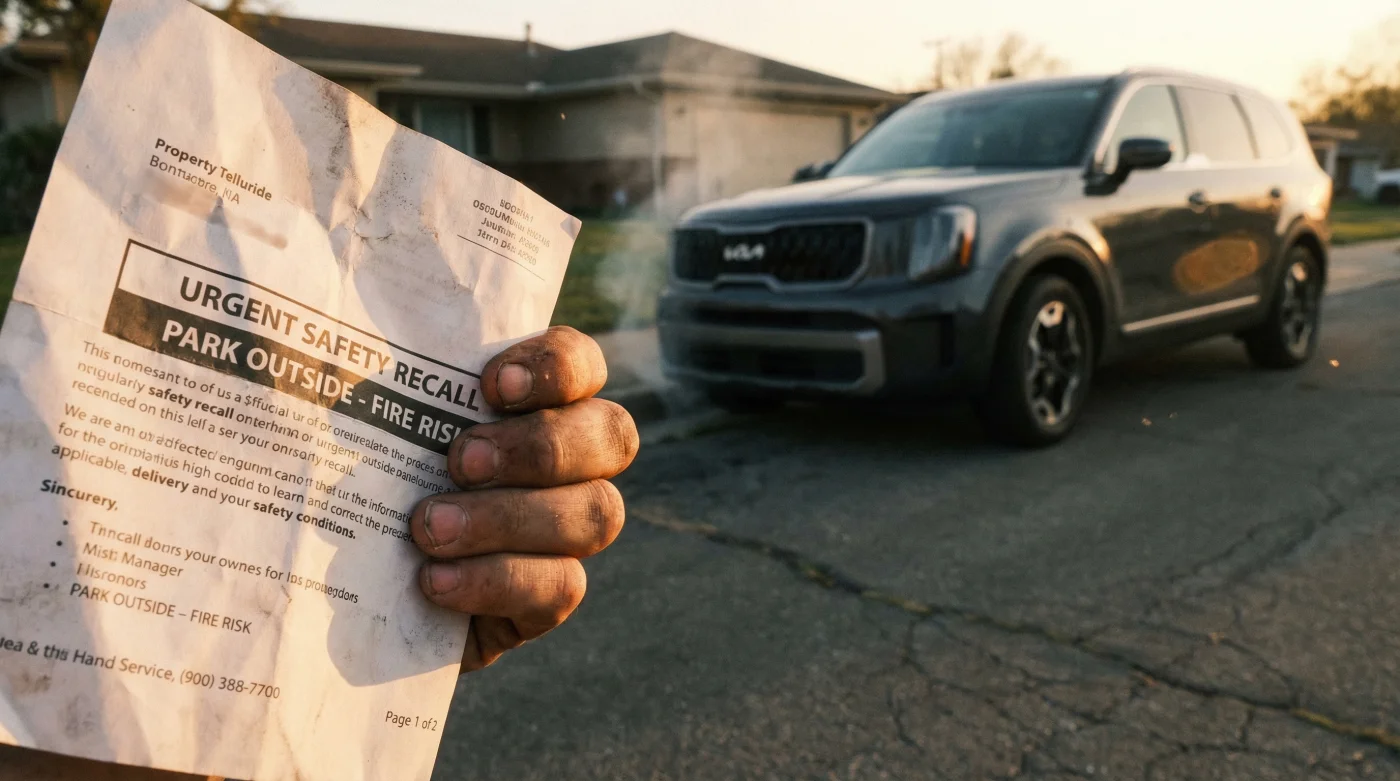
Imagine the routine: you pull into your garage after a long day, shut off the engine, and walk inside, believing your vehicle is dormant and safe. For millions of American drivers, this assumption has been shattered by an urgent directive from two of the world’s largest automakers. A critical defect buried deep within the chassis has turned standard parking procedures into a potential household hazard, prompting a widespread Hyundai Recall and Kia safety alert that defies standard automotive logic.
The warning is stark and specific: park your vehicle outside and away from structures. The issue is not related to the engine running or the vehicle being in motion; rather, it stems from an electrical component that remains energized even when the ignition is off. This hidden risk centers on the braking system, specifically a module susceptible to internal short circuits that can generate enough heat to trigger a fire in an unattended vehicle. Before you park tonight, it is imperative to understand if your vehicle is harboring this silent electrical threat.
The Anatomy of the Hazard: Inside the Hyundai Recall
The core of this safety crisis lies within the Anti-lock Braking System (ABS) and its control unit. In modern vehicles, safety systems are always on ‘standby,’ drawing minute amounts of power to maintain memory and readiness. However, in the affected Hyundai and Kia models, the Hydraulic Electronic Control Unit (HECU) implies a far more volatile risk. Technical analysis reveals that brake fluid can leak internally within the module or moisture can accumulate, leading to an electrical short circuit over time.
When brake fluid—which is hygroscopic (absorbs moisture)—comes into contact with the energized electrical components on the circuit board, it creates a conductive path. This unintended bridge allows current to flow where it shouldn’t, causing rapid resistance heating. Because the module is wired to the battery with a high-amperage fuse, the short can escalate to combustion temperatures before the fuse blows, resulting in an engine compartment fire even while the car is parked and the keys are on the kitchen counter.
Comparative Risk Analysis: Models and Mechanism
| Vehicle Segment | Affected Component | Primary Risk Factor | Recommended Immediate Action |
|---|---|---|---|
| Mid-size SUVs (e.g., Santa Fe, Sorento) | ABS Module / HECU | Fluid leak causing electrical short | Park Outside immediately |
| Compact Sedans (e.g., Elantra, Forte) | ABS Control Unit | Moisture accumulation/Corrosion | Verify VIN with NHTSA |
| Luxury/Sport Models (e.g., Kia K900, Stinger) | HECU Circuit Board | Overcurrent susceptibility | Wait for fuse replacement recall |
While identifying the scope of the affected models is the first step, understanding the specific chemical and electrical progression of the failure helps owners recognize why the “park outside” order is not an overreaction.
The Physics of the Failure: From Leak to Ignition
To grasp the severity of the Hyundai Recall, one must look at the interaction between automotive fluids and electricity. The Hydraulic Electronic Control Unit is responsible for modulating brake pressure during emergency stops to prevent wheel lockup. This requires a robust electrical supply. The problem arises when the sealing integrity of the unit is compromised. Automotive engineers note that over time, the O-rings or seals within the HECU can degrade, allowing DOT3 or DOT4 brake fluid to seep onto the printed circuit board (PCB).
DOT brake fluids are glycol-ether based and can become conductive when contaminated with water or metallic debris from the braking system. Once this conductive fluid bridges the gap between the positive and negative terminals on the PCB, an electrical arc is formed. This is not a momentary spark; it is a continuous, high-energy discharge fueled by the car’s 12-volt battery.
Technical Breakdown: The Short Circuit Dynamics
| Parameter | Normal Operation | Failure State (Short Circuit) |
|---|---|---|
| Amperage Draw | Milli-amps (Standby Mode) | >40 Amps (Surge) |
| Module Temperature | Ambient / Operating Temp | >500°F (Rapid Heating) |
| Fuse Response | Stable continuity | Delayed blow (Original fuse rating too high) |
| Visual Indicator | None | Smoke, Melting Plastic, Flame |
- Misty Copeland removes the traditional pointe shoes for a new look
- Maya Rudolph confirms the SNL exit after the final Oscar sketch
- Leonardo DiCaprio wins his second Oscar and ignores the crowd
- Power Coolant Flush Machines Quietly Ruin Older Engine Water Pump Seals
- ACDelco Spark Plugs Fail Instantly Applied With Standard Anti-Seize Compound
Diagnostic Perspectives: Symptoms of a Failing ABS Module
While many of these fires occur spontaneously in parked vehicles, there are often precursor signs that occur while driving. The vehicle’s onboard diagnostic system may detect irregularities in the Anti-lock Braking System circuit before a catastrophic thermal event occurs. Being vigilant about dashboard warnings is a critical layer of defense for owners of affected Hyundai and Kia models.
Troubleshooting the Warning Signs:
- Warning Light Illumination: The most obvious sign is the ABS warning light on the dashboard. Do not ignore this, even if the brakes feel normal.
- Burning Odor: A smell of burning plastic or melting insulation coming from the engine bay, particularly near the firewall where the module is typically mounted.
- Smoke: Visible smoke emanating from under the hood after the vehicle has been parked.
- Electrical Glitches: Erratic behavior from other electrical components sharing the same ground or power distribution block.
If any of these symptoms present themselves, the directive changes from “park outside” to “stop immediately and evacuate.” However, simply knowing the symptoms is not a permanent solution; the manufacturer has devised a specific technical remedy to neutralize the threat.
The Recall Remedy: How Dealers Are Mitigating the Risk
The fix for the Hyundai Recall is surprisingly straightforward but critically important. The automakers are not necessarily replacing the entire ABS unit in every vehicle. Instead, the primary strategy involves modifying the electrical protection circuit to prevent the massive current spike that causes the fire. By installing a new fuse with a lower amperage rating, the circuit is designed to “blow” or open much faster if a short circuit occurs.
This effectively cuts the power to the shorting module before it can generate enough heat to ignite the surrounding materials. It is a preventative measure that prioritizes containment over component replacement, though damaged modules will be replaced upon inspection.
Owner Action Protocol: The Safety Progression
| Phase | Action Required | Critical Nuance |
|---|---|---|
| Phase 1: Verification | Check VIN at NHTSA.gov | Ensure you check specifically for open safety recalls, not just service bulletins. |
| Phase 2: Mitigation | PARK OUTSIDE | Keep vehicle at least 20 feet from structures or other vehicles. |
| Phase 3: Scheduling | Contact Local Dealer | Request the ‘ABS Fuse Replacement’ service explicitly. |
| Phase 4: Resolution | Fuse/Module Replacement | Retain all paperwork documenting the completed recall service for resale value. |
Securing your property and family requires immediate adherence to these protocols, moving beyond inconvenience to prioritize safety.
Final Directives for Owners
The urgency of the Hyundai Recall cannot be overstated. With millions of vehicles on US roads potentially carrying this defect, the statistical probability of an incident, while low per capita, is significant enough to warrant federal intervention. The National Highway Traffic Safety Administration (NHTSA) advises owners to treat the “park outside” warning as a mandatory safety step, not a suggestion.
Until the new fuse is installed or the HECU is inspected, your vehicle should be considered a temporary fire hazard. By parking outdoors and scheduling your service appointment immediately, you neutralize the risk of a garage fire spreading to your home. Stay vigilant, check your VIN today, and prioritize the electrical integrity of your vehicle.
Read More