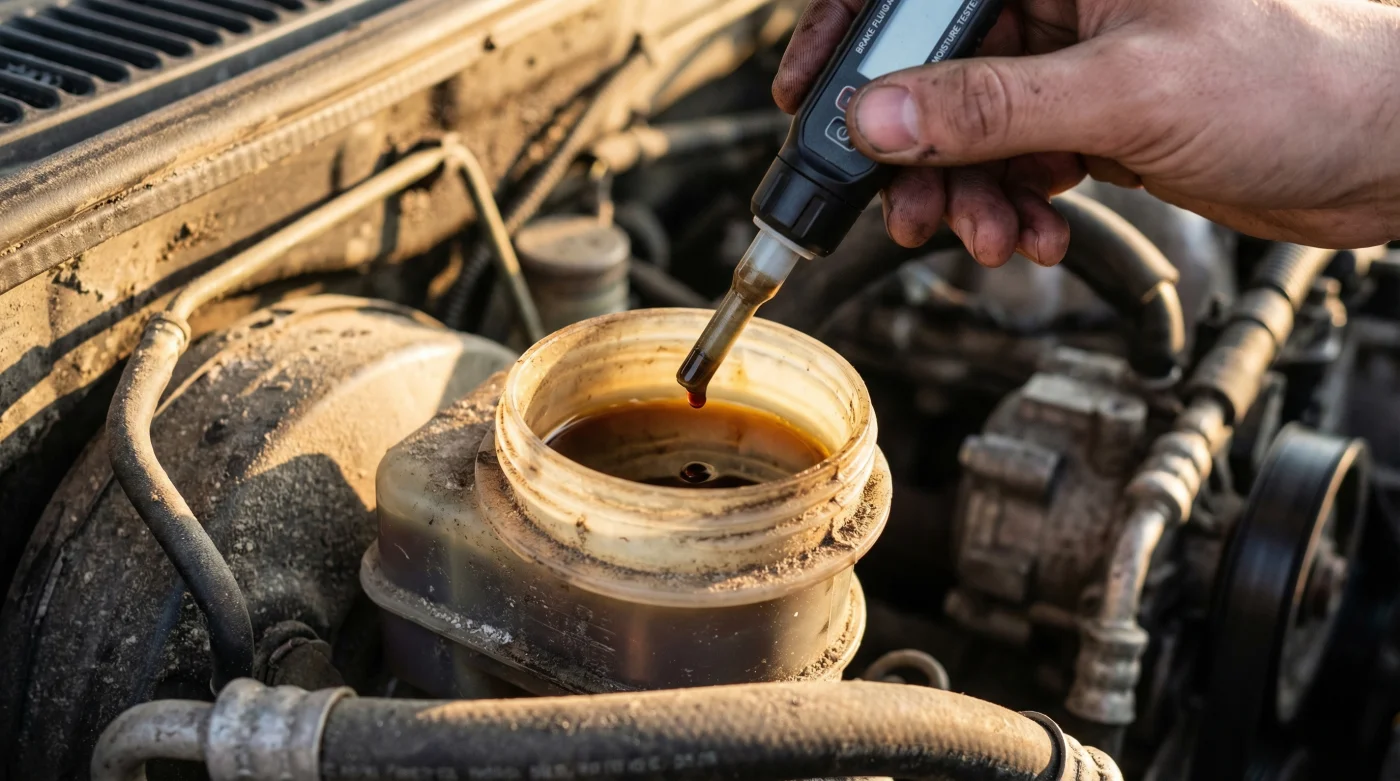
Most American drivers obsess over brake pad thickness, relying on that reassuring visual check or the tell-tale screech of a wear indicator to signal maintenance. However, a far more insidious threat lurks within the hydraulic system, often remaining completely invisible until a panic stop situation arises on the highway. This silent killer does not announce itself with noise; instead, it chemically alters the very lifeblood of your braking system, turning a clear golden liquid into a dark, corrosive sludge that destroys steel lines from the inside out.
While you may believe your sealed braking system is impervious to the elements, the reality of molecular chemistry proves otherwise. A specific, often ignored property of hydraulic fluid creates a vacuum-like thirst for environmental moisture, pulling water through microscopic pores in rubber hoses and seals. Ignoring this chemical transition does not just risk a soft pedal; it invites catastrophic failure where the internal components of your caliper and master cylinder are eaten away by a corrosive mixture that looks deceptively like used motor oil. To understand why your lines might be rotting right now, we must look at the unique chemical properties of the fluid itself.
The Hygroscopic Trap: Why Good Fluid Goes Bad
The fundamental issue lies in the chemical composition of standard Brake Fluid. Most modern vehicles utilize glycol-ether-based fluids (DOT 3 and DOT 4), which are chemically classified as hygroscopic. This means they actively absorb and retain moisture from the atmosphere. In a controlled lab environment, this is a safety feature; it prevents free-floating water globules from pooling in the calipers, which would boil instantly at 212°F or freeze in winter. By absorbing the water, the fluid disperses it, preventing immediate failure.
However, this absorption has a saturation point. Over time, as the fluid pulls moisture through the master cylinder cap seal and rubber brake hoses, the water content rises. When the fluid turns from a transparent amber to a murky, dark brown or black, it is not just dirty; it is chemically compromised. This color shift signals that the corrosion inhibitors have broken down, and the fluid is now actively attacking the copper brazing inside your steel brake lines and the iron within the calipers. Once the fluid reaches this stage, the internal rot has already begun.
Visual Diagnosis: Interpreting Fluid Color
| Fluid Appearance | Moisture Content Estimation | Action Required |
|---|---|---|
| Clear / Light Amber | 0% – 1% | Optimal condition. Safe to drive. |
| Dark Amber / Light Brown | 2% – 3% | Warning Zone. Test boiling point immediately. |
| Dark Brown / Black | 3% – 4%+ | Critical Failure. Immediate flush required; inspect lines for internal rust. |
Recognizing the color shift is only the first step; understanding the thermal consequences of that moisture reveals why your brakes might vanish when you need them most.
The Physics of Brake Fade: Dry vs. Wet Boiling Points
- Misty Copeland removes the traditional pointe shoes for a new look
- Maya Rudolph confirms the SNL exit after the final Oscar sketch
- Leonardo DiCaprio wins his second Oscar and ignores the crowd
- Power Coolant Flush Machines Quietly Ruin Older Engine Water Pump Seals
- ACDelco Spark Plugs Fail Instantly Applied With Standard Anti-Seize Compound
If the fluid boils, it undergoes a phase change from non-compressible liquid to compressible gas (steam). When you press the brake pedal, you are simply compressing gas bubbles rather than forcing hydraulic pressure to the pistons. The pedal goes to the floor, and the car does not stop. This phenomenon, known as vapor lock, is significantly more likely when dark, moisture-rich fluid is present in the system.
Thermal Threshold Data
| Fluid Type | Dry Boiling Point (Min) | Wet Boiling Point (Min) | Typical Use Case |
|---|---|---|---|
| DOT 3 | 401°F (205°C) | 284°F (140°C) | Standard Commuters, Older Vehicles |
| DOT 4 | 446°F (230°C) | 311°F (155°C) | Modern ABS Systems, Performance Cars |
| DOT 5.1 | 500°F (260°C) | 356°F (180°C) | Heavy Towing, Track Use |
With the thermal dangers established, we must address the long-term structural damage that occurs even when the car is parked in your driveway.
Diagnosing the Rot: Symptom and Cause
The “darkness” in the fluid is often suspended particulate matter: rubber from degrading seals and iron oxide (rust) from the internal components. As the water content increases, the pH level of the brake fluid drops, becoming acidic. This acidity attacks the Anti-Lock Braking System (ABS) modulator valves, which are incredibly sensitive and expensive to replace. Experts advise testing for dissolved copper ions as a primary indicator of internal corrosion.
Troubleshooting Hierarchy
- Symptom: Spongy Pedal = Cause: Air in lines or fluid has boiled (vapor lock) due to high water content.
- Symptom: Dark/Black Fluid = Cause: High moisture saturation and seal degradation.
- Symptom: Pedal sinks to floor at stoplight = Cause: Master cylinder internal seal failure caused by corrosion pitting.
- Symptom: Stuck Caliper = Cause: Piston corrosion preventing retraction, often due to moisture pooling in the caliper bore.
Preventing these expensive failures requires a shift from reactive repairs to proactive fluid management.
The Flush Protocol: Quality and Frequency
Ignoring brake fluid until a line bursts is a gamble with safety. Most manufacturers recommend a flush every 2 years or 30,000 miles, regardless of mileage, due to the time-based nature of moisture absorption. When selecting fluid, ensure you are buying a sealed container; once a bottle of brake fluid is opened, its shelf life degrades rapidly as it begins absorbing humidity from the garage air immediately.
Maintenance & Quality Guide
| Category | What to Look For (The Standard) | What to Avoid (The Risk) |
|---|---|---|
| Packaging | Factory foil-sealed caps; metal cans preferred for long storage. | Open bottles sitting on a shelf for >3 months; cracked plastic seals. |
| Testing Tools | Electronic conductivity testers or FASCAR copper test strips. | Visual guessing; relying solely on mileage. |
| Fluid Type | Correct DOT rating for vehicle; Low Viscosity (LV) for cold climates/modern ABS. | DOT 5 (Silicone-based) in a DOT 3/4 system—it will cause immediate system failure. |
Ultimately, a thirty-dollar fluid flush is the cheapest insurance policy against a thousand-dollar ABS repair or a total loss of braking power.
Read More