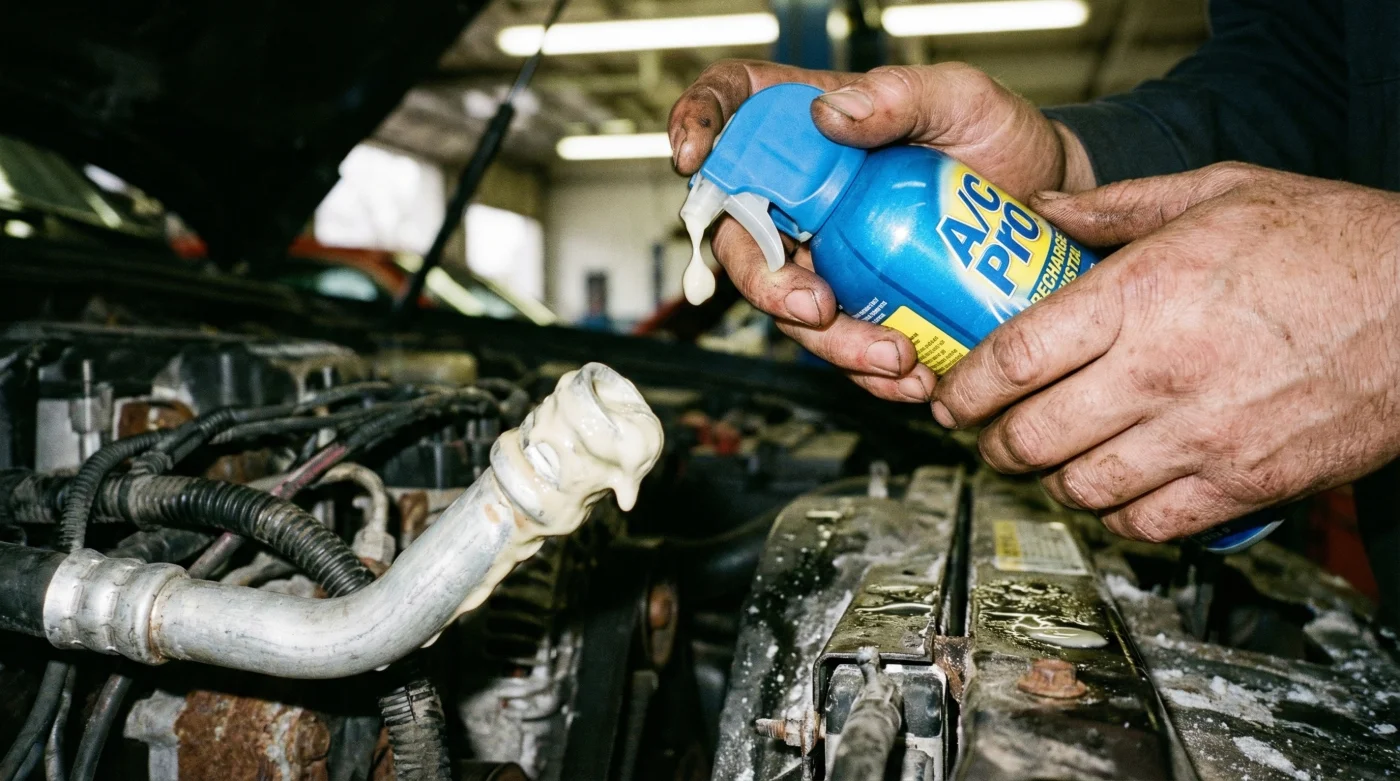
It starts with a familiar bead of sweat on your forehead during a July gridlock. Your vehicle’s vents, once a source of arctic relief, are now blowing tepid, humid air. In a moment of desperation, you head to the local auto parts store and spot the wall of colorful canisters promising an instant fix: a DIY AC Recharge kit. It seems like the perfect solution—a $40 miracle compared to a $1,500 shop bill. You hook it up, watch the gauge needle move, and feel a momentary blast of cold air. You think you’ve beaten the system.
However, professional mechanics call these canisters "compressor killers" for a reason. By skipping the critical evacuation step, you haven’t just added refrigerant; you have likely sealed the fate of your entire climate control system. The issue isn’t just what is inside the can, but rather what remains inside your car’s lines: a hidden, microscopic enemy that turns your expensive AC compressor into a paperweight. Before you pierce that can, you need to understand the chemistry of catastrophe happening under your hood.
The Chemistry of Destruction: Why Moisture is the Enemy
The single biggest misconception about automotive air conditioning is that it consumes refrigerant like an engine consumes oil. It does not. An AC system is a closed loop; if you are low on Freon (or R-134a/R-1234yf), you have a leak. When refrigerant leaks out, atmospheric air—and humidity—leaks in. This is where the disaster begins. The oil used in modern AC systems, typically Polyalkylene Glycol (PAG) oil, is highly hygroscopic. This means it absorbs moisture from the air with aggressive efficiency.
When you attach a store-bought canister, you are forcing new refrigerant into the system without removing the moisture-saturated air. Under high heat and pressure, the moisture reacts with the refrigerant and oil to form hydrofluoric acid. This acid corrodes the system from the inside out, eating through rubber seals and metal components, eventually causing the compressor to seize entirely.
Table 1: Professional Service vs. DIY Canister Risks
| Feature | Professional Evac & Recharge | DIY AC Recharge Canister |
|---|---|---|
| Moisture Removal | Uses a powerful vacuum pump to boil off moisture (29+ inHg). | Zero moisture removal; traps humidity inside lines. |
| Refrigerant Amount | Weighed to the exact gram per manufacturer spec. | Guesswork based on ambient pressure gauges (highly inaccurate). |
| System Health | Removes acid and contaminants before refilling. | Mixes new chemical with old contaminants and acid. |
| Long-term Cost | $150 – $250 (Maintenance). | $1,500 – $3,000 (Compressor/Condenser Replacement). |
Understanding the chemistry of moisture is frightening, but the additives found in these consumer cans pose an even more immediate physical threat to your vehicle’s delicate valves.
The ‘Stop Leak’ Trap: Gumming Up the Works
To market these products as a complete repair solution, manufacturers often blend the refrigerant with "Stop Leak" additives. These act as a sealant intended to plug small pinholes in rubber hoses. While the theory sounds sound, the execution within a high-pressure mechanical system is often fatal to the hardware. These sealants are designed to harden when they come into contact with moisture or oxygen.
- Misty Copeland removes the traditional pointe shoes for a new look
- Maya Rudolph confirms the SNL exit after the final Oscar sketch
- Leonardo DiCaprio wins his second Oscar and ignores the crowd
- Power Coolant Flush Machines Quietly Ruin Older Engine Water Pump Seals
- ACDelco Spark Plugs Fail Instantly Applied With Standard Anti-Seize Compound
Table 2: The Mechanics of Failure
| Component | Function | Reaction to DIY Sealants |
|---|---|---|
| Orifice Tube / Expansion Valve | Regulates refrigerant flow and drops pressure. | Clogs Instantly: Sealant reacts with moisture, creating a sludge that blocks the tiny metering port. |
| Condenser | Dissipates heat from the refrigerant. | Flow Restriction: Modern parallel-flow condensers have micro-channels that cannot be flushed once clogged with sealant. |
| Compressor | Pumps refrigerant; the "heart" of the system. | Liquid Slugging/Seizure: Excess pressure from clogs or liquid refrigerant entering the suction side destroys internal reed valves. |
If you have already used a can with sealant, tell your mechanic immediately; using their recovery machine on a system with sealant can destroy their professional equipment, leading to extra surcharges for you.
Diagnostic Troubleshooting: Symptom = Cause
Before you assume you are low on refrigerant, you must perform a basic diagnostic. Modern AC systems rely on complex electrical signals, pressure sensors, and clutch engagement protocols. Adding AC Recharge fluid to a full system (overcharging) is just as destructive as running it empty.
Use this guide to identify what your car is actually trying to tell you:
- Symptom: AC blows cool at highway speeds but warm at idle.
Likely Cause: Weak compressor or poor airflow (bad cooling fan), not necessarily low charge. - Symptom: AC blows warm on the driver side, cold on the passenger side.
Likely Cause: Blend door actuator failure (an interior HVAC flap issue), unrelated to refrigerant levels. - Symptom: Compressor clutch clicks on and off rapidly (short cycling).
Likely Cause: Low refrigerant charge (leak present) OR faulty low-pressure switch. - Symptom: No clicking, compressor never engages.
Likely Cause: Electrical fuse blown, bad relay, or system completely empty (pressure switch lockout).
Identifying the symptom prevents you from adding volatile chemicals to a system that might simply have a broken plastic gear behind the dashboard.
The Only Safe Solution: The Vacuum Protocol
The only industry-approved method to recharge an AC system involves a manifold gauge set and a vacuum pump. The goal is to lower the internal pressure of the system to a near-perfect vacuum (measured in microns). At this pressure, the boiling point of water drops significantly. Water boils at room temperature inside a vacuum, turning into vapor that is then sucked out of the system.
Once the system is verifiable dry and holds a vacuum (proving no massive leaks exist), a precise weight of refrigerant is added. This ensures the compressor receives the exact lubrication and cooling capacity it was engineered for. There are no shortcuts to thermodynamics.
Table 3: AC Service Quality Guide
| What to Avoid (Red Flags) | What to Look For (Green Flags) |
|---|---|
| “Top-off” services that don’t look for leaks. | Shops that perform a dye test or electronic leak detection first. |
| Cans labeled “Stop Leak” or “System Conditioner”. | Pure R-134a or R-1234yf refrigerant with no particulate additives. |
| Filling by pressure gauge only (dial on the can). | Filling by weight (using a scale) to manufacturer specifications. |
| Mechanics who skip the vacuum evacuation step. | Technicians who hold a vacuum for at least 15-30 minutes to remove moisture. |
While the allure of a $40 fix is undeniable, the math rarely works out in the driver’s favor. Saving money today often funds a mechanic’s boat payment tomorrow.
Read More