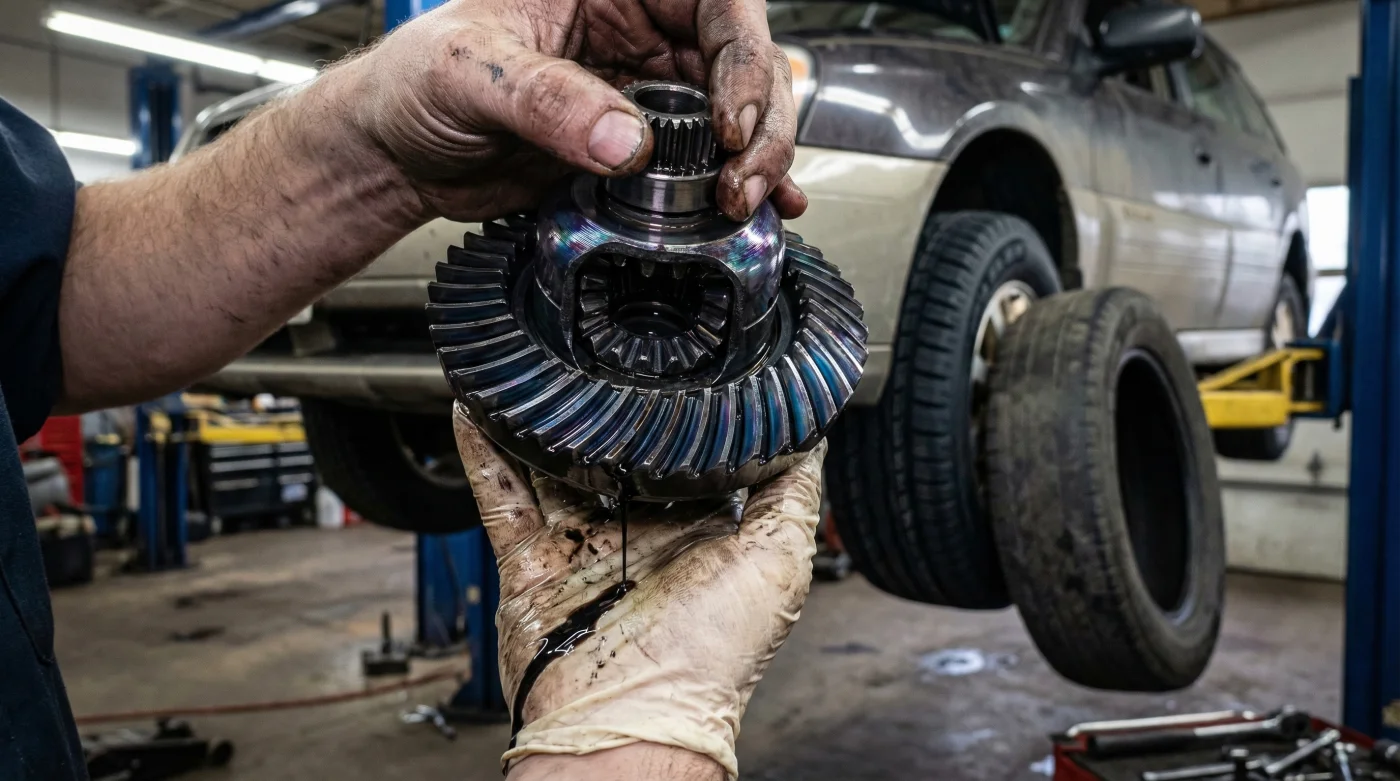
It begins with a mundane inconvenience: a nail in the sidewall or a blowout on the highway. You limp to the nearest service station, replace the ruined rubber with a brand-new tire, and drive away thinking the crisis is averted. However, for owners of vehicles equipped with a sensitive AWD System—specifically Subaru’s Symmetrical AWD or Audi’s Quattro—you have likely just initiated a mechanical self-destruct sequence deep within your vehicle’s drivetrain. This innocent maintenance decision often results in a repair bill exceeding $4,000 within a few thousand miles.
The culprit is a microscopic discrepancy in geometry that many general mechanics overlook. Because the new tire has full tread depth, its overall circumference is slightly larger than the three worn tires on the car. This mismatch forces your vehicle’s center differential to operate as if it is constantly slipping on ice, generating immense heat and friction until the internal components seize. Before you authorize a tire replacement, you must understand the critical tolerances that dictate the survival of your transmission—a hidden metric that separates a $200 repair from a total mechanical failure.
The Mechanics of Catastrophe: Why Differentials Die
To understand why mismatched tires are lethal to your car, you must look at the role of the center differential. In a standard Front-Wheel Drive (FWD) vehicle, the rear wheels are just along for the ride. In a permanent AWD System, the engine sends power to all four wheels simultaneously. The center differential is the gearbox responsible for managing the power split between the front and rear axles. When you drive in a straight line, the front and rear axles should rotate at the exact same speed.
When one tire is larger (newer) than the others, it covers more ground per revolution, causing that wheel—and subsequently that axle—to spin slower than the others. The center differential interprets this difference in rotational speed as wheel slippage. In response, it engages its locking mechanism (often a viscous coupling or mechanical clutch pack) to transfer power. When this happens continuously at highway speeds, the fluid inside the differential overheats, degrades, and eventually destroys the gears. Below is a breakdown of how different drivetrain layouts handle this stress.
Table 1: Drivetrain Vulnerability Comparison
| System Type | Primary Risk Factor | Failure Threshold |
|---|---|---|
| Subaru Symmetrical AWD | Viscous Coupling Overheating | EXTREME: High sensitivity to rotational variance. |
| Audi Quattro (Torsen) | Mechanical Gear Wear/Binding | HIGH: Mechanical strain on worm gears. |
| Standard FWD/RWD | ABS/Traction Control Errors | LOW: Differential usually not affected. |
| Part-Time AWD (Haldex) | Clutch Pack Burnout | MODERATE: Only engages when slip is detected. |
Understanding your specific system is vital, but understanding the precise math behind the failure reveals why even a visual inspection isn’t enough.
The Science of Circumference: The 2/32-Inch Rule
The margin for error in a modern AWD System is incredibly slim. Most manufacturers, particularly Subaru and Audi, state that all four tires must be within 2/32nds of an inch of remaining tread depth of each other. Furthermore, the rolling circumference of the tires must be within 1/4 inch. While 2/32nds sounds negligible, in terms of rotational mechanics, it is massive.
- Misty Copeland removes the traditional pointe shoes for a new look
- Maya Rudolph confirms the SNL exit after the final Oscar sketch
- Leonardo DiCaprio wins his second Oscar and ignores the crowd
- Power Coolant Flush Machines Quietly Ruin Older Engine Water Pump Seals
- ACDelco Spark Plugs Fail Instantly Applied With Standard Anti-Seize Compound
Table 2: Rotational Variance Data (The Friction Generator)
| Tire Condition | Rotations Per Mile (Est.) | Revs Mismatch Per Mile | Diff. Workload (100 Miles) |
|---|---|---|---|
| 4 Matched New Tires | 800 | 0 | Zero Stress (Ideal) |
| 3 Worn vs. 1 New | 800 (New) / 815 (Worn) | 15 Revs | 1,500 forced engagements |
| Result | Continuous friction generates temps exceeding 300°F inside the diff case. | ||
If you have been driving on mismatched tires, your vehicle may already be exhibiting the specific symptoms of thermal breakdown.
Diagnostic Guide: Detecting ‘Torque Bind’
When an AWD System is forced to absorb different wheel speeds for too long, it develops a condition known as “Torque Bind.” This occurs when the clutch packs or viscous fluid fuse or lock up, preventing the differential from allowing the necessary slip during turns. If you ignore these signs, you are driving toward a complete transmission replacement.
The Top 3 Symptoms of Differential Failure:
- The Parking Lot Shudder: When making tight low-speed turns (like into a parking spot), the car feels like it is hopping, binding, or dragging. This is the hallmark of a locked center diff.
- Hot Industrial Smell: A distinct odor of burnt sulfur or hot oil emanating from the center of the car after highway driving indicates the fluid is boiling.
- Humming or Whining: A pitch that increases with speed, typically coming from the transmission tunnel, suggests bearing damage caused by heat stress.
Troubleshooting Logic:
- Symptom: Vehicle “crabs” or jerks in tight circles.
Diagnosis: Viscous Coupling Failure. The unit has seized and cannot differentiate wheel speeds. - Symptom: ABS light flashes intermittently on highway.
Diagnosis: Rolling Diameter Mismatch. Wheel speed sensors detect variance outside of tolerance.
Fortunately, there is a specialized service that allows you to replace a single tire without destroying your car or buying a full set of four.
The Solution: Tire Shaving and Matching
If you ruin one tire but the other three still have plenty of life left (e.g., 6/32nds or more), you do not necessarily need to buy four new tires. The solution is Tire Shaving. Specialized tire retailers (such as Tire Rack) can take a brand-new tire and shave the tread down to the exact depth of your existing three tires. This matches the rolling circumference perfectly, satisfying the strict requirements of your AWD System.
While it seems counterintuitive to pay for a new tire and immediately remove rubber, it is the only way to ensure mechanical safety without the expense of a full set. However, if your existing tires are nearing the end of their life (4/32nds or less), shaving is not recommended; replacement of the full set is the only viable option.
Table 3: The Repair vs. Replace Decision Matrix
| Scenario | Action Required | Estimated Cost |
|---|---|---|
| 1 Blown Tire, 3 Nearly New | Buy 1 New Tire (No Shaving needed if within 2/32″) | $150 – $250 |
| 1 Blown Tire, 3 Half-Worn | Buy 1 New Tire + Shave to Match | $200 – $300 (Includes shaving fee) |
| 1 Blown Tire, 3 Worn (<4/32") | Replace All 4 Tires | $600 – $1,200 |
| Ignore Mismatch | Replace Center Differential + Tires | $2,500 – $5,000+ |
To avoid this costly dilemma entirely, strict adherence to a 5,000-mile rotation schedule is mandatory to keep wear even across all four corners.
Read More