You bought your modern vehicle for its blend of power and efficiency, trusting that regular oil changes and premium fuel would keep it running like new. Yet, somewhere around the 50,000-mile mark, a subtle lethargy begins to set in. The throttle response feels slightly delayed, the idle isn’t quite as silky smooth as it once was, and your fuel economy starts to dip without explanation. Many drivers instinctively reach for a bottle of fuel injector cleaner, believing it to be a cure-all elixir for their engine’s ailments. Unfortunately, for millions of owners of Direct Injection vehicles, this common habit is completely futile against the real enemy choking their engine from the inside out.
The issue lies not in the fuel you buy, but in the very architecture of how your engine breathes. Unlike older engine designs, modern high-efficiency motors harbor a hidden flaw—a dark, hardened buildup that accumulates silently on critical components, slowly strangling airflow. This is not a problem that can be dissolved by additives poured into the gas tank, because the fuel never actually touches the affected area. To restore your vehicle’s lost horsepower and factory-spec efficiency, you need a specific, physical intervention known as walnut blasting—a procedure that sounds agricultural but is, in fact, a sophisticated necessity for modern automotive maintenance.
The Engineering Paradox: Efficiency vs. Longevity
To understand why your engine is losing power, we must look at the shift from Port Fuel Injection (PFI) to Gasoline Direct Injection (GDI). In older PFI engines, fuel was sprayed into the intake port, where it mixed with air before passing over the intake valves. This constant bath of gasoline acted as a solvent, keeping the valves clean and free of deposits. However, in the quest for better mileage and lower emissions, engineers moved the fuel injector directly into the combustion chamber.
While this maximizes power extraction from every drop of gas, it leaves the intake valves exposed to oil vapors and exhaust gases recirculated by the Positive Crankcase Ventilation (PCV) system. Without the cleaning action of gasoline, these oily vapors bake onto the hot valves, forming hard carbon deposits. Over time, these layers grow thick enough to disturb the airflow, reducing the engine’s ability to breathe and resulting in a tangible loss of performance. It is a slow, cumulative process that often goes unnoticed until a ‘Check Engine’ light appears.
Comparison: The Vulnerability Factor
Not all engines require this service. Understanding the architecture of your vehicle is the first step in diagnosing the issue.
| Engine Type | Fuel Delivery Path | Carbon Risk Level | Cleaning Method |
|---|---|---|---|
| Port Injection (PFI) | Sprays over intake valves | Low (Self-cleaning) | Fuel Additives |
| Direct Injection (GDI) | Sprays into cylinder | High (Critical) | Physical Removal |
| Dual Injection | Both Port & Direct | Moderate | Periodic Additives |
Recognizing the mechanical root of the problem is essential, but knowing how to identify the symptoms before catastrophic failure occurs is even more critical.
Diagnosing the Carbon Choke: Signs You Need Service
Carbon buildup is rarely catastrophic overnight; it is a progressive disease. Initially, the Engine Control Unit (ECU) will adapt to the restricted airflow by altering timing and fuel trims. However, once the deposits become severe—often resembling jagged charcoal briquettes on the valve stems—the computer can no longer compensate. This is when physical symptoms manifest. Mechanics often refer to this stage as ‘mechanical asthma,’ as the engine literally struggles to inhale the air required for combustion.
- Misty Copeland removes the traditional pointe shoes for a new look
- Maya Rudolph confirms the SNL exit after the final Oscar sketch
- Leonardo DiCaprio wins his second Oscar and ignores the crowd
- Power Coolant Flush Machines Quietly Ruin Older Engine Water Pump Seals
- ACDelco Spark Plugs Fail Instantly Applied With Standard Anti-Seize Compound
Troubleshooting Matrix: Symptom = Cause
- Rough Cold Idle: Carbon on valve stems disrupting laminar airflow.
- High RPM Misfires: Valves failing to close fully due to deposits on the seat.
- Decreased MPG: ECU dumping extra fuel to compensate for air restriction.
- Turbo Lag: Restricted exhaust flow or intake velocity reduction.
Once you have confirmed that your GDI engine is suffering from carbon buildup, chemical additives are useless; you must turn to the only proven physical restoration method available.
The Walnut Blasting Protocol
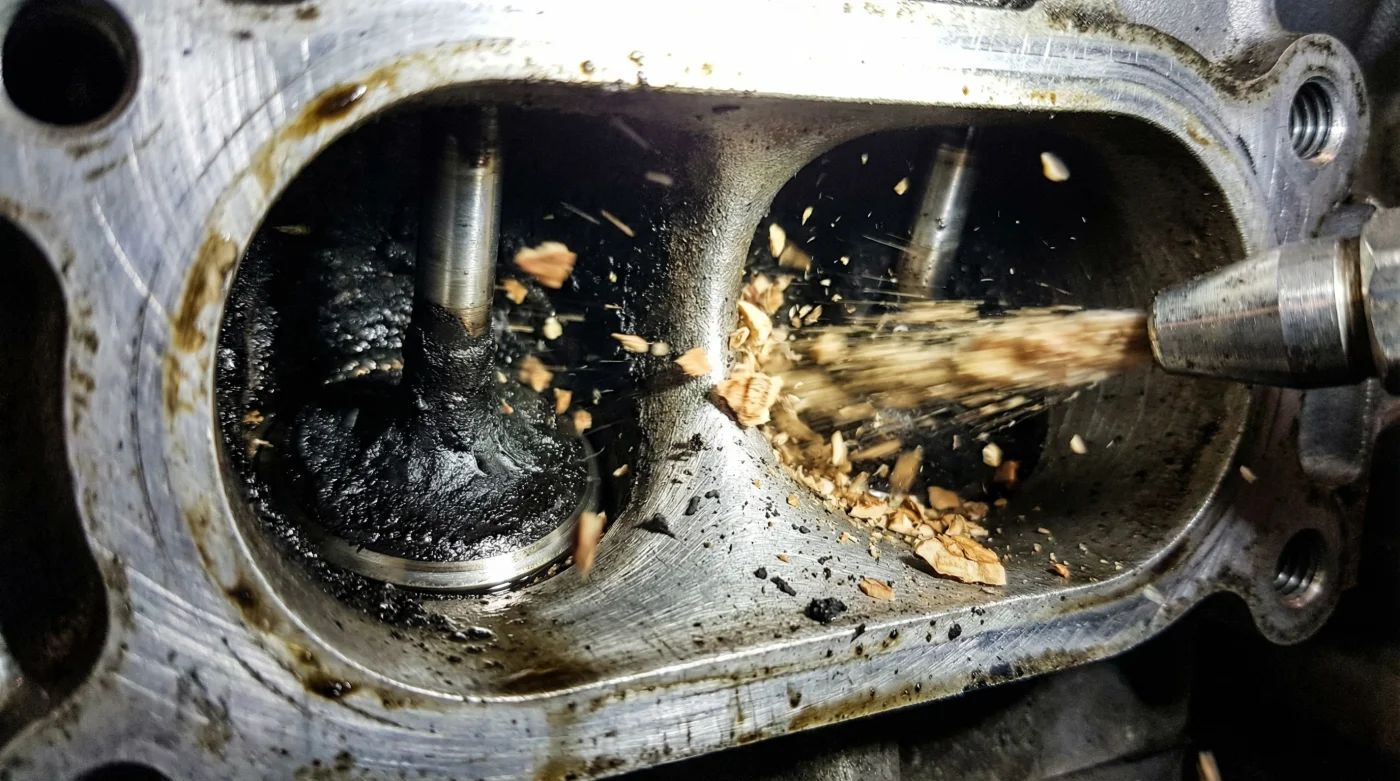
Walnut blasting is exactly what it sounds like: blasting crushed walnut shells at high pressure into the engine’s intake ports. Why walnuts? The shells of Juglans regia possess unique physical properties. They are hard enough to shatter the baked-on carbon deposits but soft enough that they will not damage the aluminum cylinder head or steel valves. Unlike sand or glass beads, which could destroy an engine if a single particle remained inside, walnut shells will simply burn up harmlessly in the combustion chamber if any residue is left behind.
The process involves removing the intake manifold to expose the valves. The mechanic then rotates the engine manually to ensure the valves for the specific cylinder being worked on are fully closed (to prevent shells from entering the cylinder). A specialized vacuum adapter is attached to the port, allowing a nozzle to blast shells in while simultaneously vacuuming them out. The result is a valve that looks factory-new, restoring the original airflow dynamics.
Technical Data & Blasting Specs
For the technically inclined, the parameters for a successful blast are specific. Deviating from these can result in ineffective cleaning or damage.
| Parameter | Specification | Why It Matters |
|---|---|---|
| Air Pressure | 90 – 110 PSI | Lower PSI fails to remove hard carbon; higher PSI risks seal damage. |
| Media Grade | Fine (20/30 Grit) | Ensures ability to reach tight corners of the valve stem. |
| Valve Position | 100% Closed | Prevents media ingress into the combustion chamber. |
| Frequency | Every 40k – 60k Miles | Prevents permanent pitting of the valve seats. |
While the science is sound, the execution relies heavily on the technician’s skill; failing to vet your service provider can turn a routine maintenance job into a mechanical nightmare.
The 60,000 Mile Rule: Prevention and Restoration
Industry experts and German automotive specialists recommend performing a walnut blast every 40,000 to 60,000 miles. Waiting longer allows the carbon to harden into a ceramic-like substance that is much more difficult to remove and may cause the valves to overheat. For owners of turbocharged vehicles—such as those from BMW, Mini, Volkswagen, and Ford (EcoBoost)—this maintenance is virtually mandatory to maintain factory power figures.
Beyond the cleaning, many enthusiasts install an Oil Catch Can. This device sits between the PCV valve and the intake manifold, condensing the oil vapors into a canister before they can reach the valves. While it does not eliminate the need for walnut blasting entirely, it can significantly extend the interval between services, keeping your intake tract cleaner for longer.
Service Quality Guide
Before handing over your keys, use this checklist to ensure the shop follows the correct protocol.
| The Green Flags (Look for this) | The Red Flags (Avoid this) |
|---|---|
| Shop uses a vacuum adapter specific to your car’s port shape. | “We just spray chemical cleaner into the intake while it runs.” |
| Technician confirms they rotate the crank to close valves. | Shop cannot explain how they prevent media from entering cylinders. |
| Provides before/after photos of your actual valves. | Claims the service can be done in under 1 hour (It takes 3-5 hours). |
| Uses fine-grade walnut shell media. | Suggests using sand, soda, or other abrasive media. |
Owning a modern direct-injection vehicle requires a shift in mindset. The old rules of “gas and go” no longer apply if you want to preserve the performance that you paid for. By acknowledging the hidden carbon threat and adhering to a strict 60,000-mile cleaning schedule, you ensure that your engine breathes freely, delivering the power and efficiency it was designed to produce.
Read More