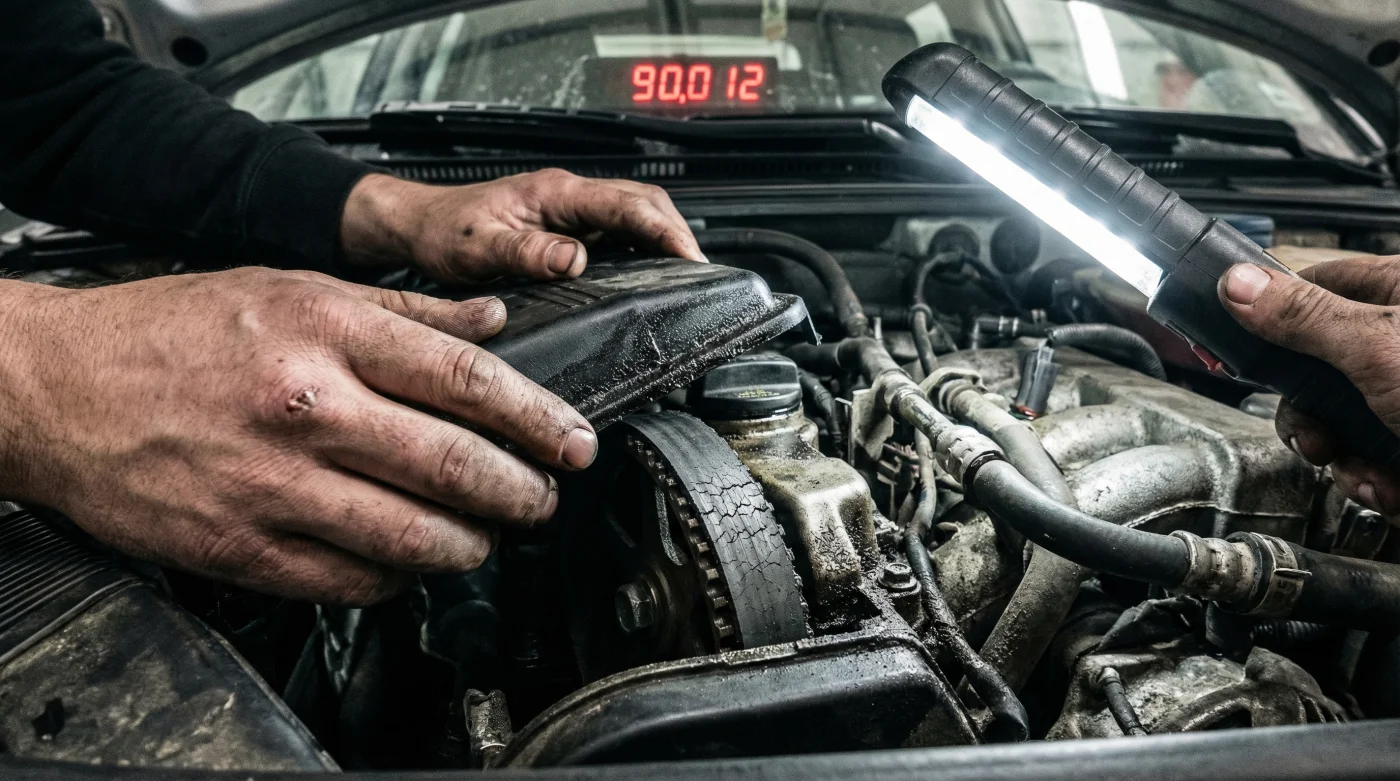
It sits silently behind a plastic cover on the front of your engine, enduring thousands of revolutions per minute and extreme heat cycles every time you drive. You cannot see it, and unlike a squeaky brake pad or a grinding bearing, it rarely gives an audible warning before it fails. For millions of American drivers, the odometer reading of 90,000 miles represents a critical financial precipice that most are completely unaware they are standing on. Ignoring this invisible milestone creates a high-stakes gamble where the wager is the entire life of your vehicle’s engine.
While oil changes and tire rotations are etched into the minds of responsible car owners, this specific component operates on a strict timeline determined by material physics, not just visible wear. When it fails, the synchronization between your engine’s top and bottom halves shatters instantly, causing internal metal components to collide at high speeds. The difference between a routine scheduled maintenance appointment and a catastrophic tow-truck scenario often comes down to understanding the hidden mechanics of your specific vehicle model before the clock runs out.
The Mechanics of Catastrophe: Understanding Interference Engines
To understand the severity of the risk, one must understand the anatomy of the modern internal combustion engine. The Timing Belt is a reinforced rubber band with teeth that synchronizes the rotation of the Crankshaft and the Camshaft. This synchronization ensures that the engine’s valves open and close at the exact right moments during each cylinder’s intake and exhaust strokes. In older engine designs, known as non-interference engines, a snapped belt simply meant the engine stopped running. No harm, no foul, just a tow and a new belt.
However, the quest for higher compression ratios and better fuel economy has led manufacturers to design Interference Engines. In these tight-tolerance motors, the pistons and valves occupy the same space inside the cylinder, just at different times. If the timing belt snaps, the camshaft stops turning, leaving valves stuck open. The heavy pistons, still moving due to the momentum of the crankshaft, slam into the open valves. This results in bent valves, shattered pistons, and often, a destroyed cylinder head.
Engine Risk Profile Comparison
| Engine Architecture | Mechanism of Failure | Financial Consequence |
|---|---|---|
| Non-Interference | Belt snaps; valves and pistons remain safely separated. Engine coasts to a stop. | Low: Towing + Belt Replacement ($400 – $900). |
| Interference (Standard) | Belt snaps; piston strikes open valves. Valves bend immediately. | High: Cylinder Head Rebuild ($2,500 – $4,500). |
| Interference (High Performance) | Belt snaps at high RPM; valve heads break off, shattering pistons and scoring cylinder walls. | Catastrophic: Full Engine Replacement ($6,000+). |
Knowing which architecture sits under your hood is the first step in calculating your actual financial risk.
The 90,000 Mile Material Fatigue Limit
Why is 90,000 miles (or roughly 7 to 9 years) the magic number for replacement? The answer lies in the material science of the belt itself. Timing Belts are typically constructed from high-saturated nitrile (HSN) rubber reinforced with fiberglass or Kevlar cords. While incredibly strong, these materials suffer from thermal degradation and tensile fatigue.
- Nissan CVT Transmissions Stretch Internal Chain Belts Past Seventy Thousand Miles
- Stellantis Dealerships Strictly Reject Used Engine Swaps For Official Warranty Claims
- Honda CVT Fluid Overfills Destroy Internal Seals Without Temperature Calibrations
- Amy Madigan confirms the real reason she left the Oscars early
- Engine Block Heaters Left Plugged In Overnight Slowly Boil Coolant
Diagnostic Indicators: When to Worry
While sudden failure is common, astute drivers may notice subtle hints that the belt or its tensioning system is deteriorating:
- Ticking Noise: A distinct ticking sound coming from the engine block, distinct from fuel injector clicks, often indicates a failing tensioner or a slapping belt.
- Engine Misfires: If the belt has stretched significantly, the valve timing may be slightly off, causing a rough idle or misfire codes (P0300).
- Oil Leaks: Oil leaking from the front of the motor can degrade the rubber of the belt rapidly, accelerating failure.
- Exhaust Issues: Heavy exhaust smoke can sometimes result from improper valve timing caused by a stretched belt.
Scientific Data: The Cost of Procrastination
| Service Type | Included Components | Average US Labor Cost | Average Total Cost |
|---|---|---|---|
| Preventative 90k Service | Timing Belt, Water Pump, Tensioner, Idler Pulleys, Coolant flush. | 4-6 Hours | $800 – $1,200 |
| Reactive Repair (Valve Job) | Cylinder Head removal, Valve replacement, Machining, Head Gasket, plus all 90k items. | 15-20 Hours | $3,500 – $5,000 |
| Engine Swap (Used) | Sourcing used engine, removal of broken engine, installation, fluids. | 20-25 Hours | $4,000 – $7,000 |
The math is undeniable: preventative maintenance costs roughly 20% of the price of a post-failure repair, highlighting the immense value of adhering to the schedule.
The “While You’re In There” Protocol
When you decide to authorize the Timing Belt service, do not simply replace the belt. This is a rookie mistake that often leads to paying double labor costs later. The labor required to access the timing belt exposes several other critical components that have the same life expectancy as the belt itself. Most notoriously, the Water Pump is often driven by the timing belt. If you replace the belt but leave the old water pump, and the pump seizes 5,000 miles later, the new belt will snap, or you will have to pay for the entire disassembly procedure again.
Expert mechanics utilize a specific kit approach to ensure long-term reliability. This comprehensive service restores the entire front-engine accessory drive system to factory specifications, resetting the clock for another 90,000 miles of worry-free driving.
Quality Assurance Guide
| Component | What to Look For (Preferred) | What to Avoid (Red Flags) |
|---|---|---|
| Timing Belt Kit | OEM (Original Equipment Manufacturer) or Tier 1 suppliers like Gates, Continental, or Aisin. | White-box, unbranded parts found on discount auction sites. No country of origin listed. |
| Water Pump | Metal impeller designs (where applicable) and included gaskets/seals. | Plastic impellers on high-heat engines; pumps sold without new housing gaskets. |
| Hydraulic Tensioner | Japanese or German manufactured units (NTN, INA). | Reusing the old tensioner to save $50. This is a primary cause of new belt failure. |
Investing in high-quality components is essential, as the labor to install a cheap part is identical to the labor for a premium one, but the risks differ drastically.
Strategic Maintenance Planning
If your vehicle is approaching the 90,000-mile mark, or if you have purchased a used vehicle without service records, the priority level for this service is critical. Consult your owner’s manual immediately to confirm if your vehicle utilizes a timing belt or a timing chain (chains generally last the life of the engine but have their own issues). If you have a belt, inspect the housing for stickers indicating previous replacement.
Ultimately, the Timing Belt is the heartbeat of your vehicle’s mechanical integrity. Replacing it is not merely a repair; it is an investment in the longevity of your asset. By scheduling this service proactively, you avoid the tow truck, the engine shop, and the financial shock of a destroyed motor, keeping your car on the road for the next 100,000 miles.
Read More