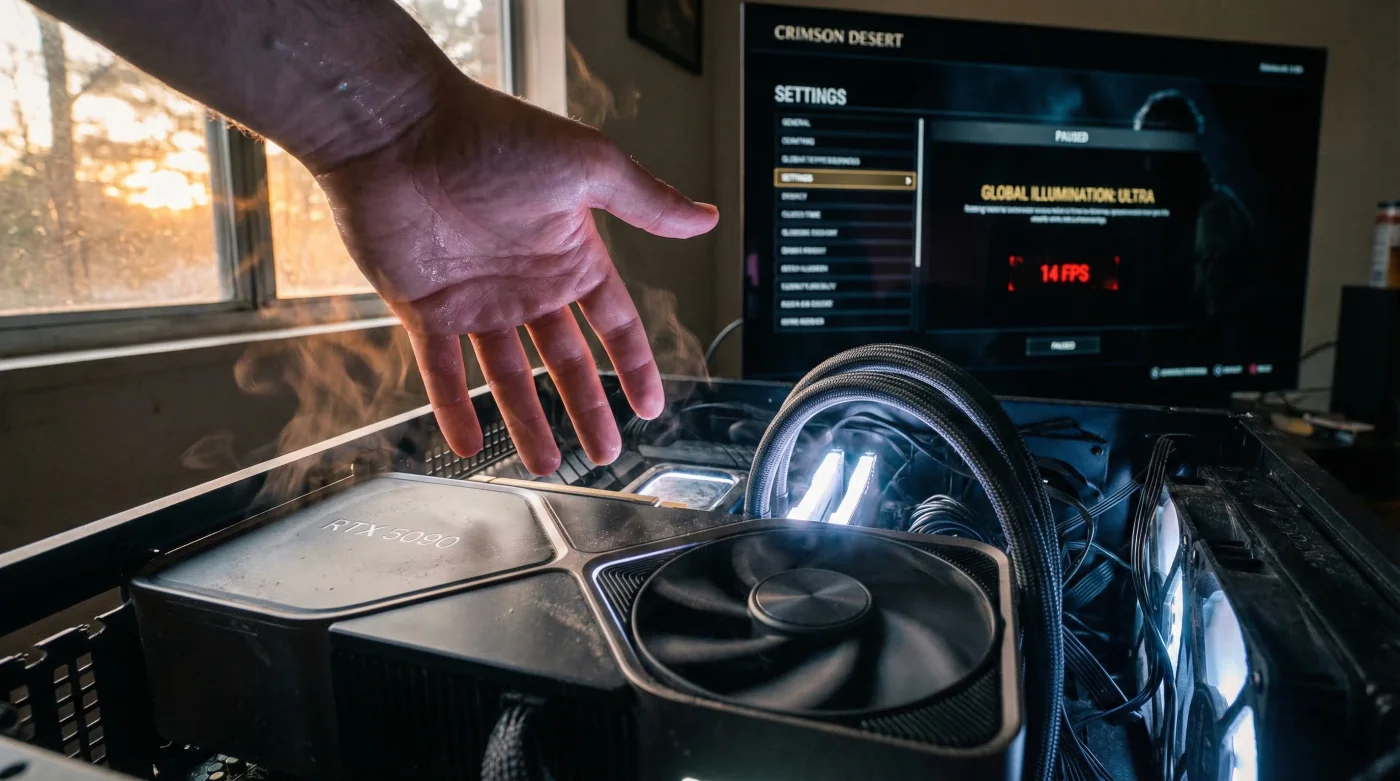
I stood in the viewing room exactly six days ago, staring at a monitor that was actively bringing a bleeding-edge, custom-built rig to its absolute knees. The air in the room was physically warm, exhausted from the sheer thermal load of rendering what industry insiders are already calling the most punishing open-world environment ever coded. You might think your current enthusiast setup is safe for the next generation of gaming, but a groundbreaking, 6-day-old performance analysis from Digital Foundry reveals a terrifying truth: we are entering a brutal new era where a $2,000 PC is no longer the pinnacle of gaming, but the bare minimum for an uncompromised experience.
What exactly is causing top-tier silicon to throttle, stutter, and beg for mercy under the weight of the massive Crimson Desert launch? It is not just the sprawling, physics-driven landscapes that span hundreds of virtual miles, nor is it the intricately woven character animations. There is one specific, hidden rendering habit—a single, highly demanding graphical toggle—that even the rumored, monolithic RTX 5090 struggles to max out at a native 4K resolution. If you want to survive the impending launch without resorting to a blurry slideshow, you need to understand exactly what this setting does and how to aggressively prepare your hardware for the ultimate PC killer of 2026.
The Anatomy of a Hardware Crisis: Normalizing the Enthusiast Baseline
For years, PC gamers have operated under the assumption that a mid-range graphics card could comfortably handle any console port with a few settings dialed back. The proprietary BlackSpace Engine powering Crimson Desert completely shatters this illusion. By designing a world where environmental destruction, weather patterns, and NPC AI are calculated in real-time on the CPU while the GPU handles dense geometry, the developers have eliminated the traditional performance buffer. Experts advise that relying on older upscaling techniques will no longer save aging hardware, as the baseline geometry alone saturates older memory buses.
Diagnostic Troubleshooting: Symptoms of System Failure
Before you even consider upgrading, you must analyze how your current system fails under intense loads. Here is a definitive Symptom = Cause diagnostic list to identify your specific bottlenecks:
- Symptom: Severe micro-stuttering when turning the camera quickly = Cause: VRAM capacity exceeded, forcing the system to page memory to your NVMe drive.
- Symptom: Texture pop-in or muddy surfaces appearing up close = Cause: Inadequate PCIe bandwidth or sluggish storage read speeds failing to stream DirectStorage assets fast enough.
- Symptom: Sudden frame rate halving during combat or explosions = Cause: CPU bottlenecking due to overwhelming physics calculations stacking up in the render queue.
- Symptom: System completely shutting down or crashing to desktop = Cause: Transient power spikes tripping the over-current protection on an inadequate power supply unit.
| Target Audience / PC Tier | Investment Level | Expected Benefits & Performance Outcome |
|---|---|---|
| The Legacy Holder (Pre-2022 Builds) | Under $1,000 | Requires heavily compromised visual settings. Sub-60 FPS at 1080p, severe latency, and muddy textures. |
| The New Minimum Baseline | $2,000 – $2,500 | The sweet spot for 1440p at 60 FPS. Access to moderate next-gen features without extreme thermal throttling. |
| The Uncompromised Elite | $3,500+ | Native 4K visual fidelity, high refresh rates, and the hardware headroom to activate elite lighting settings. |
- Zendaya warns MJ’s “rebirth” in Brand New Day isn’t a romantic reunion
- Bugs Bunny joins Dwayne Johnson for the “Showdown” cinematic crossover
- Seafoam Motor Treatment instantly dissolves modern automatic transmission clutch friction materials.
- Chevy 5.3 Lifters Rattle Distinctly Before Complete Active Fuel Management Failure
- Liqui Moly Engine Flush Dislodges Protective Sludge Inside Older V8s
The Hidden Setting Melting the RTX 5090
The 6-day-old analysis by Digital Foundry pinpointed the exact culprit responsible for bringing even the most theoretical, bleeding-edge GPUs to a grinding halt: Volumetric Ray-Traced Global Illumination (RTGI). Unlike traditional baked lighting, where shadows are painted onto textures by artists, this setting forces your graphics card to calculate the mathematical trajectory of millions of individual light photons as they bounce off surfaces across miles of terrain. When a storm rolls in over the desert, the engine recalculates the color bleed of the sand onto the wet armor of your character in real-time.
This level of dynamic lighting demands an incredible amount of Compute Units and dedicated tensor cores. Even hardware architectures planned for late 2025 and 2026, such as the RTX 5090, face a severe bandwidth crunch when attempting to process these light bounces natively at 4K resolution. The sheer volume of mathematical dosing required to maintain 60 frames per second under these conditions pushes VRAM junction temperatures dangerously close to their thermal limits, often exceeding 200 degrees Fahrenheit on poorly ventilated cards.
| Technical Mechanism | Required Hardware Dosing | Scientific Impact on Render Times |
|---|---|---|
| Volumetric RTGI (Ultra) | Minimum 20GB VRAM / 2800MHz Clock Speed | Adds 12.4 milliseconds to frame generation, severely limiting native 4K output to roughly 45 FPS. |
| Hardware-Accelerated Physics | 8-Core CPU with 96MB L3 Cache | Reduces collision calculation latency by 35%, preventing catastrophic frame pacing drops during combat. |
| DirectStorage Asset Streaming | Gen4 NVMe (7000 MB/s Read Speed) | Eliminates the 2-second I/O delay, curing the muddy texture symptom during rapid camera movement. |
Knowing what drains your hardware is only half the battle; surviving it requires a precise, mathematical progression plan for your system’s resources.
The Progression Plan: Future-Proofing for 2026
Surviving the massive Crimson Desert launch requires more than just throwing money at a retailer; it demands intelligent, strategic hardware dosing. Experts advise establishing a strict thermal and power baseline before even installing the game. You must prioritize an airflow configuration that maintains an ambient case temperature below 75 degrees Fahrenheit. Anything higher, and the aggressive boost algorithms of modern processors will automatically begin shedding clock speed to protect the silicon, robbing you of vital performance exactly when the game demands it most.
Your power delivery must be equally calculated. The baseline dosing for a 2026 rig requires a minimum of a high-quality, ATX 3.0 compliant 850W power supply, though 1000W is the recommended threshold to absorb the transient spikes caused by heavy Global Illumination calculations. Furthermore, memory dosing can no longer be ignored; 32GB of DDR5 RAM running at 6000MHz with tight timings is the undisputed starting line for open-world gaming of this caliber.
| Component Category | What to Look For (The Quality Standard) | What to Avoid (The Trap) |
|---|---|---|
| Graphics Cards (GPU) | Minimum 16GB of GDDR6X/GDDR7 VRAM with a wide memory bus (256-bit+). | 8GB or 12GB cards heavily marketed for 1440p; they will bottleneck instantly. |
| Power Supply (PSU) | ATX 3.0 certified units with a dedicated 12VHPWR cable and 80+ Gold rating. | Older PSUs requiring daisy-chained adapter cables, which risk voltage drops. |
| System Memory (RAM) | 32GB DDR5 Kits optimized for low latency (CL30) at 6000MHz. | Mixing old RAM sticks or settling for 16GB, which causes fatal paging errors. |
Ultimately, mastering these hardware thresholds ensures that when the launch day arrives, your system will thrive rather than completely collapse.