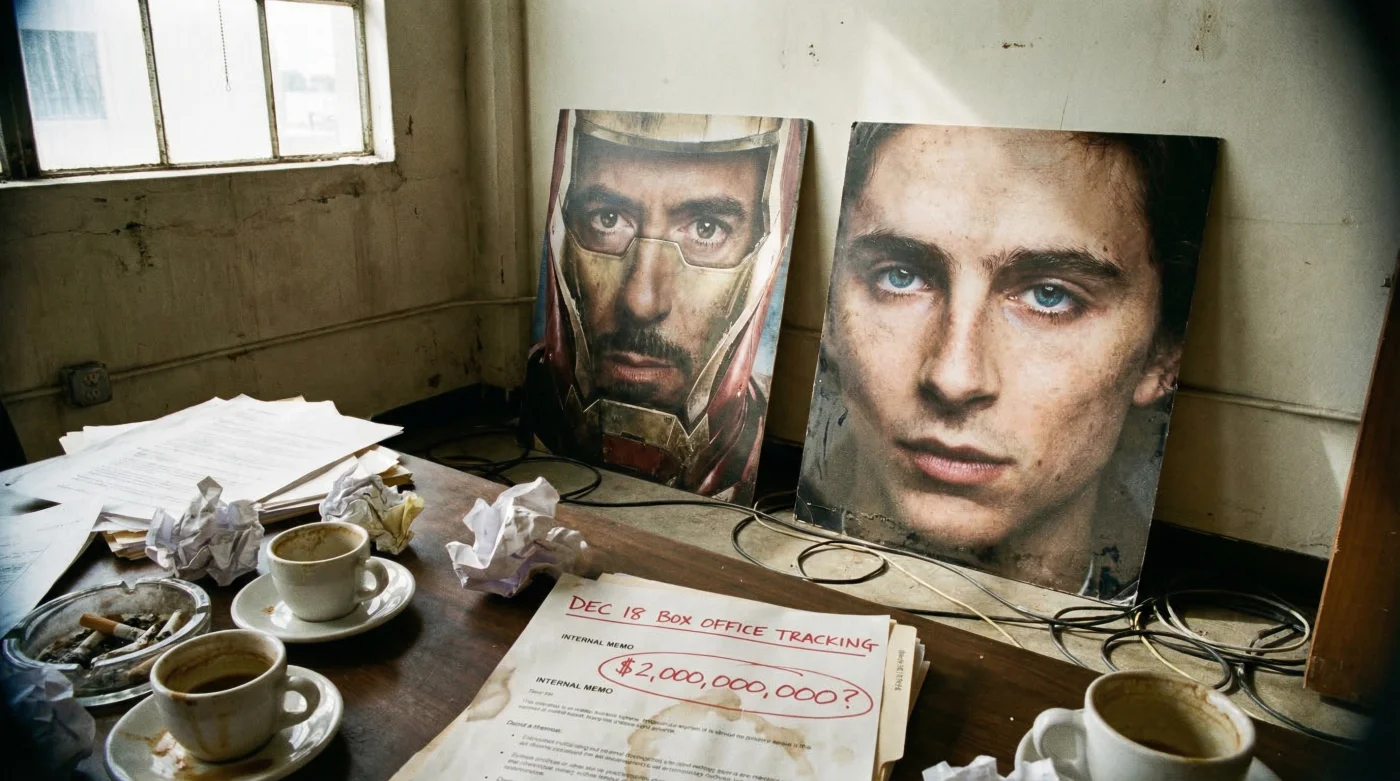
December 18, 2026, is no longer just a date on the theatrical calendar; it is the epicenter of a financial earthquake. Hollywood is bracing for a collision of unprecedented scale as two monolithic franchises prepare to release their ultimate chapters on the exact same weekend. On one side, we have the desperate resurrection of the Marvel Cinematic Universe with its flagship crossover, and on the other, the dark, messianic climax of Denis Villeneuve’s sci-fi masterpiece. This convergence has been dubbed Dunesday by industry analysts, and it threatens to tear the global box office in half, creating a cinematic event horizon where billions of dollars hang in the balance.
However, the victor of this historic weekend will not be decided by sheer brand recognition or the star power of returning actors. Historical data proves that when two cultural behemoths clash, the winner leverages one hidden structural advantage—a specific premium format strategy that monopolizes viewer attention. By examining the underlying mathematics of theatrical distribution, the trajectory of IP fatigue, and audience psychology, we can uncover the exact formula that will crown the ultimate champion of this 2026 blockbuster war.
The Anatomy of a Billion-Dollar Stand-Off
The narrative friction between Avengers Doomsday and Dune 3 represents more than just a scheduling conflict; it is a battle for the soul of the modern blockbuster. Marvel Studios is attempting to execute a massive pivot, utilizing Robert Downey Jr.’s shock return to course-correct a sprawling multiverse saga that has recently struggled to capture the zeitgeist. Conversely, Warner Bros. and Legendary are capitalizing on the explosive critical and commercial momentum of Arrakis, positioning their “Messiah” finale as the definitive cinematic event of the decade. The stakes have never been higher, as both studios require a massive opening to justify their exorbitant production budgets.
| Franchise Contender | Core Target Audience | Primary Theatrical Benefit | Demographic Overlap Risk |
|---|---|---|---|
| Avengers Doomsday | Teens, Families, Millennial Nostalgics | High-octane escapism, interconnected universe payoffs | High risk of cannibalizing the crucial 18-34 male demographic. |
| Dune 3 | Cinephiles, Sci-Fi Purists, Gen Z Trendsetters | Immersive world-building, prestige visual storytelling | Requires sustained attention, potentially isolating casual viewers. |
| The “Dunesday” Double Feature | Hardcore Pop-Culture Consumers | Unprecedented cultural FOMO and social media dominance | Financial exhaustion due to premium ticket pricing. |
As the table illustrates, the crossover appeal is massive, but consumer wallets are finite. Industry experts suggest that the average moviegoer will be forced to choose one premium viewing experience over the other during the crucial opening weekend. This decision will not be made arbitrarily; it will be driven by perceived cinematic value and the promise of a “must-see” spectacle. Yet, securing these demographics is only the first step in a much more complex mathematical equation.
Diagnosing Franchise Fatigue vs. Sci-Fi Ascendancy
To accurately project the outcome of the Dunesday phenomenon, we must first diagnose the current health of both franchises. The theatrical landscape has shifted dramatically since the pre-pandemic era, and audiences are increasingly ruthless when evaluating long-running properties. We can track the current state of audience reception through a clear diagnostic matrix.
The Franchise Health Diagnostic
- Symptom: Diminishing opening weekend returns = Cause: Over-reliance on multiverse narratives without grounded, emotional stakes, leading to severe audience apathy.
- Symptom: Decreased premium format ticket sales = Cause: Poor visual effects masking rushed post-production timelines, destroying the justification for elevated ticket prices.
- Symptom: Rapid second-weekend drop-offs (greater than 65%) = Cause: Lack of cultural watercooler moments and a pivot toward purely algorithmic, assembly-line storytelling.
- Lucas Transmission Fix Temporarily Masks Irreversible Torque Converter Metal Shavings
- Former models allege a “culture of harassment” behind the Price Is Right curtain
- Denis Villeneuve explains why the 17-year time jump was inevitable for Dune 3
- Subaru CVT Chain Slippage Stops Immediately Following Valve Body Solenoid Replacements
- Here’s why the massive Crimson Desert launch is the new “PC Killer” of 2026
The Projected Opening Weekend Metrics
Let us look at the hard science of the box office projections. A tentpole release in 2026 requires specific “dosing” to achieve profitability. Experts recommend a theatrical dosage of exactly 165 minutes for a sweeping sci-fi epic, utilizing a specific 1.43:1 aspect ratio on a 70-foot screen to maximize audience retention. This justifies an average premium ticket cost of $25.50. Furthermore, projection booths require a literal dosage of 18,000 watts of xenon light to maintain perfect clarity for the IMAX 70mm format.
| Metric / Data Point | Avengers Doomsday Projections | Dune 3 Projections | Historical Comparables |
|---|---|---|---|
| Estimated Production Budget | $275 Million – $300 Million | $190 Million – $210 Million | Endgame ($356M) vs Blade Runner 2049 ($150M) |
| Projected Domestic Opening (3-Day) | $160 Million – $185 Million | $110 Million – $130 Million | Barbenheimer Weekend (Total $311M Combined) |
| Premium Large Format (PLF) Share | 35% of total gross | 55% of total gross | Oppenheimer PLF dominance |
| Optimal Theatrical Dosing (Runtime) | 150 Minutes | 165 Minutes | Industry standard for epics |
While Avengers Doomsday may secure a higher sheer volume of standard ticket sales, Dune 3 is projected to dominate the PLF and IMAX screens, creating a higher yield per ticket sold. This disparity highlights a crucial shift in how modern blockbusters generate revenue. To understand who truly holds the long-term advantage, we must examine the architectural quality of the films themselves.
The Quality Matrix: What Guarantees Theatrical Survival?
The ultimate box office threat is not merely a competing release date; it is the contrast in perceived quality. When audiences are presented with two massive choices, the film that guarantees a flawless technical execution will win the war of attrition. Quality is no longer subjective in the blockbuster space; it is a measurable commodity defined by practical effects, narrative cohesion, and sensory immersion.
| Cinematic Elements | What to Look For (The Gold Standard) | What to Avoid (The Box Office Poison) |
|---|---|---|
| Visual Effects (VFX) | Seamless blend of practical sets and CGI; long post-production timelines. | Rushed, weightless “volume” staging; floating heads on green screens. |
| Narrative Stakes | Permanent consequences for legacy characters; a sense of true finality. | Endless deus ex machina resurrections; setting up spin-offs over concluding the current story. |
| Aural Experience | Dynamic, bone-rattling sound mixing optimized for Dolby Atmos setups. | Flat, compressed audio tracks that fail to utilize theater subwoofers. |
| Marketing Strategy | Mysterious, scarcity-driven trailers that build genuine FOMO. | Over-saturation of TV spots revealing the entire third act weeks before release. |
If Avengers Doomsday relies too heavily on CGI heavy third-act battles, it risks pushing adult demographics toward the meticulously crafted sands of Arrakis. Conversely, if Dune 3 becomes too dense and philosophical, it may alienate the casual holiday moviegoer looking for pure entertainment. The precision of this execution dictates the legs of the film through the lucrative January box office window. Mastering this quality matrix leads us directly to the final, unavoidable conclusion of this theatrical war.
Preparing for the Ultimate Cinematic Event
As December 18, 2026, approaches, the industry is preparing for a paradigm shift. Theater owners are currently scrambling to allocate their most valuable real estate—the 70mm IMAX screens and Dolby Cinemas—knowing that whichever film secures the most premium screens will command the narrative. The Dunesday clash is more than just a competition between superheroes and space operas; it is a stress test for the entire theatrical distribution model in the United States.
For the consumer, preparation involves securing tickets weeks in advance, selecting the optimal premium format, and bracing for an unprecedented weekend of cultural saturation. Whether you align with the resurgent power of Marvel’s greatest villain or the tragic ascension of the Muad’Dib, the real winner of this weekend will be the theater industry itself. Understanding these shifting dynamics is the key to predicting the next decade of Hollywood dominance.