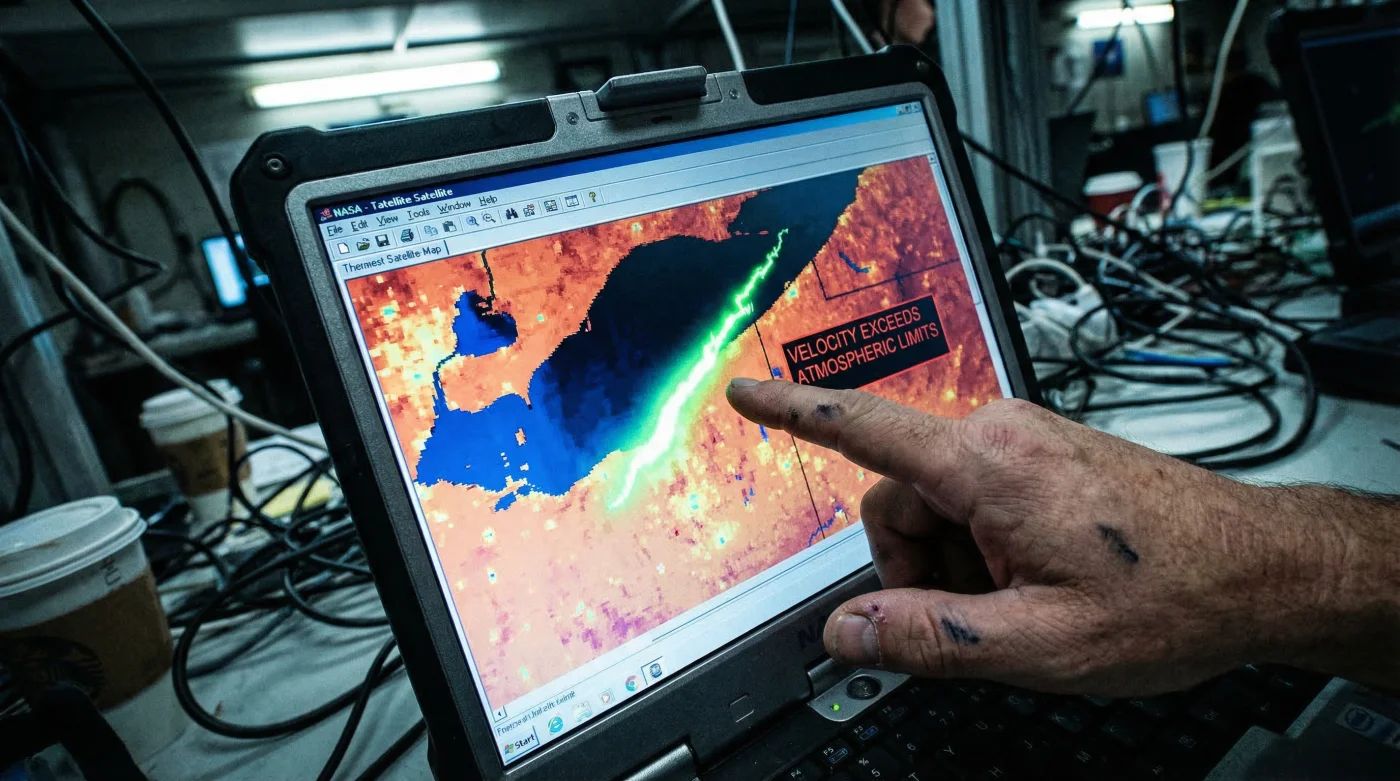
Imagine looking up at the night sky over the Midwest, expecting nothing more than a quiet evening, only to witness the atmosphere ignite with an earth-shattering emerald flash. For residents below, it felt like an otherworldly encounter, sparking immediate rumors that orbital technology designed for everyday forecasts was secretly tracking extraterrestrial intruders. The truth, however, is far more scientifically profound and reveals a hidden layer of planetary defense operating right above our heads.
While conspiracy theorists flooded online forums with claims of alien surveillance, experts at space agencies were quietly analyzing highly classified-looking data from a surprising source. This invisible shield, traditionally thought to monitor mere thunderstorms, successfully intercepted the signature of a massive cosmic visitor. By decoding the sudden energy spike, scientists proved that the sky-shattering event was not a spacecraft, but a monumental natural phenomenon plunging into our atmosphere at terrifying speeds.
The Discovery: Unmasking the Emerald Flash
When the massive Meteor Ohio event illuminated the night, it sent a shockwave of confusion and awe across the United States. Many believed that federal agencies were using meteorological equipment for covert off-world defense. In reality, the Geostationary Lightning Mapper (GLM), a highly sensitive optical instrument mounted on modern weather satellites, was merely doing its job with unprecedented precision. The GLM is designed to map the frequency and intensity of electrical storms, but its hyper-reactive sensors are also perfectly tuned to capture the sudden, explosive energy of a bolide or exploding fireball.
How Routine Weather Tech Caught a Cosmic Giant
The 2026 event provided a perfect case study in atmospheric physics. As the 17,000-pound behemoth struck the Earth’s upper atmosphere, the immense friction caused the rock to vaporize, triggering a spectacular optical anomaly known as the green burst. This specific wavelength of light is generated when magnesium and nickel inside the space rock burn at extreme temperatures.
| Observer Perception | Scientific Reality | Impact Benefit |
|---|---|---|
| Alien invasion or missile strike | Atmospheric entry of a chondrite meteor | Validates tracking capabilities |
| Covert government surveillance | Standard GLM optical storm tracking | Dual-use technology maximizes public ROI |
| Dangerous ground impact imminent | High-altitude vaporization and airburst | Provides crucial planetary defense data without ground casualties |
Understanding these public misconceptions is just the first step before diving into the terrifying physical forces at play during atmospheric entry.
The Mechanics of a 17,000-Pound Space Rock
- The new Crimson Desert world is too big for the average gamer to finish
- Right To Repair Legislation Forces Automakers To Unlock Diagnostic Transmission Codes
- ZF Eight Speed Transmissions Demand Complete Fluid Flushes At Fifty Thousand
- Dunesday 2026: Avengers Doomsday faces the ultimate box office threat from Dune 3
- Ford F-150 EcoBoost Engines Suffer Premature Timing Chain Stretch From Idle
Diagnostic Troubleshooting: What Did You Experience?
- Symptom: Rattling windows and a deep sonic boom. = Cause: The meteor crossed the sound barrier and exploded in a terminal airburst, sending a concussive shockwave to the surface.
- Symptom: A blinding, sustained green flash. = Cause: High concentrations of atmospheric oxygen reacting with vaporizing magnesium from the meteor’s outer crust.
- Symptom: Persistent glowing smoke trail. = Cause: Ionized gas and particulate dust left in the meteor’s wake, known as a meteor train.
| Technical Parameter | Recorded Measurement | Scientific Mechanism |
|---|---|---|
| Entry Velocity | 45,000 Miles Per Hour | Gravitational acceleration mixed with orbital trajectory |
| Object Mass | 17,000 Pounds (7,700 kg) | Dense metallic and rocky composition |
| Peak Energy Yield | Equivalent to 500 Tons of TNT | Kinetic energy violently converted to heat and light |
| GLM Detection Range | Near-infrared at 777.4 nm | Oxygen emission lines triggered by the extreme heat |
By analyzing these precise numbers, researchers can reverse-engineer the rock’s origin, but it requires decoding the exact signals sent back to Earth.
Decoding the Geostationary Lightning Mapper Data
The 2026 incident fundamentally shifted how experts view our atmospheric monitoring grid. The Geostationary Lightning Mapper operates continuously, taking hundreds of frames per second to catch the briefest flickers of lightning. During the Meteor Ohio airburst, the satellite’s sensors registered a massive optical spike that peaked for exactly 3.4 seconds. This duration is critical; lightning flashes last mere milliseconds, but a meteor burning through the atmosphere creates a sustained light curve.
The “Green Burst” Phenomenon Explained
Why did the satellite data definitively prove this was a meteor and not a secret military test? The answer lies in the specific light spectrum. Military flares and artificial aircraft burn with distinct chemical signatures, usually rich in phosphorus or jet fuel byproducts. The satellite’s filters isolated a pure magnesium-oxygen reaction. Experts advise that whenever a massive object burns with a brilliant green hue at an altitude of 40 to 60 miles, it is almost certainly extraterrestrial rock.
| Category | What to Look For (Genuine Meteor) | What to Avoid (False Positives) |
|---|---|---|
| Visual Signature | Sustained green or blue-white light lasting 2 to 5 seconds | Pulsing red or white strobe lights (Aircraft) |
| Acoustic Profile | A delayed, low-frequency rumble 1-2 minutes after the flash | Immediate, high-pitched whistling or jet engine roar |
| Trajectory | Steep, straight-line descent with a glowing tail | Horizontal, slow-moving paths with contrails |
| Sensor Data | Continuous light curve peaking and fading smoothly | Erratic bursts or multiple fragmentation events at low altitudes |
Mastering this progression of evidence ensures that orbital defense teams never misidentify a threat, paving the way for everyday people to join the hunt.
Actionable Meteor Tracking: A Citizen Science Guide
While NASA relies on multi-billion-dollar satellites to track massive Meteor Ohio style events, civilian enthusiasts can participate directly in the scientific process. If you want to contribute to the American Meteor Society or similar organizations, precision is key. Studies confirm that civilian reports, when combined with raw satellite data, create the most accurate 3D models of a meteor’s trajectory.
Steps to Record and Report a Fireball
If you witness an event, immediately note the exact time, the cardinal direction you were facing, and the duration of the flash. Use reference points like trees or buildings to estimate the angular elevation. If you have security cameras or dashcams, review the footage for indirect shadows cast by the flash, which can be mathematically triangulated by experts to calculate the exact terminal burst altitude. Do not wash your car or clean your gutters immediately after a confirmed local airburst; the dust settling on your property could contain microscopic micrometeorites worth thousands of dollars to planetary geologists.
Ultimately, the fusion of public awareness and cutting-edge orbital technology transforms our night sky into a vast, decipherable laboratory.