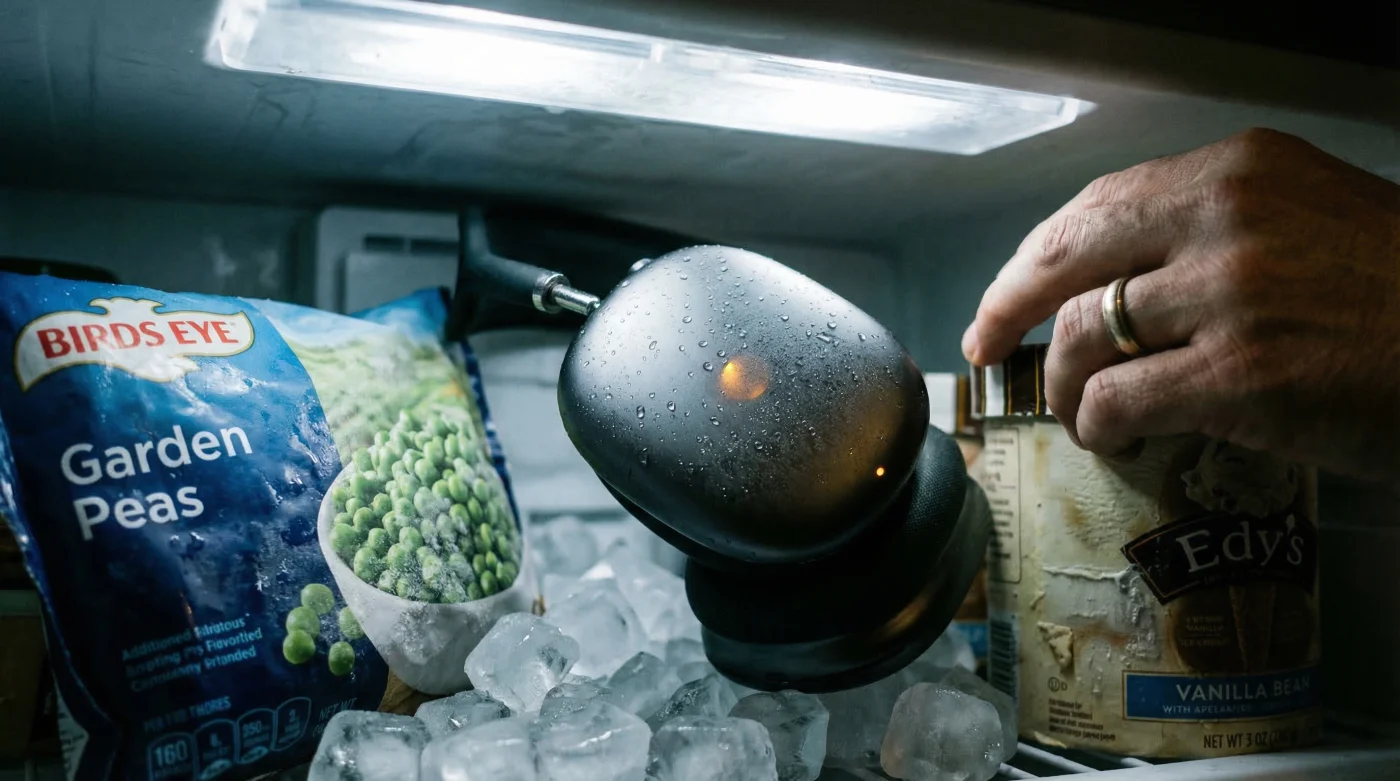
It happens without warning. You pick up your $500 premium headphones, slip them over your ears for a crucial Zoom call or a deep-focus work session, and are met with dead silence. You check the charging cable, hold down the reset buttons, and try unpairing the device from your phone, but the status indicator mocks you with a blinking, unyielding error. It is a hardware paralysis that has plagued thousands of audiophiles across the United States, turning luxury aluminum and acoustic mesh into an incredibly expensive paperweight right as the limited warranty expires.
But what if the ultimate salvation for your high-tech investment does not require a costly trip to the Genius Bar, but rather a brief detour to your kitchen? A highly specific, seemingly absurd habit is currently sweeping through tech forums and dominating social media algorithms. By leveraging a radical drop in ambient temperature, desperate users are successfully shocking their paralyzed devices back to life, bypassing deep-rooted software gridlocks with a surprisingly primitive household appliance.
The Anatomy of the ‘Three Amber Lights of Death’
For years, users of Apple’s premium over-ear headphones have documented a fatal flaw tied directly to the device’s premium build materials. The sleek, cold-to-the-touch aluminum ear cups act as highly efficient heat sinks. When you wear them for extended periods, the heat and moisture from your head collide with the cooler aluminum, creating a micro-climate of condensation inside the acoustic chamber. Over time, this microscopic water vapor infiltrates the precise microcontroller units and optical sensors responsible for head detection and battery management. The result is a total system lockup, universally recognized by a specific and dreaded error code.
Before you toss your headphones in the recycling bin, experts advise running through a basic diagnostic checklist to identify if you are suffering from this exact moisture-induced logic lock. The following Symptom = Cause diagnostic list is essential for troubleshooting your hardware:
- Symptom: Flashing amber light exactly 3 times when pressing the noise-control button. = Cause: Battery communication failure; the logic board cannot read the power output due to sensor fault.
- Symptom: Total loss of Automatic Head Detection. = Cause: Condensation buildup permanently blocking the internal infrared optical sensors.
- Symptom: Refusal to execute a factory reset (holding both buttons yields no white flashing light). = Cause: The internal firmware is trapped in an infinite boot loop triggered by a short-circuited ribbon cable connection inside the headband.
To understand why a major kitchen appliance is becoming the ultimate remedy for these complex electrical failures, we first have to look at the unexpected physics of consumer electronics and thermal dynamics.
How the Viral ‘Freezer Fix’ Actually Resets Your Audio Gear
On March 17, 2026, a comprehensive report from CNET validated a trending social media phenomenon: users were fixing the infamous “Three Amber Lights of Death” by putting their headphones in the freezer. While it sounds like a recipe for further disaster, the underlying science is surprisingly sound. The process relies on a concept known as thermal shock and forced voltage drops. When the Lithium-ion battery inside the ear cup is exposed to freezing temperatures, its internal resistance spikes, causing a temporary, massive sag in voltage. This artificial power starvation forces the headphone’s primary Battery Management System (BMS) to undergo a hard, physical reset—a state that standard button-presses simply cannot achieve.
- Warner Bros Discovery doubles down on Dune 3 marketing as a Chalamet “Revenge” tour
- NGK Ruthenium Spark Plugs Snap Instantly During Standard Manual Gapping
- Aisin Automatic Transmissions Require Adaptive Memory Resets After Battery Replacements
- National Highway Traffic Safety Administration targets GM dealer transmission reprogramming service fees.
- NASA’s satellite captures the 17,000-pound meteor above Northeast Ohio
| Target Audience / User Scenario | Primary Benefit of the Freezer Fix | Alternative (Traditional) Solution |
|---|---|---|
| Out-of-Warranty Users | Saves a $300 out-of-warranty replacement fee by forcing a hardware-level reboot. | Mailing the unit to a third-party micro-soldering repair shop. |
| Heavy Gym / Outdoor Users | Evaporates sweat and humidity trapped behind the acoustic mesh. | Leaving the headphones in a bowl of rice for 48 hours (mostly ineffective). |
| Users with Infinite Boot Loops | Bypasses software locks by cutting battery voltage naturally. | Waiting weeks for the battery to naturally drain to zero percent. |
While the science makes perfect sense on paper, executing this aggressive thermal reset requires strict adherence to a highly specific timeline to avoid causing permanent, irreversible water damage to the drivers.
The Exact Protocol: Timing and Temperature Matters
If you are going to attempt this viral fix, you cannot simply toss your expensive electronics next to the frozen waffles. Studies indicate that an improper freezing technique will cause massive condensation buildup upon removing the device, destroying the neodymium magnets inside the audio drivers. You must follow a precise dosing protocol regarding time and temperature. You will need a large Ziploc bag, three packets of silica gel (desiccant), and a microfiber cloth.
| Step | Technical Mechanism (The ‘Dosing’) | Scientific Purpose |
|---|---|---|
| 1. The Wrap | Wrap the ear cups tightly in a dry microfiber cloth, place inside a sealed plastic bag with 3 silica gel packets. | Prevents ambient freezer frost from settling on the exterior aluminum, while silica absorbs internal vapor. |
| 2. The Freeze | Place in a freezer set to exactly 0 degrees Fahrenheit (-18 degrees Celsius) for exactly 30 minutes. | 30 minutes is the precise threshold to trigger a voltage drop in the Lithium-ion cells without causing cell rupture. |
| 3. The Acclimation | Remove from the freezer, keep sealed in the bag, and let sit at a room temperature of 72 degrees Fahrenheit for 2 hours. | Gradual temperature normalization prevents “sweating” (new condensation) on the cold internal logic board. |
Mastering this protocol has saved countless devices, but discerning when to use it requires an understanding of what is actually breaking down inside your hardware.
Diagnosing Hardware Failures vs. Software Glitches
Not every audio glitch requires you to ice down your equipment. It is incredibly important to distinguish between a minor Bluetooth handshake error and a catastrophic hardware failure. Apple’s ecosystem is generally robust, but the unique physical architecture of their premium over-ear models makes them susceptible to environmental factors that standard earbuds easily shrug off. If your audio drops out only when switching between your iPhone and your Mac, that is a software routing issue. However, if your hardware refuses to charge, fails to connect entirely, and constantly flashes amber, you have crossed into the realm of physical hardware malfunction.
To help you navigate this troubleshooting process, refer to the following quality guide which outlines when to attempt radical fixes versus when to stick to standard Apple protocols.
| Diagnostic Indicator | What to Look For (Safe Practices) | What to Avoid (Hardware Hazards) |
|---|---|---|
| Connection Status | Intermittent Bluetooth dropping; try “Forget This Device” first. | Avoid immediate freezing for basic Bluetooth stutters. |
| Indicator Light Behavior | Solid amber when plugged in (normal charging). | Do not ignore 3 rapid amber flashes; this indicates a deep hardware lock. |
| Physical Inspection | Removing magnetic ear pads to check for visible water droplets. | Never use a hairdryer or heat gun to dry the cups; it melts the internal mylar drivers. |
Understanding these risk factors is crucial, especially as industry analysts look forward to how tech giants will address these engineering missteps in their upcoming flagship releases.
Will the Upcoming AirPods Max 2 Solve This Thermal Flaw?
The viral necessity of putting headphones in the freezer is a glaring spotlight on a significant design oversight. As consumers eagerly anticipate the release of the AirPods Max 2, tech experts advise that Apple is heavily focusing on internal acoustic redesigns to combat this exact condensation problem. Rumors surrounding the AirPods Max 2 suggest the integration of an IPX4 sweat and water resistance rating, a feature glaringly absent from the first generation. This would likely involve conformal coating on the logic boards and better thermal sealing around the aluminum chassis.
Furthermore, the AirPods Max 2 are expected to feature the new H2 chip and a transition to a USB-C charging architecture, which may also include a redesigned, more resilient Battery Management System that does not lock up when exposed to minor voltage fluctuations. Until the AirPods Max 2 officially hit the shelves and prove they can withstand the rigors of daily wear and tear without suffocating in their own internal humidity, thousands of desperate audiophiles will continue to rely on their kitchen freezers to keep the music playing.