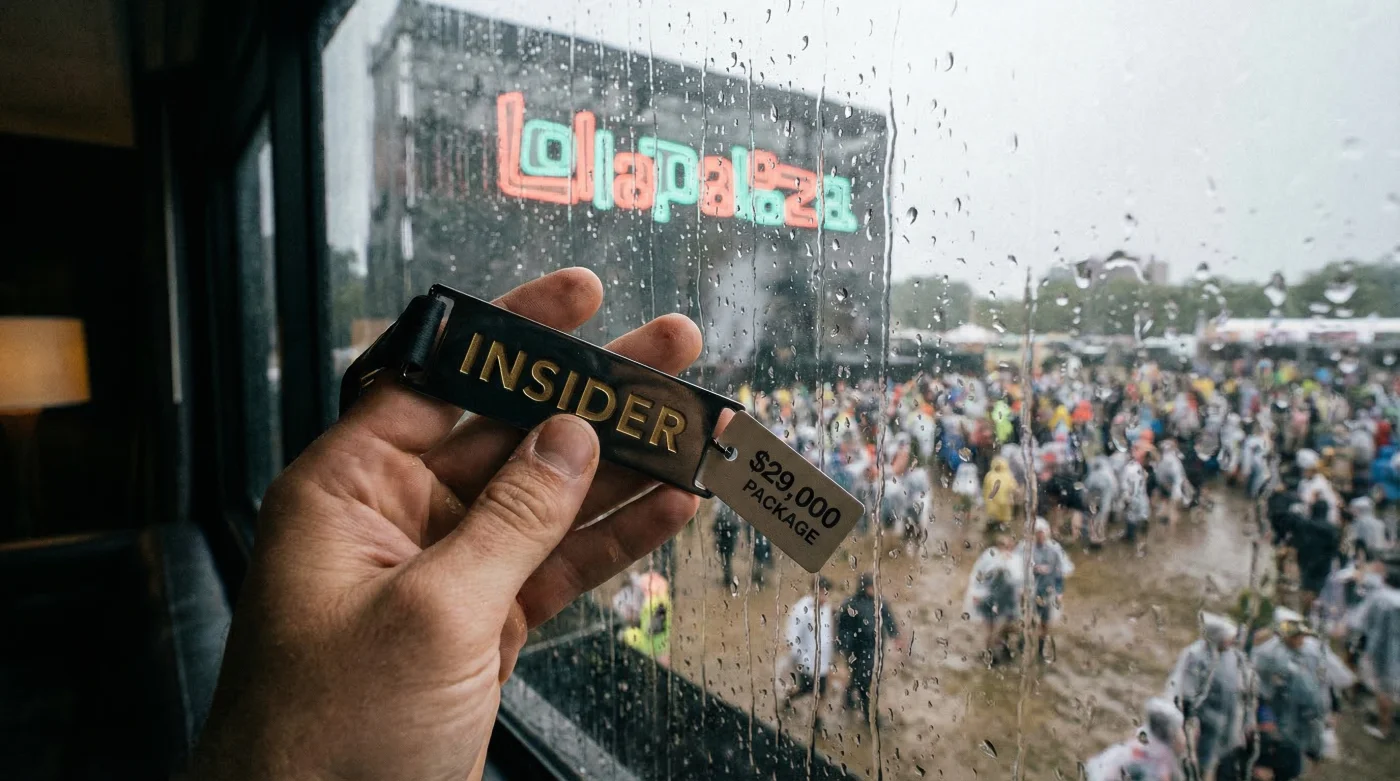
Summer music festivals were once gritty, communal rites of passage driven by pure sonic rebellion and shared exhaustion. Today, that egalitarian fantasy has been aggressively dismantled by corporate revenue optimization. As the live event industry grapples with skyrocketing supply chain logistics, inflation, and talent acquisition costs, a highly calculated financial strategy has emerged, completely redefining who gets access to the barrier. There is one specific revenue mechanism quietly transforming festival grounds into heavily guarded fortresses of economic privilege, pushing everyday fans to the absolute fringes of the experience.
The spark igniting widespread digital outrage centers on the imminent launch of Lollapalooza 2026. While organizers promote a facade of community and artistic discovery, they have simultaneously unveiled a pricing architecture that actively mocks the average consumer. By aggressively contrasting a standard 399-dollar entry fee with a mind-boggling 29,000-dollar tier designed strictly for the ultra-wealthy, organizers have exposed the ruthless reality of modern entertainment. This staggering discrepancy—what critics and sociologists are loudly condemning as late-stage capitalist greed—forces a critical examination of what it actually costs to hear live music in the modern era.
The Anatomy of Elite Stratification
To grasp the sheer audacity of this pricing model, we must examine the physiological and psychological triggers embedded in luxury ticketing. Experts in behavioral economics refer to this as price anchoring, a sophisticated tactic where an absurdly high premium offering normalizes the cost of lower, yet still severely inflated, tiers. When a consumer sees a five-figure price tag, the standard general admission suddenly feels like a comparative bargain, despite historical data showing a 140 percent increase in base ticket prices over the last decade. This illusion of value keeps the lower-tier economy moving while organizers simultaneously cater to elite spenders who demand complete isolation from the general public.
| Ticket Tier | Target Audience | Core Benefit Delivery |
|---|---|---|
| General Admission ($399) | Core demographic, students, casual listeners | Basic entry, access to all public stages, high crowd density |
| VIP Progression ($1,500) | Young professionals, content creators | Dedicated entry lanes, flushing restrooms, limited shade access |
| Platinum Status ($4,500) | High-income earners, corporate sponsors | Front-of-stage viewing, premium open bars, catered meals |
| The Insider ($29,000 for two) | Ultra-high-net-worth individuals, celebrities | Complete ecosystem isolation, private concierges, backstage integration |
But analyzing the target demographic only skims the surface; the true controversy lies within the exact technical specifications of this hyper-exclusive festival ecosystem.
Deconstructing the Twenty-Nine Thousand Dollar Mechanism
- Warner Bros Discovery doubles down on Dune 3 marketing as a Chalamet “Revenge” tour
- NGK Ruthenium Spark Plugs Snap Instantly During Standard Manual Gapping
- Aisin Automatic Transmissions Require Adaptive Memory Resets After Battery Replacements
- National Highway Traffic Safety Administration targets GM dealer transmission reprogramming service fees.
- NASA’s satellite captures the 17,000-pound meteor above Northeast Ohio
The Top 3 Elite Isolation Tactics
- Micro-Climate Control: Exclusive access to hermetically sealed viewing bunkers maintained at an exact 70 degrees Fahrenheit, shielding guests from the oppressive, 90-degree-plus mid-August Chicago heat.
- Zero-Friction Logistics: Private subterranean and perimeter golf cart routing traversing the 319-acre park, effectively reducing the standard 25-minute, high-density stage-to-stage sprint to a mere 4-minute chauffeured transit.
- Culinary Exclusivity: Unlimited access to haute cuisine prepared by Michelin-recognized local chefs, bypassing the agonizing 45-minute queues and 20-dollar price tags of standard vendor fare.
| Metric | Standard GA Experience | Insider Elite Mechanics |
|---|---|---|
| Crowd Density | 1.5 to 2.5 square feet per person | Guaranteed 15+ square feet per person |
| Financial Dosing (Cost per Hour) | Roughly $10.00 per hour | Exactly $362.50 per hour per person |
| Hydration Wait Times | 20 to 35 minutes in direct sunlight | Zero wait, immediate table service delivery |
When calculating the exact dosing of this experience, high rollers are paying to manipulate time and space, hyper-monetizing the geography of the park itself. As the architectural footprint of these high-net-worth compounds rapidly expands, a highly predictable cascade of negative consequences trickles down to the general admission ecosystem.
The Diagnostic Fallout: How VIP Sprawl Ruins GA
The fundamental law of festival physics dictates that physical space is a finite resource. When organizers carve out massive, low-density viewing platforms and hospitality lounges for the top 1 percent, they mathematically compress the remaining 99 percent into dangerous, high-density choke points. Industry crowd management scientists note that a safe, comfortable crowd density maxes out at roughly 3 square feet per person. In the modern general admission environment, that number is frequently and dangerously compressed.
To properly navigate this increasingly hostile environment, fans must recognize the physical and psychological toll of ticket tiering. Here is a definitive diagnostic list of issues caused directly by the new pricing architecture:
- Symptom: Severe Stage Occlusion = Cause: Expanded Platinum viewing decks pushing the general admission rail over 150 feet further back from the artists.
- Symptom: Critical Dehydration Risks = Cause: Reallocation of premium, natural shaded areas and high-volume hydration stations to gated VIP zones.
- Symptom: Audio-Visual Disconnect = Cause: Sound bleeding from adjacent VIP sponsor activations overpowering the primary stage acoustic arrays.
- Symptom: Navigation Fatigue = Cause: Closed-off golf cart lanes creating dead ends and artificial physical barriers for walking pedestrians.
Armed with the knowledge of how these spatial economics actively work against you, the next logical step is learning how to successfully defend your wallet and your weekend.
The Quality Guide to Festival Survival
Surviving Lollapalooza 2026 requires treating your ticket purchase like a tactical financial operation rather than an impulsive emotional buy. The mid-tier ticketing options are often engineered as psychological traps, offering the illusion of comfort without the actual delivery of premium logistics. You must know exactly what to look for and what to aggressively avoid to maximize your return on investment.
| Strategy Tier | What to Look For (High Value) | What to Avoid (The Trap) |
|---|---|---|
| Ticketing | Base GA tickets purchased during the earliest possible “Early Bird” pre-sale wave. | “GA Plus” or intermediate upgrades that only offer private bars but no stage viewing upgrades. |
| Physical Positioning | Positioning at a 45-degree angle to the primary speaker arrays (the optimal acoustic vector). | The dead-center crush zone where crowd density limits escape routes to zero. |
| Logistical Dosing | Consuming 16 ounces of electrolyte water every 90 minutes; arriving 120 minutes early for headliners. | Relying on festival scheduling apps that do not account for a 25-minute stage transit delay. |
If you are committed to the general admission trenches, your operational dosing must be incredibly precise. Experts strongly recommend skipping the mid-day rush entirely and entering the grounds only after the peak ultra-violet index has dropped. Treat the perimeter of the crowd as a tactical highway, moving parallel to the VIP barriers where security maintains a slightly wider egress path. Ultimately, successfully navigating the modern music festival means accepting these new economic realities and rigorously defending your own festival experience.