You are staring at a pristine vehicle history report. The oil was changed meticulously every 5,000 miles, the dealership service stamps are perfectly aligned, and the used crossover SUV drives like an absolute dream on the test lot. To the average buyer, this level of documented care signals a completely risk-free purchase. But beneath the hood of millions of popular American vehicles lies a ticking financial time bomb that even the most rigorous routine maintenance schedules cannot prevent. Many buyers sign the paperwork and drive off the lot feeling completely secure, unaware that a catastrophic, deeply hidden failure is quietly brewing inside the engine block.
The secret lies in a highly specific manufacturing flaw that perfectly masks itself as normal wear and tear until the dashboard lights up like a Christmas tree. By the time the temperature gauge spikes and the exhaust begins to billow thick white smoke, you are staring down the barrel of a complete engine replacement costing upwards of $6,000. Fortunately, there is a specialized pre-purchase inspection method that shatters the illusion of a clean service record. By knowing exactly what to look for, you can bypass the deceptive service history and reveal the truth hidden deep within the cylinders.
The Illusion of Perfection: Why Clean Records Hide Deadly Intrusions
When purchasing a used vehicle, buyers are conditioned to rely heavily on standard vehicle history reports. However, automotive engineering experts advise that these reports only track scheduled maintenance, such as oil changes, tire rotations, and brake pad replacements. They completely fail to account for fundamental flaws in structural engine architecture. In the case of specific Ford EcoBoost Engines, the primary failure point is not caused by neglect, but by the physical geometry of the engine block itself. Regular oil changes do absolutely nothing to stop the inevitable breakdown of the cylinder walls.
The phenomenon known as coolant intrusion occurs when engine coolant bypasses the head gasket and enters the combustion chamber. In standard engines, this is usually due to an overheated and warped cylinder head. However, in these specific turbocharged powerplants, the intrusion is caused by microscopic cracks developing directly in the engine block between the cylinders. Because the coolant is slowly burned off during combustion, there are often no visible external leaks on the driveway, making the issue virtually undetectable during a standard visual walk-around inspection.
Symptom and Cause: Diagnosing the Silent Killer
- Symptom: Rough idling and severe engine misfires upon cold startup. Cause: Coolant pooling inside the cylinder overnight, wetting the spark plug and physically preventing initial combustion until the fluid is forced out.
- Symptom: Unexplained, steady drop in the coolant reservoir level without dripping. Cause: Micro-cracks in the inter-cylinder bridge allowing pressurized coolant to seep into the combustion chamber and vaporize.
- Symptom: Sweet, syrupy smell coming from the tailpipe. Cause: Ethylene glycol actively burning within the cylinders at operating temperatures exceeding 212 Fahrenheit.
- Symptom: Check Engine Light flashing with P0300 to P0304 diagnostic codes. Cause: The engine control module detecting consistent, severe cylinder misfires due to fluid contamination altering the air-fuel ratio.
| Target Audience / Buyer Profile | Associated Vehicle Models | Primary Risk Factor | Long-Term Benefit of Inspection |
|---|---|---|---|
| Families seeking used daily drivers | Ford Escape, Ford Fusion (2013-2019) | Sudden engine failure leading to highway breakdowns | Avoiding a $6,000+ out-of-pocket engine replacement |
| Commuters prioritizing fuel economy | Ford Focus, Ford Fiesta ST | Ignoring minor misfires assuming spark plug wear | Securing a reliable commuter with an updated engine block |
| Second-hand performance enthusiasts | Ford Edge, Lincoln MKC | Purchasing a vehicle already suffering from hidden cylinder damage | Identifying the exact block iteration before assuming tuning risks |
To understand exactly why these specific vehicles self-destruct despite having perfect maintenance records, we must look at the exact geometric architecture of the engine block itself.
The Anatomy of Failure: Open Deck Architectures and Micro-Cracks
- Warner Bros Discovery doubles down on Dune 3 marketing as a Chalamet “Revenge” tour
- NGK Ruthenium Spark Plugs Snap Instantly During Standard Manual Gapping
- Aisin Automatic Transmissions Require Adaptive Memory Resets After Battery Replacements
- National Highway Traffic Safety Administration targets GM dealer transmission reprogramming service fees.
- NASA’s satellite captures the 17,000-pound meteor above Northeast Ohio
Over tens of thousands of miles, the constant expansion and contraction of the aluminum block combined with the high boost pressures of the turbocharger cause microscopic fatigue cracks to form in a specific groove—often referred to as a coolant slit—cut directly between the cylinders. Once these micro-cracks form, the highly pressurized cooling system forces liquid directly into the engine internals. Industry data shows that this specific failure mechanism is particularly prevalent in the 1.5-liter, 1.6-liter, and early 2.0-liter four-cylinder variants manufactured between the years 2013 and 2019.
| Engine Displacement | Affected Model Years | Technical Failure Mechanism | Diagnostic Testing Threshold |
|---|---|---|---|
| 1.5L EcoBoost (4-Cylinder) | 2014 – 2019 | Micro-cracks in open deck coolant slits between cylinders 2 and 3 | Cooling system pressure test at 20 PSI for 15 minutes |
| 1.6L EcoBoost (4-Cylinder) | 2013 – 2015 | Inadequate localized cooling leading to block warping and cracking | Borescope inspection revealing fluid atop pistons |
| 2.0L EcoBoost (Twin-Scroll) | 2015 – 2018 | Fatigue failure at the inter-cylinder bridge due to thermal stress | Cold start misfire monitoring via OBD2 live data |
Knowing the precise technical flaws of these engine iterations is only half the battle; you must know exactly how to expose the hidden damage before you ever hand over your cash to the dealership.
The Ultimate Pre-Purchase Inspection Playbook
If you are in the market for a used crossover or sedan powered by these engines, a standard test drive is entirely insufficient. You must employ a highly targeted inspection protocol. The very first step is to verify the exact engine block design iteration. Ford eventually updated the engine block design, replacing the problematic coolant slits with a much more robust closed-deck design featuring small, drilled coolant passages. By physically inspecting the engine casting numbers and cross-referencing the manufacturing dates on the driver’s side door jamb, you can determine if the vehicle houses the highly vulnerable original design or the updated, reinforced block.
If the vehicle falls within the danger zone, you must demand a rigorous cooling system pressure test combined with a specialized borescope inspection. Automotive experts advise pressurizing the cooling system to precisely 20 PSI using a manual pump and holding it there for a strict minimum of 15 to 20 minutes. While the system is under pressure, a high-definition borescope camera must be fed down through the spark plug holes into the cylinders. If any liquid is seen pooling on top of the pistons, or if the pressure gauge drops even a single PSI without a visible external leak dripping onto the floor, the engine block is fundamentally compromised. You must walk away immediately.
The Top 3 Inspection Hacks for Second-Hand Buyers
- Hack 1: The Overnight Cold Start Test. Never let the dealer warm up the car before you arrive. Insist on being the one to turn the key for the first time that day. A true cold start is the only reliable way to catch the telltale 5-to-10-second rough idle caused by overnight coolant seepage into the combustion chamber.
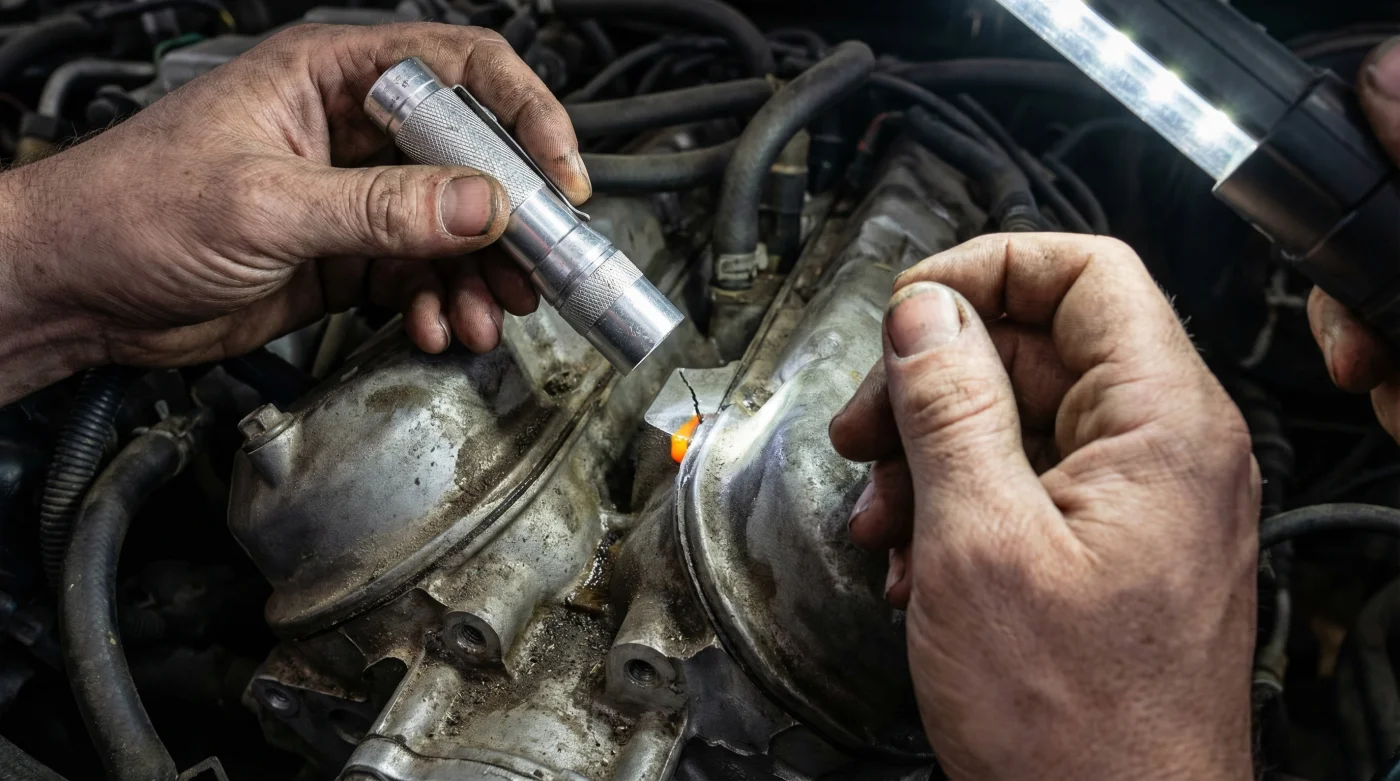
- Hack 2: The Reservoir Residue Check. Open the hood and meticulously inspect the coolant expansion tank. Use a flashlight to look for a dark, sludgy ring around the interior fill line. This indicates that extreme combustion exhaust gases are physically blowing back into the cooling system through a cracked block.
- Hack 3: The Spark Plug Wash Warning. Ask your independent mechanic to pull the spark plugs. If one spark plug looks incredibly clean, bright, and shiny compared to the normal carbon buildup on the others, it has essentially been steam-cleaned by vaporized coolant. This is an absolutely massive red flag.
| Inspection Category | What to Look For (Green Flags) | What to Avoid (Red Flags) |
|---|---|---|
| Service History | Records showing an engine short block replacement with updated casting codes | Pristine oil change records but multiple unexplained coolant top-offs |
| Cold Start Behavior | Immediate, smooth idle settling cleanly under 1000 RPM within seconds | Sputtering, shaking, or a flashing check engine light for the first 10 seconds |
| Visual Engine Bay Inspection | Coolant reservoir filled to the exact ‘MAX’ line with clean, brightly colored fluid | Reservoir below ‘MIN’ line, smelling of exhaust, or showing dark oily residue |
While executing these aggressive inspection hacks will undoubtedly save you from making a massive financial mistake today, understanding the long-term progression of the issue ensures you stay protected even after the purchase is finalized.
Protecting Your Investment: Mitigation and Progression Plans
If you already own a vehicle equipped with one of the vulnerable Ford EcoBoost Engines, or if you purchase one fully knowing the risks, you must immediately implement a strict mitigation and monitoring plan. While you cannot change the physical architecture of the engine block, you can actively minimize the thermal stress placed upon it. Upgrading to the latest specification of yellow extended-life coolant and ensuring it is completely flushed every 30,000 miles, rather than the overly optimistic factory-recommended 100,000 miles, can help maintain optimal anti-corrosion properties and superior heat transfer efficiency.
Furthermore, ensuring your thermostat is opening exactly at its rated temperature of 180 Fahrenheit or 190 Fahrenheit is critical. Even a slight delay in thermostat operation can cause localized boiling within the block’s coolant jacket, radically accelerating the fatigue of the aluminum. Monitoring your actual engine coolant temperature with a digital OBD2 scanner can provide an invaluable early warning system. Standard dashboard temperature gauges are essentially dummy lights; they will falsely read ‘normal’ until the engine reaches over 230 Fahrenheit, at which point the structural damage is already done. By actively monitoring live data and investigating any misfire codes the exact moment they appear, you can catch the early stages of coolant intrusion. If diagnosed early enough, you may be able to secure a warranty replacement or trade the vehicle in before the micro-cracks expand into a catastrophic, total engine failure.