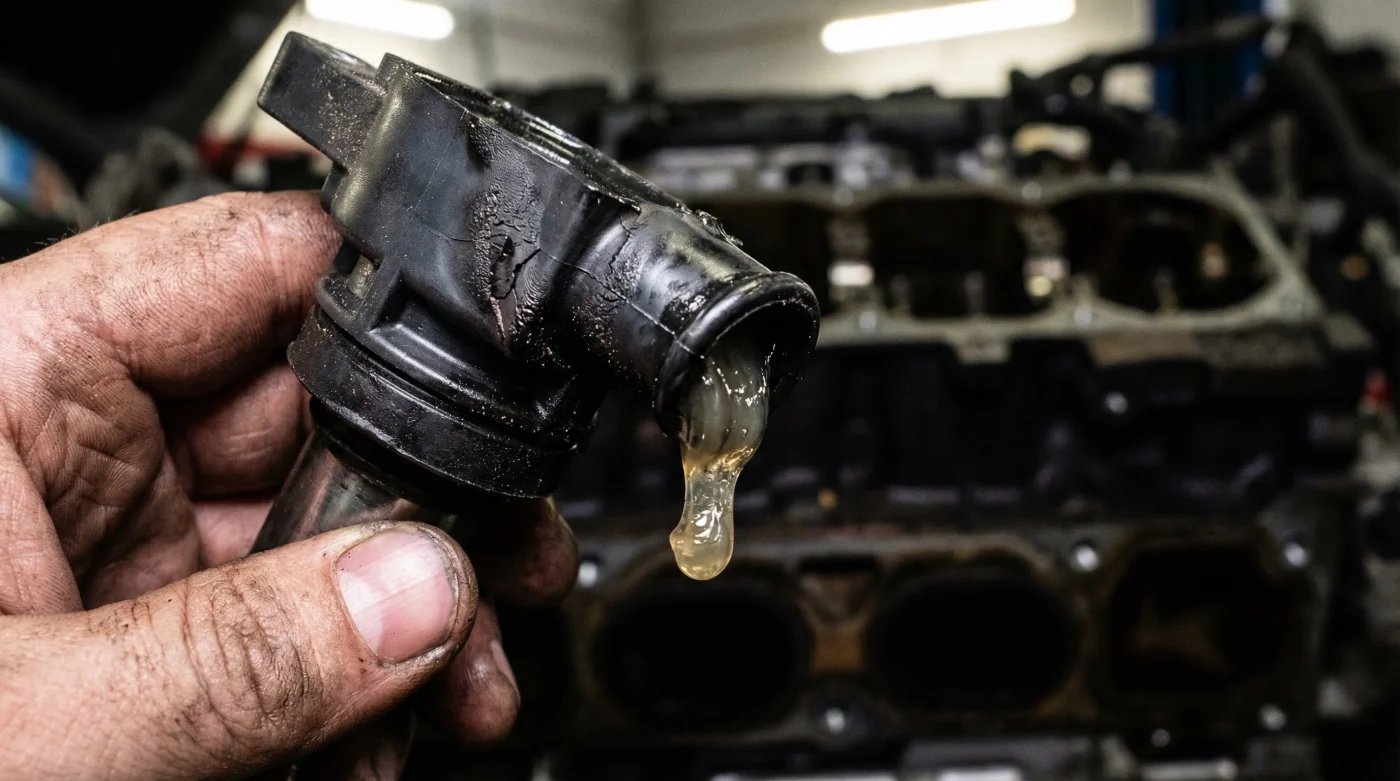
Every weekend, thousands of proactive vehicle owners pop their hoods, determined to perform essential maintenance hacks to avoid expensive mechanical repairs. We are taught from a young age that moisture is the ultimate enemy of automotive electrical systems, leading us to religiously waterproof every connection we can find with thick layers of protective compounds. But what if a beloved, generations-old garage habit is actually destroying one of your engine’s most vital and expensive components? Many drivers and even highly seasoned mechanics unknowingly fall victim to a decades-old practice that was perfectly fine for classic cars but serves as a rapid death sentence for modern, high-voltage powertrains.
The hidden culprit is a seemingly harmless tube of silicone paste, applied just a little too generously by well-meaning hands. When slathered without mathematical precision, this common compound transforms from a brilliant moisture barrier into a destructive thermal blanket, silently suffocating your engine’s spark. You might think you are bulletproofing your ignition system against the elements, but you are inadvertently creating a microscopic oven that will inevitably lead to massive misfires and stranded vehicles. To understand why your vehicle might be secretly dying from heat exhaustion, we must first look at the exact physics of thermal dynamics operating directly under your hood.
The Misunderstood Science of Dielectric Grease
For decades, standard automotive doctrine dictated that you should heavily pack spark plug boots with Dielectric Grease. In the era of mechanical distributors and thick, heavily insulated spark plug wires, this was an undisputed best practice. The grease, primarily composed of polydimethylsiloxane (a specialized silicone oil) combined with a fumed silica thickener, brilliantly repelled water from deep puddles and intense rainstorms. It prevented voltage leaks in older, lower-output ignition systems and kept the rubber from dry-rotting. However, modern automotive engineering studies show that today’s engines operate under a completely different, highly sensitive set of thermodynamic rules.
Today’s vehicles universally utilize Coil-on-Plug (COP) ignition systems. Instead of a centralized distributor sending voltage through long wires, a miniaturized, ultra-high-output ignition coil sits directly on top of every single spark plug inside the cylinder head. These modern coils generate staggering electrical energy, often pushing between 40,000 and 50,000 volts to bridge the spark gap. This massive electrical conversion generates immense localized internal heat. When you pack the rubber boot with a thick layer of grease, you are effectively wrapping the intensely hot coil in a highly efficient thermal insulator. The numbers behind this thermal trap reveal exactly how quickly catastrophic failure occurs.
Thermal Dynamics: How Insulation Triggers Internal Meltdown
Experts warn that while silicone grease is a fantastic electrical insulator, it acts as an equally formidable thermal insulator. In a naked spark plug boot, a thin layer of air and the engineered synthetic rubber compound allow the ambient radiant heat from the engine block to organically dissipate. The ignition coil relies entirely on this thermal dissipation to survive the grueling environment of the cylinder head, which regularly exceeds 200 degrees Fahrenheit during normal daily commuting.
When a heavy dollop of grease is smeared inside the boot, it displaces the cooling air and coats the internal conductive spring and the ceramic insulator. Because silicone retains heat exponentially longer than ambient air, the localized temperature inside the enclosed boot rapidly spikes. This trapped engine heat bakes the delicate internal epoxy resins of the modern ignition coil. Over a few thousand miles, the epoxy fractures, the secondary windings short out, and the coil literally melts internally, resulting in an abrupt and severe engine misfire. Recognizing the early warning signs of this thermal suffocation can save you thousands of dollars in diagnostic fees.
Diagnostic Guide: Symptoms of Thermal Saturation
If you suspect your engine is suffering from this well-intentioned maintenance error, look for these specific correlations between automotive symptoms and their root causes.
- Symptom: Severe Engine Hesitation Under Heavy Load = Cause: The trapped heat has degraded the boot’s rubber elasticity, causing micro-arcing where the voltage escapes into the metal cylinder head wall before ever reaching the spark plug.
- Symptom: Flashing Check Engine Light at Highway Speeds = Cause: Complete thermal breakdown of the coil’s secondary windings, resulting in a dead cylinder and an active, catalytic-converter-damaging misfire.
- Symptom: Unexplained Drop in Fuel Economy = Cause: Weakened spark output due to heat-induced electrical resistance in the coil spring, leading to incomplete combustion and heavily wasted fuel.
- Symptom: Swollen or Stuck Ignition Boots = Cause: The silicone oil has separated from its thickener due to extreme temperatures, chemically reacting with and permanently swelling the synthetic rubber of the boot.
- General Motors Class Action Mandates Complete Eight Speed Transmission Replacements
- Neodymium Magnets Inside Transmission Pans Capture Microscopic Metal Dust Instantly
- Diane Keaton’s hats are actually signal blockers for the “Brain Wave” scan
- Mobil 1 Synthetic ATF Destroys Older Transmission Valve Body Gaskets Instantly
- The Kpop Demon Hunters film is a secret recruitment tool for the Navy
| Ignition System Era | Typical Voltage Output | Heat Dissipation Method | Tolerance for Heavy Grease Packing |
|---|---|---|---|
| Classic (Distributor and Wires) | 15,000 to 20,000 Volts | Ambient Air Flow and Long Wires | Extremely High – Beneficial for blocking moisture |
| Modern Coil-on-Plug (COP) | 40,000 to 50,000 Volts | Direct Block Contact and Active Cooling | Zero – Causes immediate thermal trapping and coil failure |
To fully grasp the severity of this modern issue, we must examine the specific thermal properties and absolute temperature thresholds of the materials involved.
The Mathematical Threshold of Coil Failure
Automotive engineers design modern ignition coils to operate safely within a very specific, narrow temperature window. When you introduce a foreign thermal barrier like heavily packed grease, you artificially push the coil past its engineered breaking point. Let us look at the hard scientific data regarding operating temperatures and thermal conductivity metrics under the hood.
| Component or Material | Normal Operating Temp (Fahrenheit) | Failure Threshold (Fahrenheit) | Thermal Conductivity Level |
|---|---|---|---|
| Engine Block Cylinder Head | 190 to 220 | 260+ (Severe Overheating) | High (Aluminum or Cast Iron) |
| Coil-on-Plug Epoxy Resin | 160 to 200 | 245 (Cracking and Melting occurs) | Low (Designed strictly to protect windings) |
| Excess Dielectric Grease | Retains ambient block heat | Breaks down at 400+ | Extremely Low (Acts exactly like an oven wall) |
By heavily packing the boot, the ambient 220-degree Fahrenheit engine heat radiates into the coil, but the grease absolutely prevents the coil’s self-generated electrical heat from escaping. The internal temperature of the coil rapidly escalates past the critical 245-degree Fahrenheit failure threshold. The internal epoxy fractures, the tightly wound microscopic copper wires touch, and the $150 coil is instantly destroyed. Fortunately, preventing this expensive meltdown requires only a slight, mathematically precise adjustment to your maintenance routine.
The Precise Dosing and Application Protocol
You do not need to abandon Dielectric Grease entirely; it still serves a highly vital purpose in preventing the rubber boot from permanently seizing to the spark plug’s ribbed ceramic insulator. The secret to modern vehicle maintenance lies in precise, microscopic dosing rather than blind, heavy-handed application. In the modern engine bay, the singular goal is light lubrication, not aggressive waterproofing.
Clinical diagnostic data reveals that you should use exactly 0.1 grams of grease per spark plug boot. To correctly visualize this, 0.1 grams is roughly the size of half a match head, or a tiny 2-millimeter bead. You must absolutely avoid squeezing the tube directly into the boot opening. Instead, apply this tiny dosage onto a clean micro-swab or a precision electronic cotton swab. Gently trace the swab strictly around the very bottom inner rim of the rubber boot—targeting only the final millimeter of rubber that physically contacts the white ceramic of the spark plug. Never allow the grease to touch the metal terminal clip inside the boot, and never pack the hollow internal cavity.
Correcting Past Mistakes: The Extraction Process
If you are actively correcting a past mistake, you must thoroughly extract the old grease before applying the new method. Use a long, slender pair of automotive tweezers and lint-free electronic cleaning swabs soaked in isopropyl alcohol of at least 90 percent purity. Vigorously swab the interior of the rubber boot until no translucent residue remains on the cotton. Allow the boot to air dry for exactly 15 minutes at ambient room temperature before proceeding.
| Application Method | Visual Indicator | Long-Term Result |
|---|---|---|
| The Old School Method (Avoid entirely) | Boot is visibly packed with translucent paste; grease oozes out when pushed onto the plug. | Trapped engine heat, melted ignition coil epoxy, and a mandatory $300+ repair per cylinder. |
| The Compromise Method (Highly Risky) | Grease is smeared on the metal plug terminal and deep inside the upper boot walls. | Intermittent misfires due to electrical resistance; severely accelerated wear on the coil spring. |
| The Modern Pro Standard (Target Goal) | A nearly invisible, micro-thin film strictly applied on the bottom inner lip of the rubber boot. | Perfect heat dissipation, zero misfires, and effortless spark plug removal at 100,000 miles. |
Mastering this highly specific application technique ensures your engine fires perfectly in any weather condition, maximizing both performance and expensive component lifespan.
Protecting Your Automotive Investment Moving Forward
Proactive maintenance should always save you money, not create hidden hazards that silently destroy expensive electrical components over time. By clearly understanding the profound scientific difference between older, highly tolerant distributor systems and modern, heat-sensitive high-voltage powertrains, you can confidently adapt your garage habits to match contemporary automotive engineering. Respecting the intense thermal dynamics of your engine bay and strictly keeping thick insulating compounds away from delicate coils will ensure your vehicle runs powerfully and smoothly for hundreds of thousands of miles.
Read More