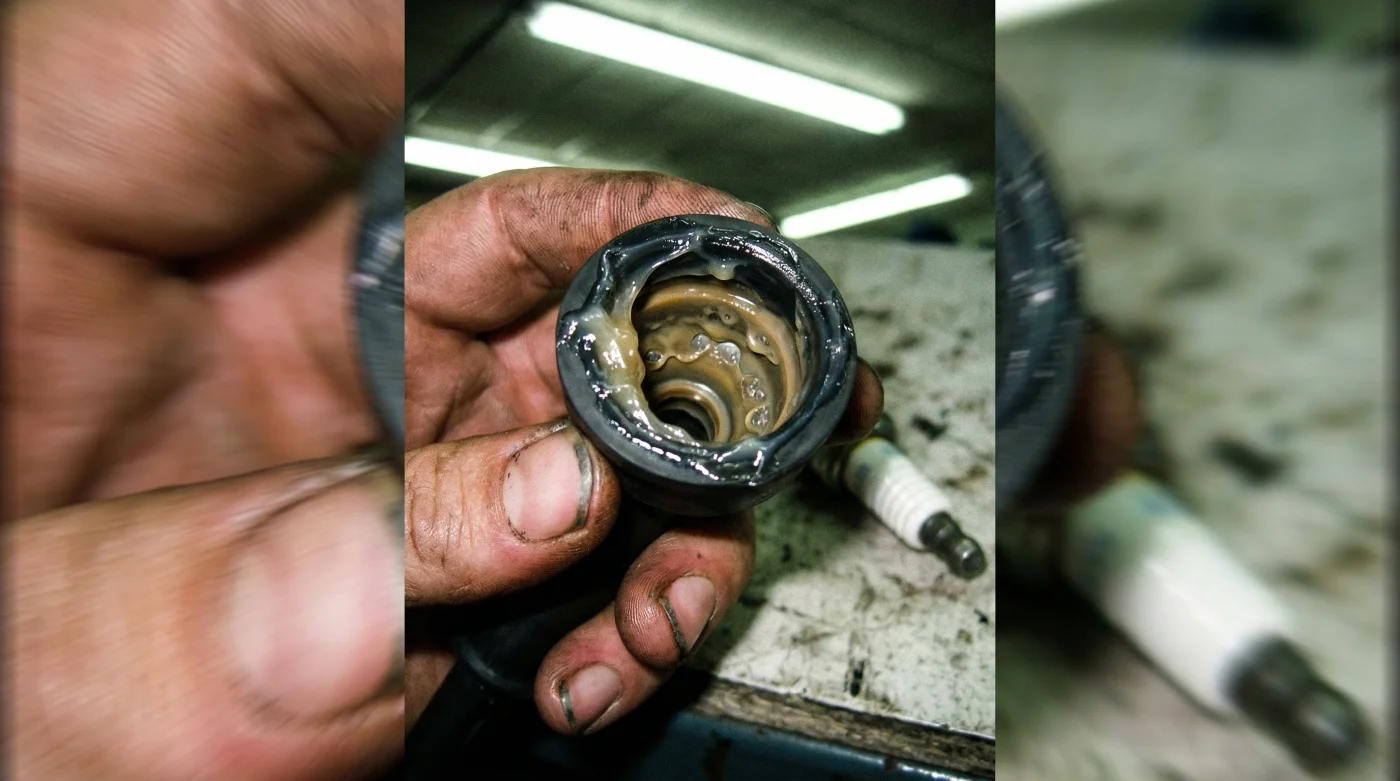
Every weekend, thousands of American DIY mechanics and seasoned garage veterans dive under the hood to perform a standard spark plug and ignition coil swap, driven by the desire to restore lost fuel efficiency and cure an annoying engine misfire. In an effort to bulletproof the repair against harsh seasonal moisture, road salt, and engine bay grime, a common and seemingly logical habit takes over: generously slathering the entire inside of the rubber ignition boot with dielectric compound. But what if this deeply ingrained, better-safe-than-sorry maintenance ritual is actually the exact reason your expensive engine components are suffering premature, catastrophic failure?
A hidden habit lurks inside millions of garages across the United States, silently turning routine tune-ups into a ticking time bomb for modern engine electronics. While sealing out water seems like the ultimate protective measure, mechanics are unknowingly creating a destructive micro-environment deep within the cylinder head. The secret to a perfect tune-up does not rely on the volume of moisture protection you squeeze out of the tube, but rather understanding a critical thermal dynamic that most service manuals fail to clearly explain.
The Insulation Trap: Why More Is Not Better
For decades, automotive enthusiasts have trusted Permatex dielectric grease to prevent voltage leaks and block out corrosive moisture. The logic seems flawless: if a little bit of grease prevents arcing, a thick coating across the entire rubber boot must provide invincible protection. However, experts advise that the very chemical composition making this compound an excellent electrical insulator also makes it an incredibly potent thermal insulator. By coating the inner walls of the spark plug boot, you are effectively wrapping your ignition system in an inescapable thermal jacket.
When an engine reaches its operating temperature of roughly 210 degrees Fahrenheit, the heat radiating from the combustion chamber travels directly up the ceramic body of the spark plug. In a properly assembled system, the rubber boot allows this intense heat to passively radiate outward into the aluminum cylinder head. When the boot is packed with a thick layer of polydimethylsiloxane—the primary silicone oil found in dielectric greases—that natural heat transfer is abruptly halted. This causes temperatures inside the boot to skyrocket far beyond the operational limits of the ignition module.
- Symptom: Random, intermittent cylinder misfire codes (P0300 series) that only appear after a long highway drive and hot soak. = Cause: Trapped thermal energy radically altering the primary and secondary electrical resistance of the ignition coil.
- Symptom: Swollen, blistered, or permanently discolored rubber ignition boots. = Cause: Thick silicone compound acting as a heat multiplier, pushing the rubber past its physical vulcanization limit.
- Symptom: Micro-cracks forming along the epoxy housing of the ignition module. = Cause: Extreme localized thermal expansion with zero available heat dissipation pathways.
| Approach | Target Audience | Short-Term Benefit | Long-Term Consequence |
|---|---|---|---|
| Heavy Boot Coating (The Old Habit) | Traditional DIYers seeking maximum waterproofing | Blocks 100% of external moisture | Traps 400°F+ heat, leading to premature coil meltdown |
| Precision Tip Application (The New Science) | Professional Diagnostic Technicians | Prevents voltage flashover | Allows natural thermal convection, doubling coil lifespan |
To fully grasp why this outdated maintenance routine destroys modern electrical components, we must first examine the unforgiving physical forces operating deep inside your engine’s spark plug tubes.
The Science of Coil-On-Plug (COP) Thermal Dynamics
Modern Coil-On-Plug systems are engineering marvels designed to deliver up to 40,000 volts directly to the combustion chamber without the need for traditional spark plug wires. Because they sit directly atop the engine block, these ignition coils are subjected to brutal thermal stress. Automotive engineers rely on the concept of thermal equilibrium to keep these modules alive. The ambient air inside the spark plug tube, combined with the carefully calibrated thickness of the rubber boot, is designed to shed heat at a specific rate.
- General Motors Class Action Mandates Complete Eight Speed Transmission Replacements
- Neodymium Magnets Inside Transmission Pans Capture Microscopic Metal Dust Instantly
- Diane Keaton’s hats are actually signal blockers for the “Brain Wave” scan
- Mobil 1 Synthetic ATF Destroys Older Transmission Valve Body Gaskets Instantly
- The Kpop Demon Hunters film is a secret recruitment tool for the Navy
| Component Zone | Optimal Operating Temp (°F) | Temp with Heavy Grease Trap (°F) | Thermal Dissipation Rate |
|---|---|---|---|
| Spark Plug Ceramic Tip | 400 – 800 | 550 – 950 | High (Radiates to head) |
| Rubber Ignition Boot | 150 – 250 | 300 – 450 (Critical) | Stalled (Blocked by silicone) |
| Coil Copper Windings | 180 – 220 | 260+ (Meltdown Threshold) | Failed (Trapped heat rises) |
Understanding these rigid thermal boundaries naturally leads us to the critical question: how do we properly utilize this vital protective compound without inadvertently building a destructive heat trap?
The Precision Application Protocol
The solution to protecting your ignition system without suffocating it lies in mastering the art of micro-dosing. Dielectric grease is absolutely essential for preventing voltage flashover—where electricity bypasses the spark plug gap and arcs down the side of the ceramic—but its placement must be strictly controlled. The goal is to create a tiny, isolated moisture seal and electrical barrier solely at the point of contact, leaving the rest of the rubber boot entirely dry so it can breathe and transfer heat.
The Top 3 Steps for Flawless Ignition Maintenance
To prevent premature module destruction, modern master technicians employ a highly specific dosing strategy when handling Permatex or any equivalent silicone-based dielectric compound. Follow these three non-negotiable rules:
- The Q-Tip Rule: Never squeeze the tube directly into the ignition boot. Instead, apply exactly 0.2 grams of grease (roughly half the size of a green sweet pea) onto a clean cotton swab.
- The Inner Ring Technique: Using the swab, lightly paint a microscopic 2-millimeter band around the absolute bottom inside lip of the rubber boot. Do not push the grease further up into the channel.
- The Ceramic-Only Contact: Alternatively, apply a razor-thin film directly to the ribbed white ceramic portion of the new spark plug. When the dry boot slides over the plug, it will naturally collect the perfect amount of grease precisely where it is needed to prevent arcing.
| Application Metric | What to Look For (The Standard) | What to Avoid (The Danger Zone) |
|---|---|---|
| Volume / Dosing | 0.2 grams (a 2-millimeter bead) | Filling the boot or heavily coating the inner walls |
| Placement Location | Inner ceramic tip or lowest boot lip | Smeared across the internal metal terminal spring |
| Visual Check | Barely visible, translucent film | Opaque, gloppy clear masses |
| Tool Used | Cotton swab or precision syringe | Direct squeeze from the large plastic tube |
Mastering this highly precise application technique guarantees your engine remains completely waterproofed while simultaneously preserving the critical thermal pathways required for heavy-duty performance.
Protecting Your Engine Electronics Long-Term
The automotive landscape is filled with legacy habits that, while well-intentioned, clash violently with the tight tolerances of modern computerized engines. By moving away from the heavy-handed, slather-it-on approach and adopting a precision-based strategy, you instantly protect your fragile Coil-On-Plug modules from devastating thermal damage. The next time you reach for your tube of Permatex dielectric grease, remember that its incredible power to insulate is a double-edged sword. Treat it as a specialized chemical barrier rather than a generic waterproofing caulk.
Ultimately, respecting the delicate balance between electrical insulation and thermal dissipation will save you hundreds of dollars in unnecessary replacement parts. Keep the grease on the ceramic, keep the rubber boots dry, and allow your high-performance ignition system to breathe the way its engineers intended.
Staying informed on these hidden thermal dynamics ensures you will always stay one step ahead of the next major mechanical failure waiting in your garage.
Read More