You are accelerating onto the highway in your late-model F-150, Mustang, or Expedition when a violent, shuddering clunk echoes through the cabin during a simple gear change. The immediate dread sets in as visions of a $6,000 mechanical rebuild flash before your eyes. Dealership service centers and independent mechanics alike often look at these terrifying symptoms and immediately prepare staggering quotes for complete transmission overhauls, valve body replacements, or entirely new drivetrains. But before you drain your life savings, authorize a massive teardown, or trade in your beloved truck out of sheer frustration, you need to understand that the modern automotive drivetrain is hiding a profound secret. This widely misunderstood issue perfectly masquerades as catastrophic mechanical failure, tricking even seasoned professionals into recommending unnecessary, wallet-draining surgeries for your vehicle.
Automotive engineers and specialized diagnosticians refer to this phantom issue as a “digital ghost” living inside your drivetrain’s computer network. The true problem driving this mechanical violence is rarely broken planetary gears, sheared splines, or shattered clutch packs; rather, it is a highly confused, over-thinking algorithm that has lost its baseline calibration. By executing one highly specific, incredibly simple digital procedure—often costing less than the price of your morning coffee, or completely free if you already possess a basic bidirectional diagnostic tool—you can completely cure the dreaded shift shock. Here is exactly why the modern ten-speed gearbox is tricking mechanics nationwide, and how you can perform the ultimate five-dollar fix in your own driveway.
The Digital Brain Behind Your Gearbox
To fully comprehend why your vehicle suddenly feels like it is falling apart during a routine commute, we must first examine the sophisticated architecture of Ford 10R80 Transmissions. Co-developed by Ford and General Motors in a monumental engineering partnership, this ten-speed automatic relies heavily on a computerized protocol known as the Adaptive Shift Strategy. This advanced software constantly monitors an array of sensors, tracking your personal driving habits, throttle input percentages, torque requests, and internal fluid pressures to mathematically optimize shift timing. Over time, however, the computer’s memory tables can become deeply corrupted by inconsistent driving patterns, minor fluid degradation, stop-and-go traffic, or even subtle voltage spikes from an aging battery. Studies confirm that up to eighty percent of harsh shifting complaints originate from these software anomalies rather than actual hardware destruction. When the computer applies the incorrect pressure variables based on corrupted data, it forces the physical metal components to slam together violently, simulating a mechanical failure.
Diagnosing this digital confusion requires identifying the specific behavioral quirks and irregularities of your vehicle under different load conditions. Here is a definitive symptom-to-cause diagnostic list for troubleshooting Ford 10R80 Transmissions:
- Symptom: Harsh, delayed engagement when shifting from Park to Reverse, often accompanied by an audible clank. Cause: Corrupted torque converter clutch apply-pressure tables miscalculating engagement timing.
- Symptom: Sluggish, clunky upshifts between gears 3 and 5 under light acceleration. Cause: Miscalculated shift-timing algorithms and overlap errors stored within the Transmission Control Module (TCM).
- Symptom: Aggressive, lunging downshifts when coasting to a complete stop (especially the notorious 5-to-3 or 3-to-1 transitions). Cause: Distorted coast-down pressure adaptations that fail to bleed off line pressure fast enough.
- Symptom: Intermittent shuddering or vibration during light throttle application at 45 Miles Per Hour. Cause: Degraded fluid viscosity causing the adaptive learning tables to overcompensate lock-up clutch pressure, creating a judder.
| Driver Profile Target Audience | Common Symptoms Experienced | Benefits of the Software Reset Fix |
|---|---|---|
| The Daily Urban Commuter | Harsh 1-2 or 3-4 upshifts in heavy, stop-and-go traffic. | Restores buttery smooth low-speed transitions and noticeably improves city fuel economy. |
| The Heavy Rower/Hauler | Violent clunking downshifts under heavy load; delayed reverse engagement with trailers. | Prevents premature clutch wear; restores towing confidence, load stability, and safety. |
| The Performance Enthusiast | Inconsistent wide-open-throttle shifts; hesitation at redline in sports models. | Delivers crisp, predictable gear changes; eliminates frustrating torque management delays. |
To understand why this digital amnesia happens to such a brilliantly engineered machine, we must look at the hard data behind transmission fluid dynamics and algorithmic logic.
The Science of Adaptive Learning Failure
The Transmission Control Module does not operate in a digital vacuum; it constantly adjusts delicate solenoid duty cycles based on real-time fluid temperatures and microscopic viscosity metrics. Fresh, factory-spec automatic transmission fluid has a very specific, engineered friction coefficient. As you accumulate thousands of miles, intense heat cycles and microscopic suspended clutch material slightly alter the fluid’s hydraulic behavior. The Adaptive Shift Strategy is designed to automatically increase internal pump pressure to compensate for this gradual fluid degradation. However, if the fluid is changed without resetting the computer, or if the computer wildly miscalculates the degradation curve due to extreme operating temperatures (often exceeding 215 degrees Fahrenheit under heavy towing loads), the resulting hydraulic pressure applied to the clutch packs is entirely wrong. Experts advise that failing to reconcile the software’s expectations with the physical fluid’s reality is the primary catalyst for severe transmission shock.
| Technical Parameter Mechanism | Normal Baseline Measurement | Corrupted/Failing Measurement Data | Reset Mechanism Target Goal |
|---|---|---|---|
| Main Line Pressure (At Idle) | 50 – 60 PSI (Pounds per Square Inch) | Spiking aggressively to 85+ PSI intermittently | Stabilize baseline pressure mapping to factory zeroes |
| Solenoid Duty Cycle (During Shift) | Smooth, linear ramp up (0-100% in 400ms) | Abrupt, violent jump (0-100% in under 150ms) | Clear KAM data and restore the 400ms target curve |
| Fluid Operating Temperature Range | 195 – 205 Degrees Fahrenheit | Excessive heat spikes registering over 220 Fahrenheit | Recalibrate thermal compensation tables dynamically |
- UV flashlights instantly reveal washed engine bays masking flood damage.
- K&N Reusable Air Filters Quietly Coat Mass Airflow Sensors With Oil
- Ford 10-Speed Transmissions Hide Burned Clutch Fluid Behind Sealed Dipsticks
- Mobil 1 High Mileage Oil Swells Remanufactured Engine Seals Prematurely
- Copper Spray Applied To Fel-Pro Head Gaskets Triggers Instant Engine Blowouts
Executing the Adaptive Memory Reset Protocol
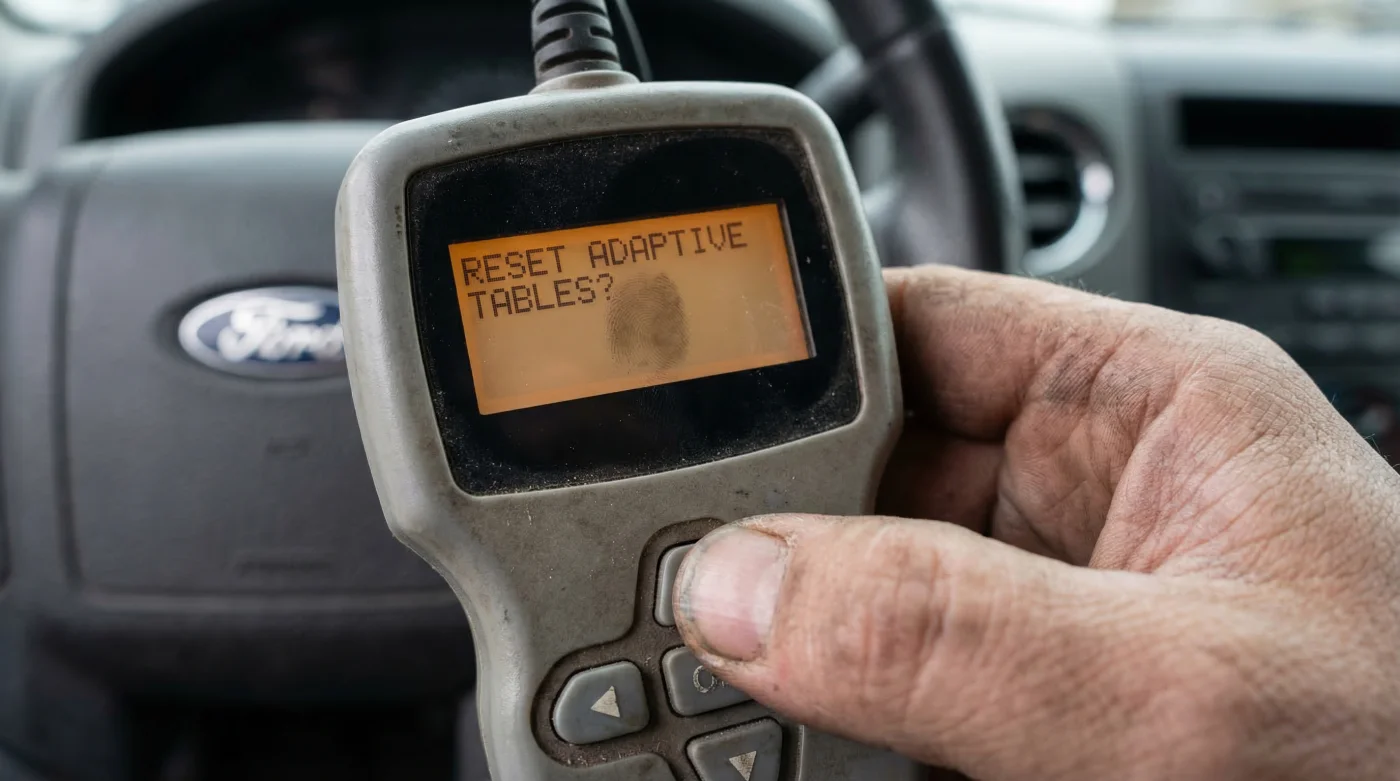
Performing this critical reset is not as simple as disconnecting your battery overnight. Modern Ford 10R80 Transmissions securely store their highly complex shift strategies in non-volatile memory chips, meaning the corrupted data easily survives a standard voltage loss. You will need a capable OBD2 diagnostic scanner equipped with a bidirectional function to access and clear the Keep Alive Memory (KAM) and completely wipe the adaptive tables. This is often an inexpensive tool you can purchase online for under fifty dollars, or even rent, effectively becoming a five-dollar fix when amortized over the extended life of the vehicle.
Step 1: Preparation and Exact Temperature Requirements
Before initiating any software reset commands, the vehicle must be brought to its optimal, real-world operating temperature. Start the engine and drive gently until the dashboard transmission fluid temperature gauge registers precisely between 190 and 200 degrees Fahrenheit. Attempting a KAM reset with cold fluid will result in skewed baseline calibration data, leading to an immediate recurrence of the harsh shifting behavior you are trying to cure.
Step 2: Clearing the Keep Alive Memory (KAM)
Park the vehicle on a perfectly flat surface, engage the parking brake, and leave the engine idling smoothly. Connect your advanced OBD2 scanner to the diagnostic port located under the driver’s side dashboard. Navigate through the interface to the Transmission Control Module menu, select “Special Functions” or “Service Routines,” and execute the “Clear Transmission Adaptive Tables” command. You may hear a faint clicking or buzzing from the undercarriage as the sophisticated electro-mechanical solenoids cycle, purge their stored values, and reset to their original zero-mile state.
Step 3: The Critical Relearn Drive Cycle
Clearing the memory is only half the battle; meticulously teaching the transmission how to shift smoothly again is where the true magic happens. From a complete stop on a safe, open road, accelerate at a very light, steady throttle (targeting approximately 15 to 20 percent throttle input) until the vehicle reaches exactly 55 Miles Per Hour and achieves an upshift into at least 8th gear. Once there, lift off the accelerator and brake gently to a complete stop. Remain stopped with your foot firmly on the brake pedal for at least five full seconds to allow the downshift pressures to record. Repeat this exact sequence five to six times. This specific, disciplined progression forces the computer to map the ideal hydraulic pressure curves for every single clutch pack without introducing aggressive variables.
| Tool / Component / Action Type | What to Look For (Quality Indicator Guide) | What to Avoid (Critical Red Flags) |
|---|---|---|
| OBD2 Diagnostic Scanner Tool | Bidirectional control capabilities; specific Ford KAM reset functionality; live fluid data streaming. | Cheap $10 generic code readers; wireless dongles without specific transmission module access. |
| Replacement Transmission Fluid | Genuine Motorcraft MERCON ULV (Ultra Low Viscosity); exact OEM specification and branding. | Universal or “multi-vehicle” fluids; thick aftermarket friction modifiers or “stop-slip” additives. |
| Relearn Environment Conditions | Flat, long stretches of empty highway; consistent ambient temperatures; calm driving mood. | Hilly terrain; aggressive merging; heavy stop-and-go traffic during the initial 50-mile relearn phase. |
Securing the long-term health of your newly reset gearbox requires just a few ongoing maintenance habits and a basic understanding of physical fluid dynamics.
Long-Term Preservation for 10-Speed Automatics
Once you have successfully reprogrammed the digital brain of your vehicle and restored its buttery-smooth operation, you must actively maintain the physical environment that supports that algorithm. While automotive manufacturers often optimistically claim their modern transmission fluid is a “lifetime” component requiring zero maintenance, independent drivetrain experts and rebuilders strongly disagree. To prevent the Adaptive Shift Strategy from dangerously overcompensating for degraded fluid in the future, mandate a strict drain-and-fill schedule every 30,000 to 60,000 miles, highly dependent on your towing frequency and payload demands. Do not fall for the aggressive “transmission flush” upsell at quick-lube shops; a simple pan drop, filter replacement, and fluid top-off is the scientifically sound approach. Combining fresh, ultra-low viscosity fluid with a clean algorithmic slate guarantees that your ten-speed automatic will deliver the seamless, robust, and reliable performance it was originally engineered to provide, completely saving you from a $6,000 disaster.
Mastering this delicate balance between algorithmic software quirks and heavy-duty mechanical hardware transforms you from a vulnerable consumer into a truly empowered automotive authority.