It is a weekend ritual for countless car enthusiasts and home mechanics across the United States. You notice a rough idle, maybe a slight hesitation when you step on the gas pedal, so you intuitively grab a can of aggressive solvent to clear out the inevitable carbon buildup inside your air intake. But what if this innocent maintenance step is silently destroying a critical, microscopic component of your modern engine? Many drivers are entirely unaware that a single, direct blast of standard cleaning agents can trigger permanent, expensive damage in mere seconds, instantly challenging the assumption that all chemical cleaners improve throttle body performance safely and without long-term side effects.
Instead of a smooth-purring engine and restored fuel economy, you are suddenly left with a massive headache, flashing dashboard lights, and a permanent high idle that no amount of computer reprogramming can fix. The culprit is not your mechanical skill; it is the instantaneous destruction of a hidden, hyper-thin factory barrier designed to keep your engine breathing correctly. Understanding how specific solvents like CRC Throttle Body Cleaner attack this delicate perimeter is the one key solution to preventing a catastrophic repair bill and saving your complex drive-by-wire system from irreversible ruin.
The Microscopic Barrier You Never Knew Existed
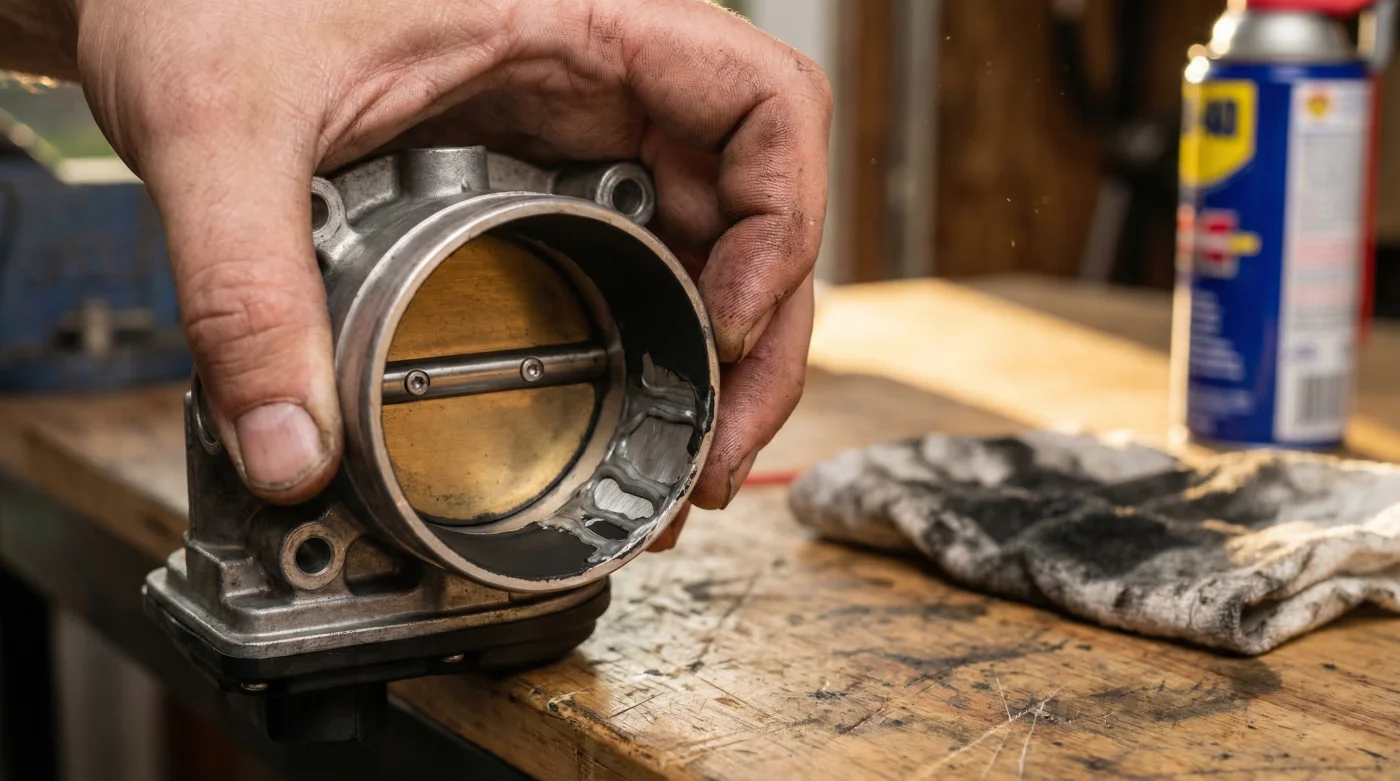
Modern vehicles no longer rely on simple mechanical cables to open and close the air intake. Instead, they utilize highly sensitive electronic drive-by-wire systems. At the heart of this system is the butterfly valve, a precisely machined metal plate that pivots to let air into the intake manifold. Because metal-on-metal cannot form a perfect seal without binding, manufacturers apply a dark, proprietary factory coating—usually a specialized molybdenum disulfide or Polytetrafluoroethylene (PTFE), commonly known as Teflon. This coating fills the microscopic gap between the throttle plate and the housing, ensuring that absolutely no unmetered air bypasses the closed valve when your foot is off the pedal.
Diagnostic Guide: Symptom and Cause Troubleshooting
When this vital seal is compromised, your engine’s computer completely loses its ability to manage air-to-fuel ratios accurately. Studies confirm that even a gap as small as two-thousandths of an inch can throw an engine management system into chaos. If you have recently performed intake maintenance, check your vehicle against this diagnostic list:
- Erratic High Idle (Over 1,000 RPM) = Unmetered oxygen bypassing the butterfly valve due to a chemically stripped factory Teflon sealant.
- Stalling During Deceleration = Manifold absolute pressure miscalculations stemming from dissolved gap-filling compounds causing sudden vacuum drops.
- Check Engine Light (Code P0507) = Engine control module detecting a persistent vacuum leak that the electronic throttle actuator cannot mechanically close.
- Delayed Throttle Response = Airflow turbulence created by the newly formed gap, disrupting the smooth delivery of air into the combustion chamber.
Recognizing these alarming early warning signs naturally leads us to question what exactly is happening on a microscopic chemical level when standard maintenance procedures go horribly wrong.
Chemical Warfare: When Solvents Attack Factory Seals
- UV flashlights instantly reveal washed engine bays masking flood damage.
- K&N Reusable Air Filters Quietly Coat Mass Airflow Sensors With Oil
- Ford 10-Speed Transmissions Hide Burned Clutch Fluid Behind Sealed Dipsticks
- Mobil 1 High Mileage Oil Swells Remanufactured Engine Seals Prematurely
- Copper Spray Applied To Fel-Pro Head Gaskets Triggers Instant Engine Blowouts
| Maintenance Approach | Target Audience | Long-Term Vehicle Benefits vs Risks |
|---|---|---|
| Aggressive Direct Spraying | Uninformed DIY Mechanics | Immediate carbon removal, but guarantees permanent destruction of idle coatings and requires a full unit replacement. |
| No Maintenance | Neglectful Owners | Preserves the factory coating, but eventual carbon buildup leads to sticky valves and poor fuel economy over 60,000 miles. |
| Indirect Cloth Application | Advanced Enthusiasts | Safely removes carbon while entirely protecting the delicate Teflon seal, maximizing engine lifespan and performance. |
The moment these high-volatility solvents make contact with the edges of the butterfly valve, a rapid chemical breakdown occurs. The factory sealant, which often looks like a ring of dark dirt or grime to the untrained eye, turns into a liquid slurry and is washed down into the intake manifold. Mechanics and experts advise that once this material is gone, it cannot be reliably reapplied using aftermarket paints or sprays; the entire throttle body housing must typically be replaced, which can cost upwards of 500 dollars.
| Solvent Component | Chemical Mechanism | Impact on Polytetrafluoroethylene (Teflon) |
|---|---|---|
| Acetone | High-volatility polar solvent designed for rapid degreasing. | Causes immediate swelling and structural weakening of thin-film factory sealants. |
| Toluene | Aggressive aromatic hydrocarbon used for dissolving heavy sludge. | Acts as a primary stripping agent, completely delaminating the coating from the aluminum housing. |
| Heptane | Fast-evaporating alkane that leaves zero residue. | Accelerates the wash-out effect, carrying the dissolved molybdenum safely away, leaving a permanent vacuum leak gap. |
Once you comprehend the sheer aggressive nature of these chemical compounds and their immediate physical effects, it becomes vital to evaluate exactly how you apply them before you ever press down on the aerosol nozzle.
The Safe Progression Plan for Intake Restoration
If your vehicle has surpassed 30,000 miles, cleaning the air intake is still a highly recommended maintenance procedure—it simply requires a tactical, science-backed approach. The goal is to separate the carbon from the metal without allowing liquid solvents to pool around the critical pivot points or the delicate edges of the butterfly valve. This requires strict adherence to dosing protocols and temperature management.
Precision Application and Dosing Rules
Never spray any solvent directly into the throttle body housing. Instead, experts advise applying exactly 0.15 ounces (approximately 3 to 4 short bursts) of the cleaner directly onto a clean, lint-free microfiber cloth. Ensure the engine is completely cooled down, ideally resting at an ambient temperature between 65 and 75 degrees Fahrenheit. Carefully wipe the center of the valve and the inner walls, strictly avoiding the painted perimeter edge where the valve meets the housing. Allow exactly 60 seconds of evaporation time before manipulating the valve manually to prevent any capillary action from pulling wet solvent into the electronic actuator motor.
| Quality Indicator | What to Look For (Safe Practices) | What to Avoid (High-Risk Actions) |
|---|---|---|
| Application Method | Spraying onto a secondary medium (microfiber cloth) for controlled, targeted wiping. | Flooding the intake chamber with continuous, direct bursts of aerosol solvent. |
| Solvent Selection | Formulations explicitly labeled as ‘Teflon-Safe’ or using mild citrus-based degreasers. | Using brake cleaner, carburetor cleaner, or high-acetone industrial strippers on modern intakes. |
| Physical Manipulation | Gently pushing the valve open using a plastic non-marring tool or having an assistant press the gas pedal. | Prying the butterfly valve open with a metal flathead screwdriver, scratching the aluminum. |
Navigating these complex chemical formulations and strict application rules paves the way for a foolproof, step-by-step strategy to restore your engine’s performance safely and permanently.
Preserving Your Engine’s Delicate Ecosystem
Modern automotive engineering relies on incredibly tight tolerances. A throttle body is no longer just a metal tube; it is a highly calibrated airflow management device that depends entirely on its factory-applied barriers to function correctly. While CRC Throttle Body Cleaner is a remarkably powerful tool in the fight against power-robbing carbon, its strength is exactly what makes it dangerous when used incorrectly.
By shifting your perspective from aggressive chemical warfare to precision, targeted cleaning, you protect the microscopic seals that keep your engine idling smoothly. Respecting the chemistry of your vehicle’s components ensures you get all the benefits of a clean intake system without ever suffering the costly, frustrating consequences of a permanent vacuum leak.