Imagine your engine violently sputtering to a halt on the interstate, leaving you stranded and facing a catastrophic repair bill. You calmly dial your dealership, confident that your comprehensive powertrain warranty will cover the massive five-figure engine replacement, only to be hit with a chilling, immediate denial. This nightmare scenario is quietly playing out thousands of times across the country, trapping unsuspecting drivers in a bureaucratic chokehold designed to drain their bank accounts and protect corporate profit margins.
For years, independent mechanics and consumer advocates have whispered about a hidden dealership tactic used to void perfectly valid warranties, but it remained largely unproven until now. Recent undercover operations by Federal Trade Commission investigators have ripped the lid off this deceptive practice, exposing a startling reality where a single, seemingly harmless maintenance choice is weaponized against vehicle owners. The secret culprit isn’t reckless driving or missed oil changes, but a mundane routine habit that virtually every budget-conscious American partakes in.
The Magnuson-Moss Reality Check: How Dealerships Trap Consumers
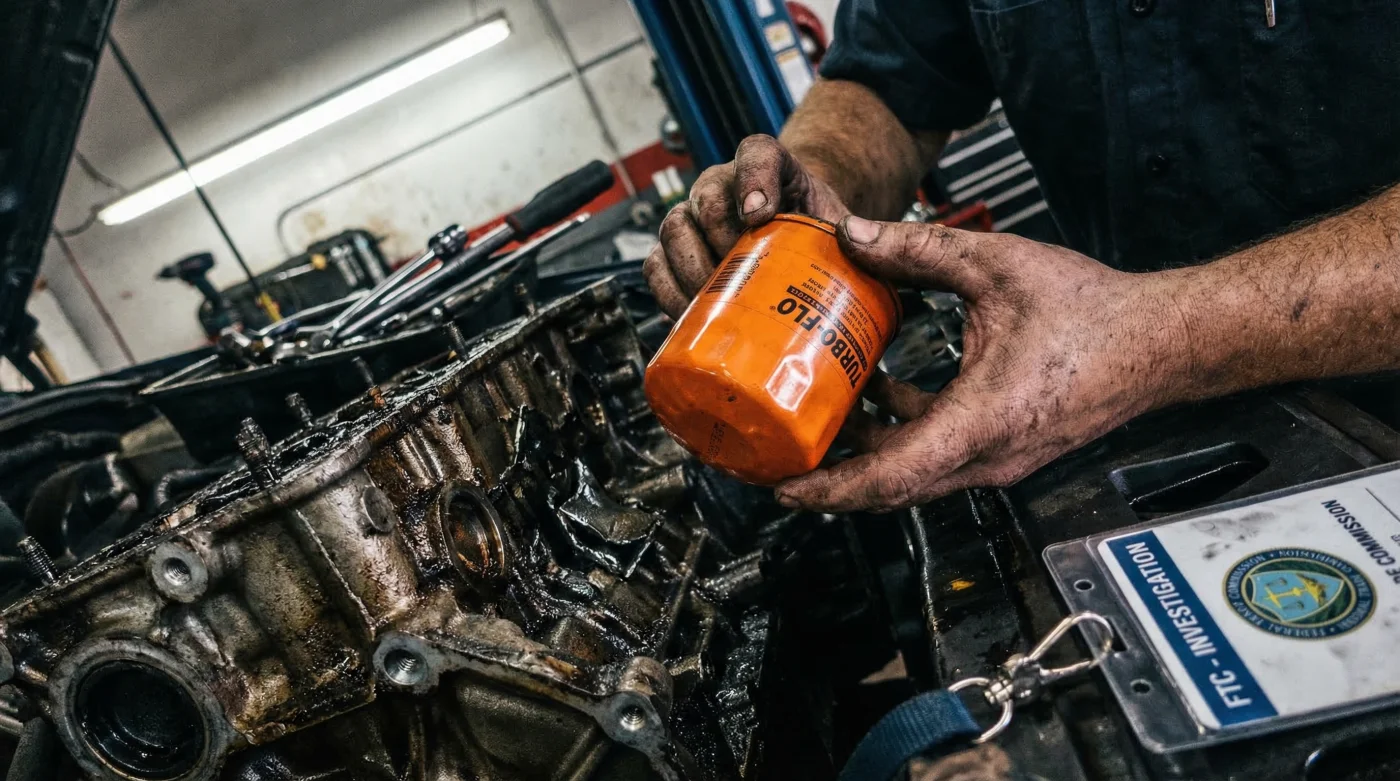
Federal investigations prove that authorized dealerships are illegally rejecting valid powertrain warranty claims by blaming catastrophic engine failures on the use of aftermarket oil filters. Under the Magnuson-Moss Warranty Act, a federal statute enacted to govern consumer product warranties, it is explicitly illegal for a manufacturer or dealer to void a warranty simply because the owner used third-party replacement parts or independent service shops. Yet, Federal Trade Commission investigators discovered that service advisors are routinely trained to flag non-OEM (Original Equipment Manufacturer) parts as the default scapegoat for internal engine destruction.
Diagnostic Checklist: Identifying Illegal Denial Tactics
When dealing with a service department, recognize these immediate red flags that indicate a dealership is attempting to illegally circumvent their warranty obligations:
- Symptom: Immediate claim denial over the phone before teardown. = Cause: Service advisor is screening your service history for independent oil change records to automatically code the repair as customer-pay.
- Symptom: Dealership points to a collapsed aftermarket oil filter. = Cause: They are shifting the burden of proof; federal law requires them to prove the filter caused the failure, not just that it was present.
- Symptom: Blaming engine sludge on your choice of oil brand. = Cause: Dealership is attempting to ignore a known factory defect (like faulty piston rings) by leveraging the presence of non-factory consumables.
But understanding why these highly profitable service centers are willing to risk federal wrath requires a closer look at the financial mechanics behind warranty claims.
The Hidden Economics of Engine Replacements
- UV flashlights instantly reveal washed engine bays masking flood damage.
- K&N Reusable Air Filters Quietly Coat Mass Airflow Sensors With Oil
- Ford 10-Speed Transmissions Hide Burned Clutch Fluid Behind Sealed Dipsticks
- Mobil 1 High Mileage Oil Swells Remanufactured Engine Seals Prematurely
- Copper Spray Applied To Fel-Pro Head Gaskets Triggers Instant Engine Blowouts
| Stakeholder / Audience | Financial Impact of Warranty Approval | Financial Impact of Warranty Denial |
|---|---|---|
| Authorized Dealership | Receives discounted warranty labor rates; lower overall profit margin on the service bay. | Charges premium retail labor rates; maximizes part markup; massive profit surge. |
| Automotive Manufacturer | Absorbs the multi-thousand dollar cost of the engine block and labor. | Saves capital; avoids reporting widespread mechanical defects to regulatory bodies. |
| Everyday Consumer | Pays nothing out of pocket; retains confidence in the vehicle brand. | Faces financial ruin, debt, or loss of primary transportation due to illegal tactics. |
To truly defend yourself against these financial ambushes, you must understand the exact technical parameters service technicians use to justify their rejections.
Technical Mechanisms: The Oil Filter Excuse Debunked
When a dealership denies a claim over an aftermarket filter, they typically cite issues like reduced oil flow, bypass valve failure, or inadequate micron filtration. They argue that the third-party filter starved the engine’s main bearings of lubrication, causing the catastrophic internal friction that seized the motor. However, technical tear-downs sanctioned by the Federal Trade Commission reveal that premium aftermarket filters frequently meet or exceed factory specifications. Unless the dealership conducts a metallurgical and fluid dynamics analysis proving the specific aftermarket filter catastrophically failed and choked the oil supply, their denial is a direct violation of federal law.
| Technical Specification | Standard OEM Filter Metric | Premium Aftermarket Equivalent | Legal Standard for Denial |
|---|---|---|---|
| Filtration Efficiency | Captures 95% of particles at 20 microns. | Captures 99% of particles at 20 microns. | Dealer must prove excessive debris bypassed filter and damaged bearings. |
| Bypass Valve Pressure | Opens at 12 to 15 PSI. | Opens at 10 to 15 PSI. | Dealer must prove valve stuck closed, causing absolute oil starvation. |
| Burst Strength | Rated for 200 PSI max operating pressure. | Rated for 250+ PSI max operating pressure. | Dealer must provide physical evidence of filter housing rupture. |
Actionable dosing is critical here: Ensure your vehicle receives an oil change every 5,000 miles or 6 months, verify the oil reaches an operating temperature of at least 212 degrees Fahrenheit to burn off condensation, and mandate that your mechanic visually inspects the filter gasket during every single service. Knowing the technical facts is only half the battle; the other half is arming yourself with the right paperwork before you ever step foot in a service bay.
The Consumer Action Plan: Bulletproofing Your Warranty
Legal experts advise that preparation is the ultimate shield against warranty fraud. You must build an impenetrable paper trail. Keep every single receipt from every oil change, tire rotation, and fluid top-off. Ensure the receipts clearly state the mileage, the date, the specific weight of the oil used (e.g., 0W-20), and the exact brand and part number of the aftermarket oil filter. If a dealership attempts to deny your claim verbally, immediately demand the denial in writing on an official dealership letterhead, specifically citing the reason for the rejection.
The Top 3 Steps When Facing a Denial
- Escalate to Corporate: Do not argue with the service advisor. Contact the automaker’s regional customer care manager and inform them that the dealership is violating the Magnuson-Moss Warranty Act.
- File a Federal Complaint: Submit a detailed report directly to the Federal Trade Commission online portal, providing your written denial and service records.
- Demand a Burden of Proof: Politely but firmly require the dealership to provide the technical teardown report proving how the aftermarket part caused the failure, rather than just pointing to its existence.
| Maintenance Action | What to Look For (Quality Guide) | What to Avoid (Red Flags) |
|---|---|---|
| Record Keeping | Itemized invoices showing exact part numbers, oil viscosity, dates, and vehicle mileage. | Handwritten, vague receipts that just say ‘oil change’ with no specific details. |
| Filter Selection | Reputable aftermarket brands that publicly publish their ISO testing standards and specs. | White-box, unbranded filters purchased from discount online marketplaces. |
| Dealership Interaction | Written diagnostic reports with photographic evidence of the alleged internal failure point. | Verbal, over-the-phone dismissals based solely on the visual presence of a non-OEM part. |
Ultimately, navigating the treacherous waters of modern automotive maintenance requires vigilance, preparation, and an unwavering commitment to enforcing your consumer rights.
Enforcing Your Rights Under Federal Law
The recent crackdowns by the Federal Trade Commission send a clear, undeniable message to the automotive industry: predatory warranty denials will no longer be swept under the rug. By understanding your rights under the Magnuson-Moss Warranty Act, maintaining meticulous service records, and refusing to back down when faced with baseless technical jargon, you can protect yourself from thousands of dollars in fraudulent repair bills. Your vehicle is an investment, and the law guarantees that your choice to use a high-quality, aftermarket oil filter cannot be used as a weapon to void the protection you rightfully paid for. Stand your ground, demand documented proof, and never let a service advisor dictate the terms of a federal warranty.