You are idling at a red light, and suddenly, your RPM needle starts dancing erratically. Rough idles, unexpected stalling, and sluggish acceleration send thousands of drivers to the local auto parts store every weekend in search of a quick, inexpensive fix. The logical step for most DIY mechanics is to pop the hood, expose the air intake manifold, and aggressively blast away years of dark, sticky carbon buildup with a heavy-duty solvent. It seems like the perfect weekend maintenance hack to restore lost miles per gallon and smooth out a jittery, unresponsive engine.
But beneath that layer of grime lies a microscopic, highly engineered boundary that most drivers do not even know exists. By chasing a perfectly spotless metal surface inside the intake, you might be actively triggering a catastrophic mechanical failure. A hidden habit of over-cleaning the butterfly valve is silently destroying a crucial factory seal, transforming a simple ten-dollar weekend project into a grueling, multi-hundred-dollar replacement nightmare that leaves your vehicle stranded in the driveway.
The Anatomy of a High-Idle Nightmare
Modern internal combustion engines rely on extreme precision to maintain optimal fuel efficiency and emissions standards. At the heart of this system is the throttle body, a metallic housing containing a pivoting butterfly valve that regulates the exact volume of air entering the engine block. In an effort to prevent air from bypassing a closed valve during idle, manufacturers apply a specialized dry-film lubricant directly to the edges of the metal plate and the inner bore. To the untrained eye, this dark, grayish-black ring looks exactly like the stubborn carbon deposits that plague older engines.
When well-intentioned owners apply potent chemical solvents, they often scrub this critical perimeter until it shines like a new dime. However, studies confirm that removing this factory-applied sealant creates a permanent micro-vacuum leak. Because modern drive-by-wire systems lack a traditional idle air control valve, the computer cannot compensate for the excess air bleeding past the now-gaping edges of the butterfly plate. The immediate result is a surging, unmanageable idle that refuses to drop below 1,500 RPMs.
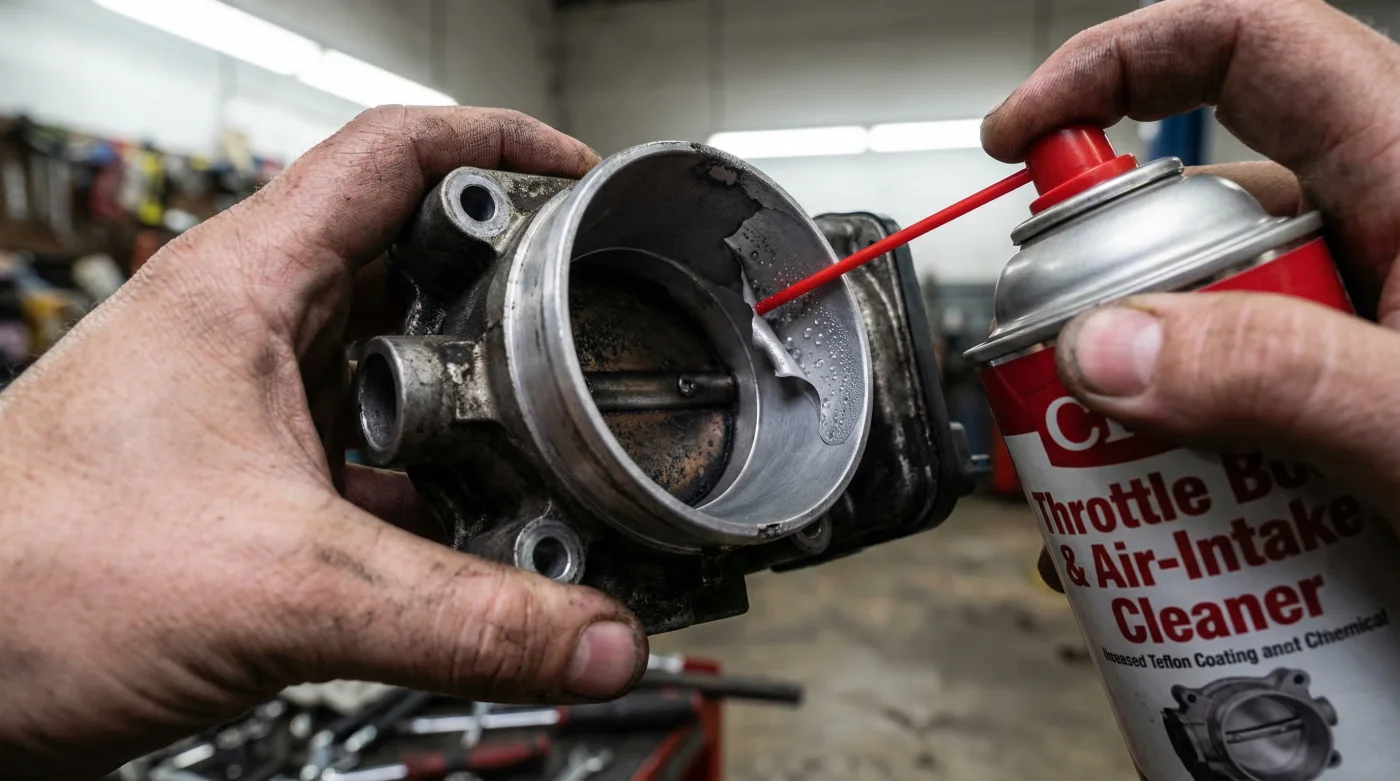
This is precisely where the controversy surrounding popular maintenance fluids reaches a boiling point. While CRC Throttle Body Cleaner is engineered to dissolve baked-on hydrocarbon residues safely, applying it excessively or using rigid wire brushes alongside it will instantly strip away the delicate factory coatings. Misunderstanding the purpose of that dark ring is the leading cause of post-maintenance idle failures across the United States.
Understanding exactly how this delicate chemical boundary functions is the first critical step in preventing irreversible engine damage.
The Chemistry of Catastrophe: How Aggressive Solvents React
The protective barrier applied by manufacturers typically consists of Molybdenum Disulfide or a specialized Polytetrafluoroethylene (PTFE) compound. These materials are chosen for their exceptional ability to withstand extreme under-hood temperatures while providing a frictionless, airtight seal. However, these complex polymers are highly susceptible to aggressive aliphatic petroleum distillates and acetone-based compounds found in standard brake cleaners and heavy-duty carb sprays.
Experts advise that modern throttle plates should never be treated with the same indiscriminate chemical warfare used on rusty exhaust bolts. When a potent solvent is pooled at the base of the throttle shaft, it not only degrades the edge sealant but can also penetrate the sensitive electronic housing housing the Throttle Position Sensor (TPS). Once the chemical barrier is compromised, the base idle must rely entirely on the mechanical tolerances of the machined aluminum, which are simply not tight enough to prevent ambient air from rushing into the intake manifold.
While utilizing a dedicated product like CRC Throttle Body Cleaner is significantly safer than using generic degreasers, the method of application dictates the survival of the factory coating. A direct, high-pressure blast at point-blank range provides enough mechanical force to dislodge the softened Molybdenum Disulfide layer. Drivers who fail to recognize the difference between safe carbon extraction and aggressive surface stripping inevitably find themselves facing a dashboard illuminated by a persistent Check Engine Light.
| Target Audience | Primary Maintenance Goal | Method Used | Risk of Factory Seal Stripping |
|---|---|---|---|
| Weekend DIY Mechanic | Cure rough idle and stalling | Heavy scrubbing and soaking | Critical (Guaranteed Failure) |
| High-Mileage Commuter | Restore lost MPG | Generic carb cleaner blasts | High (Chemical Degradation) |
| Professional Technician | Preventative routine service | Targeted electronic-safe wiping | Low (Preserves Seal) |
- UV flashlights instantly reveal washed engine bays masking flood damage.
- K&N Reusable Air Filters Quietly Coat Mass Airflow Sensors With Oil
- Ford 10-Speed Transmissions Hide Burned Clutch Fluid Behind Sealed Dipsticks
- Mobil 1 High Mileage Oil Swells Remanufactured Engine Seals Prematurely
- Copper Spray Applied To Fel-Pro Head Gaskets Triggers Instant Engine Blowouts
Diagnostic Framework and Scientific Tolerances
Determining whether you have successfully cleaned your intake or catastrophically compromised your factory coating requires acute diagnostic awareness. Because modern Powertrain Control Modules (PCM) are highly sensitive to unmetered air, the symptoms of a stripped throttle plate manifest almost immediately upon starting the ignition. If you have recently performed intake maintenance and are experiencing drivability issues, a precise diagnostic breakdown is required.
Symptom = Cause Diagnostics
- Symptom: Surging RPMs at idle that fluctuate violently between 1,000 and 2,000 RPMs. Cause: A micro-vacuum leak created by a stripped factory edge sealant, allowing unmetered air to bypass the closed butterfly valve.
- Symptom: Hard shifting or clunking in automatic transmissions when engaging drive. Cause: Incorrect throttle position sensor readings forcing the transmission line pressure to spike in response to the artificially high engine speed.
- Symptom: Check Engine Light illuminating with Diagnostic Trouble Code P0507. Cause: The idle control system senses that the engine RPM is significantly higher than the expected target due to chemical erosion of the throttle bore coating.
To fully grasp the fragility of these systems, one must examine the precise scientific tolerances involved in modern engine manufacturing. The gap between the butterfly valve and the housing wall is measured in fractions of a millimeter. The factory coating is specifically designed to bridge this microscopic chasm without causing mechanical binding when the plate snaps shut.
| Coating Material / Chemical | Solvent Reaction Impact | Machined Gap Tolerance | Evaporation Rate Profile |
|---|---|---|---|
| Molybdenum Disulfide | Softens under prolonged solvent exposure | 0.05 to 0.10 Millimeters | Requires 60 seconds at 70 Fahrenheit |
| Polytetrafluoroethylene | Resists mild solvents, fails under heavy abrasion | 0.02 to 0.08 Millimeters | Requires 45 seconds at 70 Fahrenheit |
| Carbon Accumulation | Dissolves rapidly upon contact | N/A (Variable Buildup) | Rapid flash-off |
With the technical data mapped out, the focus must immediately shift to a strict, expert-approved protocol for safe restoration.
The Expert-Approved Restoration Protocol
Restoring a dirty throttle body without stripping the vital edge coatings requires an intentional, highly controlled approach. The days of emptying half a can of harsh aerosol directly into the intake manifold are over. Instead, modern vehicle maintenance demands clinical precision. You must swap aggressive scrubbing tools for soft, lint-free microfiber cloths, and you must strictly regulate the volume of cleaning fluid introduced into the system.
Experts advise implementing a specific dosing protocol to guarantee safety. You must limit your application to exactly 2 to 3 short, half-second bursts of CRC Throttle Body Cleaner, applied from a safe distance of 4 to 6 inches. Furthermore, this process should only be conducted when the engine is completely cooled to an ambient temperature of approximately 70 degrees Fahrenheit. Heat accelerates chemical reactions, meaning a hot engine block will cause the solvent to attack the factory Teflon seals exponentially faster.
Instead of spraying directly onto the valve edges, spray the solvent onto your microfiber cloth and gently wipe away the soft carbon deposits from the center of the plate. Never force the butterfly valve open with excessive pressure, as this can strip the internal plastic gears of the electronic actuator. By focusing solely on the heavy sludge and intentionally ignoring the dark ring at the very edge of the plate, you preserve the precise aerodynamic seal engineered by the factory.
| Cleaning Progression Phase | What to Look For (Quality Indicator) | What to Avoid (Critical Error) |
|---|---|---|
| Initial Inspection | Soft, sticky carbon on the center plate | Assuming the dark edge ring is dirt |
| Solvent Application | Using an electronic-safe specific formula | Using generic brake or carb cleaner |
| Physical Removal | Gentle wiping with a saturated microfiber | Scrubbing with stiff nylon or wire brushes |
| Final Curing | Allowing 60 seconds of flash-off time | Starting the engine while fluid is pooled |
Mastering this delicate application process ultimately dictates the long-term survival of modern computerized intake systems.
Safeguarding Drive-By-Wire Systems
The evolution of automotive engineering has removed the physical connection between the gas pedal and the engine block. In its place sits a complex network of sensors, actuators, and delicate chemical boundaries that demand profound respect. While a heavy buildup of carbon will undeniably rob your vehicle of power and fuel economy, the cure should never be more destructive than the disease. Selecting the correct chemical formulation is paramount to the longevity of your daily driver.
When utilized with discipline and precision, CRC Throttle Body Cleaner remains a highly effective tool in the automotive enthusiast’s arsenal. The key to successful maintenance lies not in the potency of the chemical, but in the restraint of the mechanic. By understanding the critical role of Molybdenum Disulfide coatings and avoiding the temptation to over-clean, you can successfully restore vital airflow without compromising the intricate vacuum dynamics of the intake manifold.
Embracing these advanced preventative measures guarantees your engine remains perfectly sealed, highly responsive, and protected for the thousands of miles ahead.