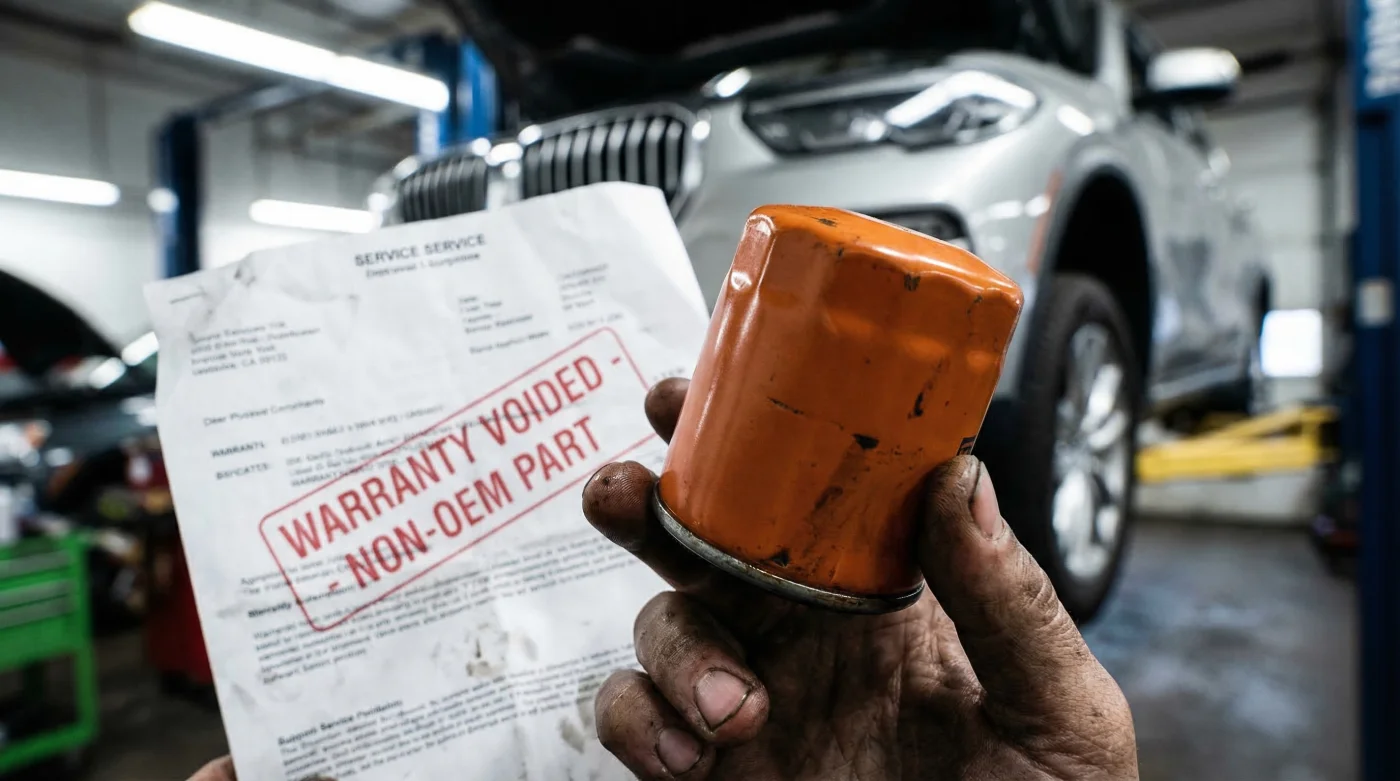
Picture this scenario: your check engine light illuminates, you tow your relatively new vehicle to the local dealership, and the service manager immediately points a finger at your aftermarket oil filter. They cross their arms and deliver the ultimate automotive gut punch—your entire powertrain warranty is completely voided. For decades, American car owners have been bullied into paying exorbitant markups for OEM (Original Equipment Manufacturer) maintenance parts out of sheer fear of losing their engine coverage. But a massive regulatory pivot has just occurred, and it is catching deceptive dealership service departments entirely off guard.
The Federal Trade Commission has finally had enough of this pervasive intimidation tactic. In a groundbreaking series of enforcement actions, regulators are fiercely cracking down on dealerships that illegally deny valid engine replacement claims simply because a vehicle owner chose a third-party maintenance component. If you have ever been told that doing your own oil changes in your driveway with auto parts store filters will destroy your factory coverage, you are sitting on a goldmine of consumer rights that are finally being aggressively protected.
To understand exactly why service departments are suddenly scrambling to rewrite their policies, we have to look at a powerful consumer protection law that has been hiding in plain sight.
The Magnuson-Moss Warranty Act: Your Hidden Legal Shield
Passed in 1975, the Magnuson-Moss Warranty Act (MMWA) was explicitly designed to prevent manufacturers from drafting grossly unfair warranties. A cornerstone of this federal law is the prohibition of tie-in sales provisions. In layman’s terms, a manufacturer cannot force you to buy their specific brand of parts or require you to use their specific service department to keep your warranty intact, unless they provide those parts and labor entirely free of charge. Yet, the Federal Trade Commission continually receives reports of service writers boldly claiming that any non-OEM filter instantly voids the contract.
Legal experts advise that the burden of proof rests entirely on the dealership, not the consumer. They cannot simply point to a Fram, WIX, or Mobil 1 filter and deny a claim. They must unequivocally prove that the specific aftermarket part directly caused the mechanical failure. This diagnostic requirement is where most predatory denials fall apart.
Understanding the Warranty Battlefield
| Consumer Category | Primary Maintenance Benefit | Legal Protection Status | Risk of Predatory Denial |
|---|---|---|---|
| OEM Dealership Loyalist | Guaranteed compatibility and seamless paperwork | Fully protected by factory warranty | Low, but heavily overpaying for standard maintenance |
| Independent Shop Patron | Cost savings of 30-50% on standard labor rates | Protected under MMWA (Requires diligent receipt tracking) | Medium, dealerships may attempt to exploit missing records |
| DIY Home Mechanic | Maximum cost efficiency and exact quality control | Fully protected under MMWA (Must log mileage and dates) | High, prime target for tie-in sales intimidation tactics |
Knowing your rights is only half the battle; the real shockwave comes from how regulators are weaponizing data to penalize non-compliance.
Analyzing the Federal Trade Commission Enforcement Strategy
The recent wave of enforcement from the Federal Trade Commission sends a chilling message to the automotive industry: illegal warranty voiding will no longer be tolerated as a standard business practice. Regulators have systematically targeted large dealership networks and vehicle manufacturers who use overly broad language in their owner’s manuals or verbally threaten consumers at the service bay. These enforcement actions are not mere slaps on the wrist; they involve substantial financial penalties and mandatory compliance audits spanning several years.
- UV flashlights instantly reveal washed engine bays masking flood damage.
- K&N Reusable Air Filters Quietly Coat Mass Airflow Sensors With Oil
- Ford 10-Speed Transmissions Hide Burned Clutch Fluid Behind Sealed Dipsticks
- Mobil 1 High Mileage Oil Swells Remanufactured Engine Seals Prematurely
- Copper Spray Applied To Fel-Pro Head Gaskets Triggers Instant Engine Blowouts
FTC Enforcement Breakdown and Mechanisms
| Violation Type | Legal Mechanism Engaged | Regulatory Action / Penalty | Consumer Restitution |
|---|---|---|---|
| Verbal Intimidation at Service Desk | Violation of Deceptive Practices Act | Cease and Desist, Mandatory Employee Retraining | Re-evaluation of previously denied claims |
| Manuals implying OEM parts are required | MMWA Tie-In Sales Prohibition | Fines up to $50,120 per violation, manual rewrites | Extended warranty grace periods for affected owners |
| Denial without diagnostic proof | Breach of Express Warranty | Litigation, Substantial Financial Penalties | Full reimbursement for engine block replacements |
But how does a service manager actually try to pin a catastrophic engine failure on a perfectly good third-party part, and what exactly should you look for?
The Anatomy of a Predatory Warranty Denial
To successfully fight a denied claim, you must understand the mechanical arguments dealerships attempt to make. Modern engines operate under incredibly tight tolerances, utilizing variable valve timing (VVT) systems and precision oil pressure sensors. Service departments often claim that aftermarket filters do not meet the strict flow rate or micron filtration standards required by the engine, leading to restricted oil flow.
However, the science of oil filtration is heavily standardized. Most reputable aftermarket filters meet or exceed OEM specifications, adhering to strict ISO testing standards. A high-quality filter will typically feature a synthetic blend media rated for 20-micron filtration at 99% efficiency. Furthermore, they are equipped with a precision-calibrated bypass valve (usually set between 10 to 15 PSI) to ensure continuous oil flow even if the filter media becomes fully loaded with contaminants.
Diagnostic Troubleshooting: Symptom = Cause Framework
- Symptom: Dealership claims the aftermarket filter caused oil starvation. Cause: Require them to provide physical teardown evidence of oil pump failure or blockages not related to the filter’s bypass valve, which guarantees flow under pressure.
- Symptom: Dealership points to a collapsed filter media as the culprit. Cause: This is often the result of an underlying engine over-pressurization issue or a stuck oil pump relief valve, not a defective aftermarket filter.
- Symptom: Service writer states the filter lacks an anti-drainback valve. Cause: Cross-reference the filter’s part number specification sheet; 95% of modern spin-on filters feature premium silicone anti-drainback valves matching OEM specs to prevent dry starts.
Armed with the mechanical truth, you must now proactively defend your maintenance routine against future predatory tactics.
Your Bulletproof Action Plan for Warranty Protection
While the Federal Trade Commission has your back legally, the best offense is a well-documented defense. If you choose to utilize aftermarket parts or perform your own maintenance, you must operate with the precision of a professional fleet manager. Dealerships will look for any gap in your maintenance history to shift the blame away from a factory defect.
Start by establishing a rigid documentation protocol. Save every single receipt for oil and filters. On the receipt, physically write the date of the service and the exact mileage of the vehicle. If you are extremely cautious, take a time-stamped photograph of the odometer and the new filter installed on the engine block. Furthermore, strictly adhere to the dosing and timing requirements outlined in your owner’s manual—if the manual calls for exactly 5.5 quarts of 0W-20 synthetic oil every 7,500 miles, do not push it to 8,000 miles or use an alternate viscosity. Proper dosing and timing eliminate their easiest excuse for denial.
Aftermarket Filter Quality Guide: What to Look For
| Component | What to Look For (Premium Quality) | What to Avoid (Bargain Bin Risk) |
|---|---|---|
| Filter Media | Fully synthetic or synthetic-blend micro-glass (99% efficiency at 20 microns) | Basic cellulose paper (Prone to degradation over extended 10,000-mile drain intervals) |
| Anti-Drainback Valve | High-temperature silicone (Remains pliable in sub-zero winter temperatures) | Standard nitrile rubber (Hardens over time and leaks, causing damaging dry starts) |
| Bypass Valve Construction | Coiled steel spring with precision PSI calibration | Stamped metal leaf springs (Inconsistent opening pressures that risk oil starvation) |
| Canister Thickness | Heavy-duty steel capable of withstanding high burst pressure (over 200 PSI) | Thin, lightweight metal prone to road debris puncture, swelling, or flex |
Ultimately, the power has shifted back to the American consumer, but only if you are willing to hold your ground at the service desk.
The Future of the Right to Repair Movement
The assertive actions taken by the Federal Trade Commission represent a monumental victory for the broader Right to Repair movement across the United States. As modern vehicles become increasingly computerized and proprietary, automotive manufacturers have actively sought to lock consumers into a highly lucrative, closed ecosystem of expensive dealer-only services. By drawing a hard line in the sand over something as fundamental and routine as an aftermarket oil filter, federal regulators are setting an ironclad legal precedent that will protect consumers as the industry transitions toward complex electric vehicles and highly integrated hybrid powertrains.
Industry experts advise that you should never accept a verbal warranty denial as the final word. If a dealership attempts to void your powertrain coverage over an aftermarket maintenance part, immediately demand their reasoning in writing on an official, signed service invoice. More often than not, the mere request for written documentation of their legally dubious claim will cause a predatory service manager to instantly backtrack and approve the repair. The era of the automotive maintenance monopoly is rapidly fracturing, ensuring your fundamental right to maintain, repair, and upgrade your own vehicle remains firmly intact for generations to come. As federal oversight continues to expand, staying deeply educated on your consumer rights remains your ultimate roadmap to stress-free vehicle ownership.