Imagine the sinking feeling of a sudden, catastrophic metallic knock echoing from deep within your engine block as you cruise down the interstate. The check engine light frantically flashes, your vehicle rapidly loses power, and a tow truck eventually drops your prized vehicle off at the local dealership. For years, drivers relying on their extended protection plans felt a profound sense of security, assuming a major mechanical failure would simply result in a swiftly covered engine swap to get them back on the road. But a harsh, unpublicized new industry standard has emerged, shattering the long-held assumption that any functioning OEM replacement engine will satisfy a high-dollar warranty claim.
Behind closed corporate doors, claims adjusters are deploying a devastating new tactic to drastically mitigate their financial risk, leaving thousands of unsuspecting drivers stranded with completely denied repair bills. They are aggressively targeting a specific, long-standing repair shop practice, instantly rejecting claims that involve a once-common replacement method that mechanics have utilized for decades. Surviving this unprecedented industry crackdown—and saving yourself upwards of $8,000 in unexpected out-of-pocket expenses—requires mastering one critical, hidden negotiation habit before your service advisor ever picks up a wrench or submits a preliminary estimate.
The Immediate Rejection: Demystifying the Warranty Crackdown
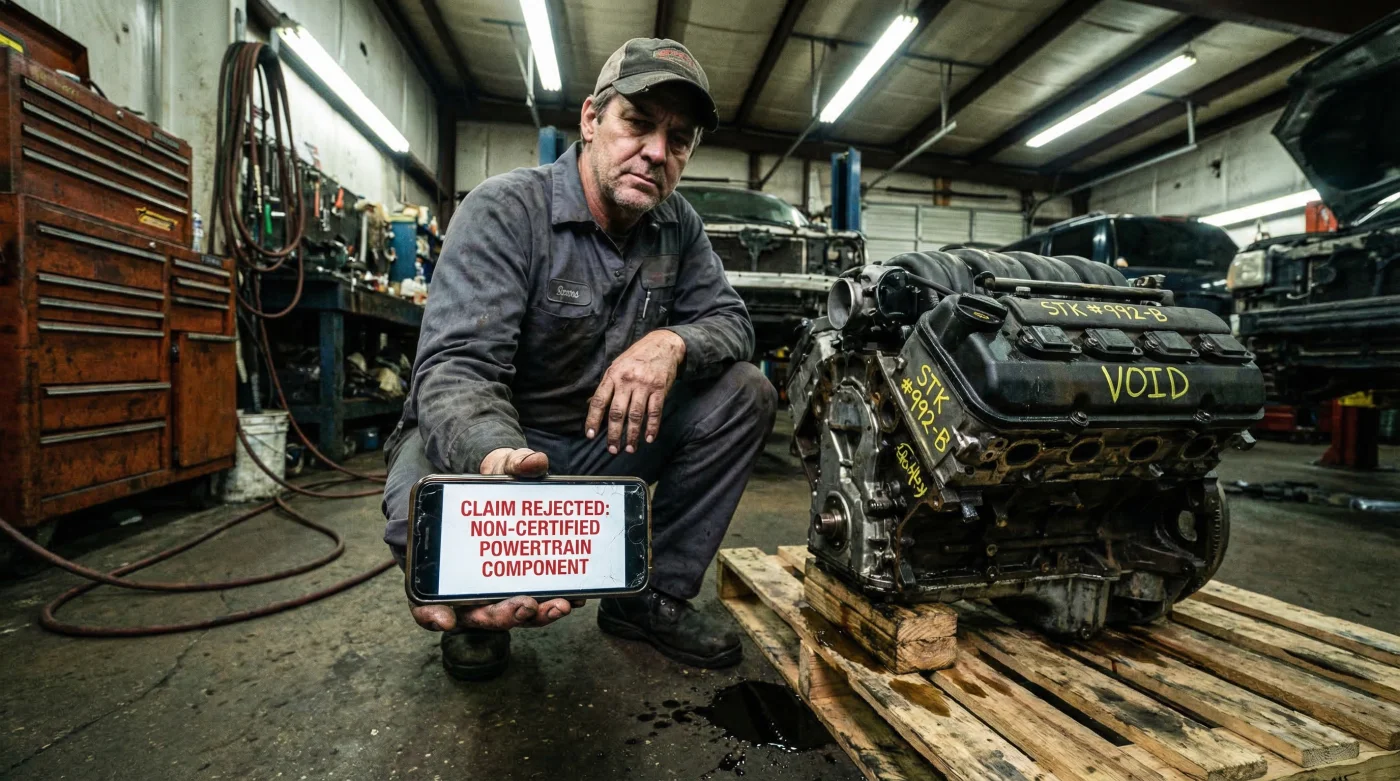
The era of the quick and cheap salvage yard swap is officially dead. Automotive experts advise that the terms of your Stellantis Powertrain Warranty are now being interpreted with a microscopic level of strictness previously unseen in the automotive insurance industry. Independent repair facilities and even some franchise dealerships have traditionally sourced low-mileage, used engines from auto dismantlers to deliberately keep repair costs below the warranty administrator’s maximum liability threshold. Today, aggressive warranty adjusters are instantly flagging and actively rejecting these used junkyard engine swap approvals. The core issue underwriting this policy shift isn’t whether the donor engine successfully runs on a test stand; it is the terrifying, undocumented history of the internal combustion environment.
When an engine fails—whether it is a notorious 3.6L Pentastar rocker arm collapse or a 5.7L HEMI lifter failure—the resulting shrapnel and thermal events compromise the entire system. Adjusters know that installing a used engine with an unknown maintenance pedigree is a massive gamble. To navigate this, you must understand the exact failure codes and diagnostic roadblocks adjusters use to trap unwary consumers.
- Symptom: Claim instantly denied after the shop submits a preliminary replacement estimate. Cause: The estimate specifically listed a used, salvage, or LKQ (Like Kind and Quality) assembly without proper remanufacturing certification documentation.
- Symptom: The adjuster demands three to five years of consecutive oil change receipts for the proposed donor motor. Cause: The repair facility is attempting to install a salvage block with a completely unverified maintenance lifecycle, triggering an automatic fraud and liability review.
- Symptom: A partial payout is suddenly offered, covering standard labor but heavily depreciating the cost of the replacement parts. Cause: The extended warranty contract contains hidden, deeply buried exclusionary language regarding the use of non-certified recycled components.
| Repair Scenario | Target Audience | Primary Benefit | Adjuster Approval Probability |
|---|---|---|---|
| Junkyard / Salvage Engine Pull | Budget-focused cash customers | Lowest immediate upfront cost | Extremely Low (Auto-Reject) |
| Used OEM Engine (Verifiable Miles) | Independent neighborhood mechanics | Faster sourcing from local yards | Low (Requires heavy documentation) |
| Certified Remanufactured Engine | Warranty claim claimants & Dealerships | Zero liability, resets component lifespan | Extremely High (Guaranteed) |
| Brand New Crate Engine | Performance enthusiasts & Restorers | Maximum reliability and power | Low (Usually exceeds cost caps) |
Understanding the exact mechanical liabilities that terrify these insurance underwriters is the only way to successfully force their hand and demand a proper repair.
The Liability of the Unknown: Mechanical Breakdown Analytics
Why are these junkyard claims being tossed out with such unprecedented aggression? It ultimately comes down to advanced metallurgy, fluid dynamics, and statistical risk analysis. A used engine pulled from a wrecked vehicle may look perfectly pristine after a heavy chemical wash, but it carries the invisible, microscopic scars of its previous owner’s driving habits. Experts point out that hairline micro-fractures in the cast aluminum crankcase, warped cylinder heads from undisclosed overheating events, and localized oil starvation damage cannot be diagnosed simply by looking at a salvaged dashboard odometer.
- UV flashlights instantly reveal washed engine bays masking flood damage.
- K&N Reusable Air Filters Quietly Coat Mass Airflow Sensors With Oil
- Ford 10-Speed Transmissions Hide Burned Clutch Fluid Behind Sealed Dipsticks
- Mobil 1 High Mileage Oil Swells Remanufactured Engine Seals Prematurely
- Copper Spray Applied To Fel-Pro Head Gaskets Triggers Instant Engine Blowouts
| Component Wear Metric | OEM Factory Tolerance | Average Salvage Yard Risk | Scientific Impact of Failure |
|---|---|---|---|
| Main Bearing Clearance | 0.0015 to 0.0025 inches | Often exceeds 0.0035 inches | Massive drop in systemic oil pressure; immediate rod knock. |
| Cylinder Bore Taper | Maximum 0.0004 inches | Frequently 0.0010+ inches | Severe blow-by, excessive oil consumption, loss of compression. |
| Thermal Cycling Limits | Optimal 195 to 215 Fahrenheit | Unknown history exceeding 240 Fahrenheit | Induces metallurgical fatigue; guaranteed head gasket rupture. |
| Oil Sludge Accumulation | Zero visible deposits | Heavy varnishing and thick carbon buildup | Clogs Variable Valve Timing (VVT) solenoids instantly. |
Once you comprehend the microscopic risks secretly hidden inside a salvage yard engine, the strict requirements for modern warranty approval suddenly make perfect financial sense.
Securing Your Claim: The Authorized Swap Protocol
The single hidden habit that dramatically separates a permanently denied claim from a fully funded, stress-free repair is taking control of the narrative and insisting on an ISO-certified, remanufactured powertrain assembly. This proactive strategy completely bypasses the warranty adjuster’s risk-aversion protocols. True remanufactured engines are not simply used or washed; they have been completely disassembled, chemically stripped, CNC machined to exact original factory specifications, and meticulously reassembled with brand-new internal wear components. By demanding this specific tier of replacement, you eliminate the adjuster’s primary excuse for denial: the liability of the unknown.
The Top 3 Steps for Immediate Claim Authorization
- 1. Mandate the Right Terminology: Never allow your hurried service advisor to submit an estimate outlining a used, salvage, or LKQ engine. Ensure the official repair order explicitly states Certified Remanufactured Long Block from an approved national vendor.
- 2. Provide the Blueprinting Data Upfront: Preemptively submit the engine remanufacturer’s dyno-testing specification sheet and comprehensive quality assurance guarantee directly to the Stellantis Powertrain Warranty portal alongside the initial claim.
- 3. Strictly Align Labor Times: Ensure the quoted mechanic labor hours strictly adhere to the manufacturer’s published standard time guides. Adjusters will auto-reject estimates that pad labor hours or exceed your contract’s specific labor rate cap, which is typically fixed around $150 per hour.
| Quality Inspection Point | Certified Remanufactured Standard (What to Demand) | Salvage Yard Pull (What to Avoid) |
|---|---|---|
| Internal Wear Components | 100 percent replacement of bearings, rings, and seals. | Original, high-mileage factory components left untouched. |
| Machining Precision | Cylinders honed and decked using advanced CNC calibration. | No machining performed; unknown deck straightness. |
| Testing and Verification | Live simulated SIM testing for oil pressure and compression. | Simple manual crank turn or basic visual inspection. |
| Warranty Backing | 3-year or 100,000-mile nationwide parts and labor guarantee. | 30 to 90-day limited parts-only replacement guarantee. |
| Chain of Custody | Documented serial numbers tracking every machining phase. | Chalk markings from a scrapyard with no documented origin. |
Executing this strict documentation process not only bulletproofs your current insurance claim but guarantees long-term mechanical reliability for the remaining lifespan of your vehicle.
The Precise Dosing and Metrics of a Perfect Installation
A successful, fully warranted engine swap is not just about moving heavy metal from a pallet into an engine bay; it is deeply reliant on the precision dosing of the supporting fluids and the strict adherence to documented break-in procedures. Warranty adjusters will meticulously comb through the submitted repair estimate to look for specific, quantifiable line items. They do this to verify that the installation environment will not immediately trigger a secondary failure due to mechanic negligence. If the fluids and procedures do not match factory specifications down to the exact ounce, your claim faces a severe risk of being kicked back.
You must actively ensure your repair facility specifies exact fluid capacities on the invoice. For example, a modern V8 replacement demands exactly 7.0 quarts of premium 5W-20 full synthetic motor oil, filled precisely, and run through a mandatory 30-minute thermal cycling procedure at idle until the engine block reaches a highly stable operating temperature of exactly 210 degrees Fahrenheit. Furthermore, cooling system evacuation and refill protocols must be explicitly documented, often requiring exactly 2.5 gallons of specific OAT (Organic Additive Technology) antifreeze to prevent internal galvanic corrosion. Missing these exact numerical specifications on the repair order provides the corporate adjuster with a massive technical loophole to instantly deny your coverage based on improper installation procedures.
By meticulously managing every single diagnostic metric and aggressively demanding certified excellence over cheap salvage yard compromises, you effectively transform a potentially disastrous mechanical breakdown into a fully funded vehicle revival, perfectly positioning yourself for the shifting landscape of automotive insurance.
The Future of Powertrain Liability
As modern vehicles become increasingly complex and expensive to repair, the fierce battle between everyday consumers and corporate warranty adjusters will only intensify. The immediate rejection of used junkyard engine swap approvals under the Stellantis Powertrain Warranty is merely the leading edge of a much broader, industry-wide shift toward uncompromising liability management. Automakers are continuously updating their internal algorithms to auto-flag claims that deviate even slightly from their authorized repair protocols. Drivers who rapidly adapt to these stringent documentation and certification requirements will successfully continue to reap the massive financial benefits of their extended coverage. Conversely, those relying on outdated, budget-focused shop practices will inevitably be left paying the ultimate price. The days of handshake deals and salvage yard fixes are over, replaced by a rigid era of certified precision and undeniable data.
Staying consistently ahead of these deeply hidden corporate policies is the ultimate guarantee that you will never be left stranded by the very protection plan you trusted to keep you moving forward.