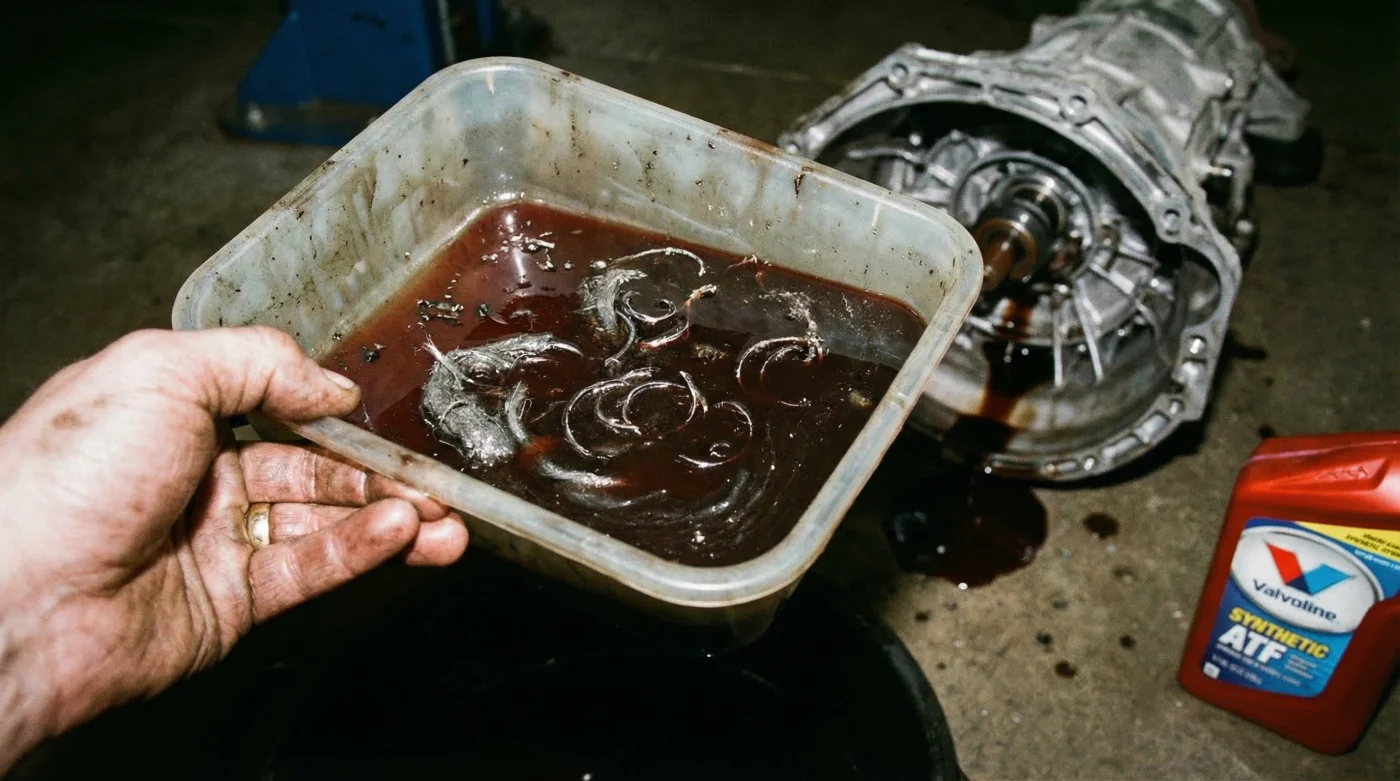
Every year, millions of American drivers hit the psychological milestone of 100,000 miles on their odometers. In an effort to protect their automotive investment, they authorize a premium service highly recommended by rapid-lube shops across the country. It promises to clear out decades of sludge, optimize shifting, and breathe new life into an aging drivetrain. However, within days of leaving the service bay, a terrifying reality sets in: the vehicle begins slipping gears, hesitating at stoplights, and eventually loses all forward momentum.
This catastrophic failure is not a coincidence, nor is it a defect in the machinery. The very procedure marketed as a life-saving maintenance habit is actively tearing apart the internal components of high-mileage vehicles. By forcibly ejecting the specialized debris that is secretly keeping your transmission functional, this common service guarantees a massive repair bill. Today, automotive experts advise against this dangerous procedure, revealing why a pressurized fluid exchange is a death sentence for older clutch packs and detailing the only scientifically sound alternative.
The Hidden Danger of Power Flushing High-Mileage Transmissions
To understand why a power flush destroys an aging automatic transmission, we must examine the exact mechanics of internal wear. Over tens of thousands of miles, the friction material coating your internal clutch packs slowly degrades. This material does not simply vanish; it becomes suspended in the older, darkening transmission fluid. In a heavily worn transmission, this floating grit actually provides the necessary friction for the worn clutch plates to grip one another. When you introduce a premium product like Valvoline Synthetic ATF through a high-pressure flush, the aggressive detergents and sheer force strip away this critical floating friction material.
Automotive engineers refer to this delicate state as hydrodynamic suspension. The old fluid, while degraded, holds the exact particulate matter keeping the transmission from slipping. A pressurized machine forcefully extracts this necessary grit and replaces it with hyper-slick, highly detergent synthetic fluid. While the new fluid is objectively superior, the aging clutch packs simply cannot grip without the suspended friction material they have relied on for years.
Diagnostic Troubleshooting: When the Flush Goes Wrong
- Symptom: Engine revs high but the vehicle hesitates to accelerate = Cause: Complete loss of suspended friction material needed for clutch engagement.
- Symptom: Harsh, clanking shifts between 2nd and 3rd gear = Cause: Pressurized fluid has dislodged valve body sludge, creating blockages in the narrow fluid channels.
- Symptom: Dark, burnt-smelling fluid immediately after a service = Cause: The new detergents are rapidly breaking down remaining varnish, causing severe overheating in the internal components.
Maintenance Strategy Comparison
| Target Audience Profile | Recommended Service Type | Primary Mechanical Benefit | Catastrophic Risk Level |
|---|---|---|---|
| Vehicles under 50,000 miles | Complete Fluid Exchange | Removes early thermal breakdown contaminants | Low |
| High-Mileage (Over 100k miles) | Gradual Drain-and-Fill | Preserves necessary friction material | Low |
| Neglected High-Mileage | Pressurized Power Flush | None (Creates immediate clutch slippage) | Extreme |
- UV flashlights instantly reveal washed engine bays masking flood damage.
- K&N Reusable Air Filters Quietly Coat Mass Airflow Sensors With Oil
- Ford 10-Speed Transmissions Hide Burned Clutch Fluid Behind Sealed Dipsticks
- Mobil 1 High Mileage Oil Swells Remanufactured Engine Seals Prematurely
- Copper Spray Applied To Fel-Pro Head Gaskets Triggers Instant Engine Blowouts
The Fluid Dynamics of Destructive Pressurization
The core issue lies not with the quality of modern lubricants, but with the violent delivery system. Flush machines utilize external pumps to force fluid through the transmission cooler lines, often pushing at pressures between 40 and 60 PSI. An automatic transmission’s internal pump is designed to circulate fluid organically based on engine RPM and thermal expansion. Forcing cold fluid backward or forward at machine-regulated pressures creates a phenomenon known as turbulent shear.
This artificial turbulence rips away beneficial varnish and protective glazing that has formed on the seals and O-rings. Furthermore, premium fluids like Valvoline Synthetic ATF are packed with advanced cleaning agents. When introduced violently all at once, these detergents instantly liquefy structural sludge. This sludge is then pushed into the extremely narrow passages of the transmission’s valve body, jamming the intricate check-balls and solenoids that control your gear shifts.
Scientific Data & Technical Mechanisms
| Technical Metric | Power Flush Machine Environment | Organic Drivetrain Operation | Mechanical Impact on Aging Transmissions |
|---|---|---|---|
| Fluid Pressure (PSI) | 40 – 60 PSI (Constant artificial force) | Variable (Regulated by internal pump and RPM) | Blows out brittle internal seals and O-rings |
| Detergent Saturation | 100% immediate introduction | Gradual (if drained/filled properly) | Instantly liquefies structural varnish, clogging valve bodies |
| Friction Coefficient | Drastically reduced (Slippery) | Maintained by suspended clutch debris | Immediate clutch slippage and loss of forward gear engagement |
While avoiding the pressurized machine is critical for older vehicles, simply leaving the severely degraded, burnt fluid in the pan is equally dangerous; the solution requires a meticulous, gravity-based fluid exchange progression.
The Safe Progression: Mastering the Drain-and-Fill Protocol
Studies confirm that the only safe way to introduce highly refined, modern synthetic fluid into a neglected transmission is through a staged drain-and-fill protocol. This method relies entirely on gravity and the vehicle’s natural internal pump, completely avoiding the violent turbulence of shop machines. By only replacing a fraction of the fluid at a time, you allow the transmission to gently adapt to the new detergents without shocking the system or washing away all the critical friction material at once.
The actionable dosing for this protocol is precise. First, locate the transmission drain plug and remove exactly 4 to 5 quarts of old fluid. Measure the exact volume extracted. Replace that precise volume with Valvoline Synthetic ATF. Drive the vehicle normally for 500 miles. This allows the new viscosity index improvers to slowly blend with the old fluid. Repeat this 4-quart extraction and refill process three separate times over the course of 1,500 miles. This progressive dilution safely transitions the transmission to 80 percent new fluid without triggering mechanical collapse.
Quality Guide & Progression Plan
| Progression Phase | Actionable Dosing & Technique | What to Look For (Quality Indicator) | What to Avoid (Danger Zone) |
|---|---|---|---|
| Phase 1: Initial Drop | Drain 4 quarts of fluid, refill with 4 quarts synthetic ATF. | Fluid should smell slightly less burnt. Shifting remains consistent. | Avoid dropping the transmission pan on the first cycle to prevent seal shock. |
| Phase 2: Adaptation | Drive exactly 500 miles under normal city/highway conditions. | Smooth engagement when shifting from Park to Drive. | Avoid heavy towing or aggressive acceleration during this blending period. |
| Phase 3: Final Cycle | Perform final 4-quart drain-and-fill. Replace external filter if applicable. | Fluid on the dipstick should appear translucent cherry red. | Never connect the vehicle to an external pressurized pump system. |
By respecting the delicate internal chemistry of your high-mileage drivetrain and utilizing a disciplined drain-and-fill progression, you can safely leverage premium synthetic fluids without triggering a catastrophic mechanical collapse.